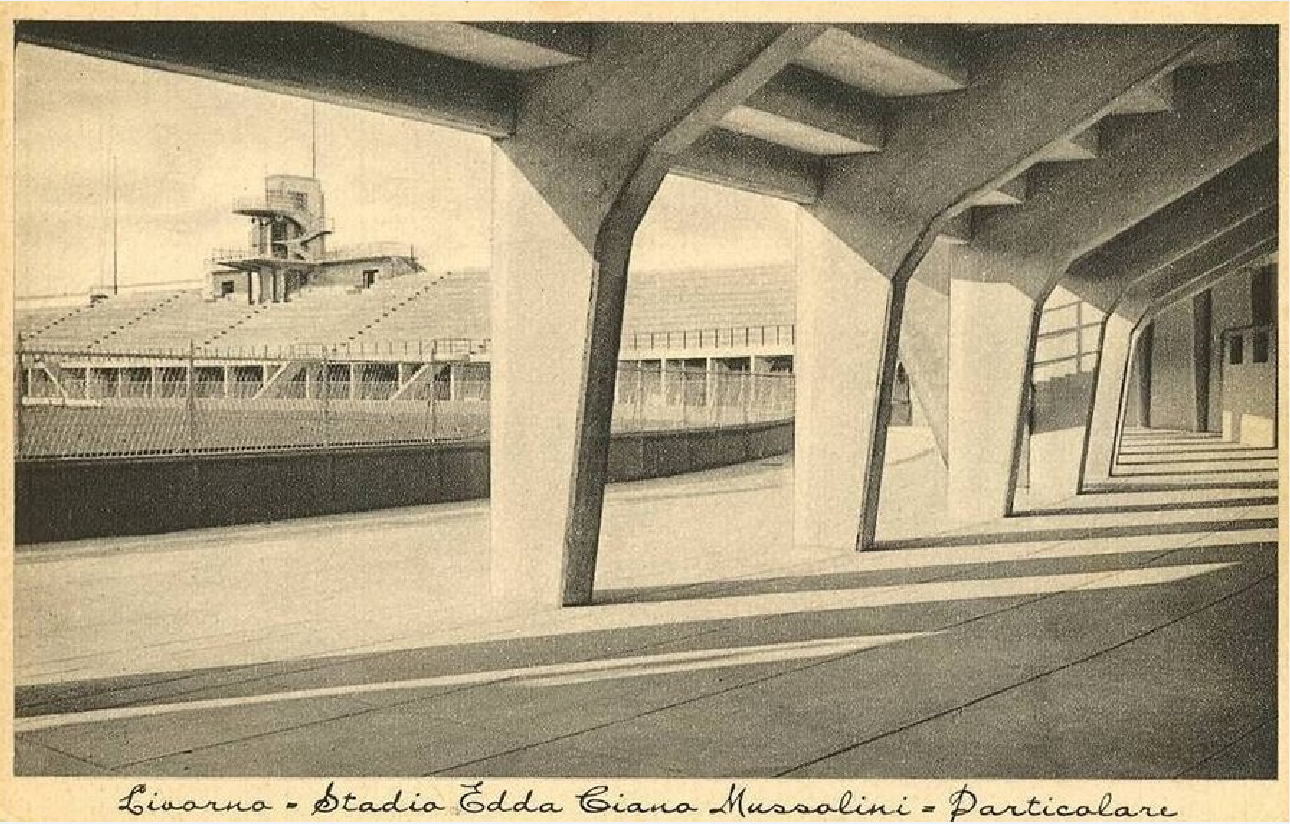
The Stadio Edda Ciano Mussolini in Livorno was designed by architect Raffaello Brizzi and completed in 1935. This photograph presents a detail of the stadium’s architectural composition, documenting the structure during Italy’s interwar period of modernist building.
Brizzi was a leading figure in Tuscan architecture and Professor of Architecture at the Academy of Fine Arts in Florence. From 1932 until 1944, he served as Dean of the Higher Institute of Architecture in Florence, where he taught alongside figures instrumental to the Modern Movement in Italy. His practice encompassed civic and institutional projects across Tuscany, including town halls, urban master plans, and cultural facilities. The Livorno Stadium represents his engagement with large-scale public architecture of the 1930s.
About Raffaello Brizzi
Raffaello Brizzi (1883–1946) was an influential Italian architect active primarily in Tuscany. He held key academic positions at Florence’s architectural institutions and taught a generation of modernist architects. Beyond the Livorno Stadium, his works included the Town Hall in Montecatini Terme and the master plan for Viareggio.
Details
- Architect: Raffaello Brizzi
- Year: 1935
- Location: Livorno, Tuscany
- Type: Public stadium
Explore more: 11 heritage places in Livorno
Frequently asked questions
Who designed the Livorno Stadium?
Raffaello Brizzi, an Italian architect and longtime Dean of the Higher Institute of Architecture in Florence, designed the stadium and completed it in 1935.
Where is the Stadio Edda Ciano Mussolini located?
The stadium stands in Livorno, in the Tuscany region of Italy.
What period of Italian architecture does this represent?
The stadium was built in 1935, during Italy’s interwar modernist period when Rationalist architectural principles shaped public and civic structures across the country.
Sources
- S1 — Ciucci, Giorgio. Gli architetti e il fascismo: architettura e città 1922-1944. Einaudi, 2002. ISBN 978-88-06-16310-5.
- S2 — Nicoloso, Paolo. Mussolini architetto: Propaganda e paesaggio urbano nell'Italia fascista. Einaudi, 2008. ISBN 978-88-06-19086-6.
Spotted an error? Write to editorial@culturalheritageonline.com and we correct it the same day.