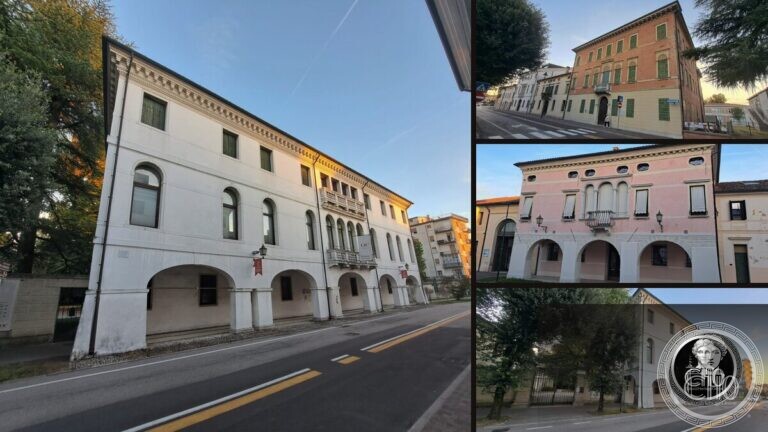
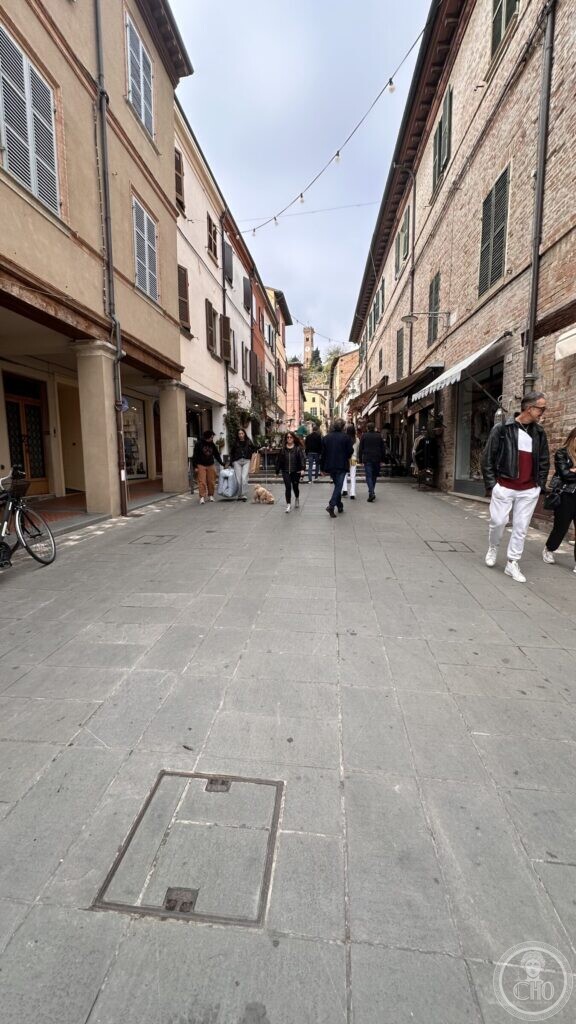
Walk the two hundred metres from the arch to the top of the old town of Santarcangelo di Romagna and you pass a shop sign painted onto plaster, one cut into travertine, one in metal script from the age of the cinema, one painted inside an oval frame moulded to look like rope, and one that is simply a name in capitals on a fanlight. Four centuries and four techniques, on one walk. None of them, as far as we could find, is protected by anything.
In short. Santarcangelo di Romagna, a town of the Rimini hinterland, still carries its commercial lettering on the buildings themselves: painted on render, incised in stone, cast in metal, enamelled. The oldest business behind one of those signs has been working since 1633. We looked for a municipal rule protecting historic shop signs here and found none: what survives, survives because the shopkeepers kept it.
Why look at the signs at all?
Because a shopfront sign is the piece of a building that nobody is obliged to keep. The façade is protected, the roofline is protected, the paint colour may be in a plan. The sign belongs to whoever is trading, and it changes when the trade changes. That makes it the fastest-moving layer of a historic street, and therefore the one that tells you, at a glance, how much of the old commerce is still there.
In Santarcangelo a surprising amount of it is. This is not a preserved town centre with a costume: the shops are ordinary shops, there is a tobacconist and a chemist and a bar with a heated terrace. But the names on them have been put up by six generations using whatever technique was current, and nobody has taken the old ones down.
Painted straight onto the wall
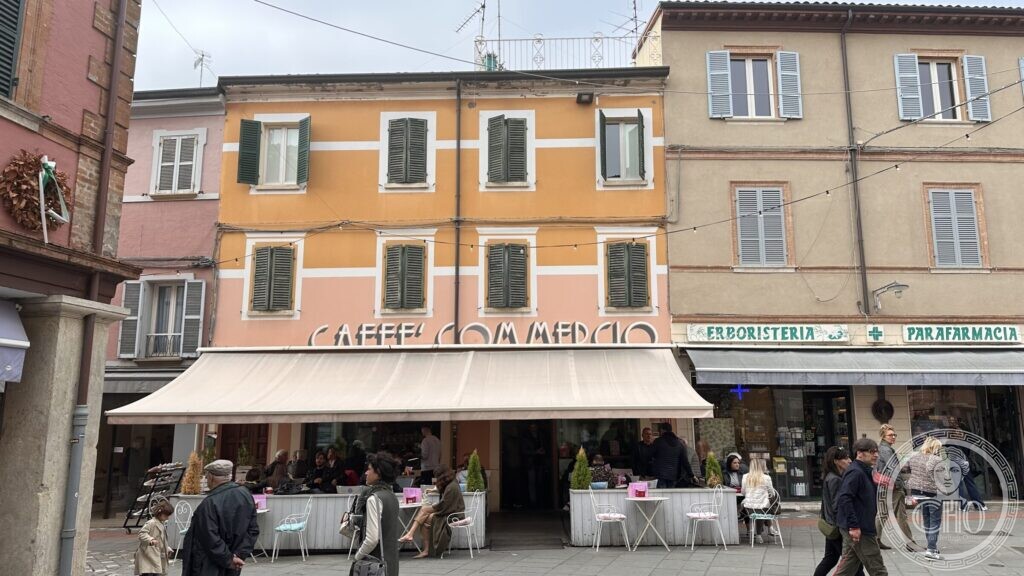
The plainest method is also the most exposed: a brush, a stencil, and the render of the building. On the corner of via Molari, above a café awning and a row of outdoor tables, CAFFÈ COMMERCIO runs across two storeys of apricot and pink plaster in letters a metre high. The paint has faded to a ghost in places and nobody has refreshed it; you read it because the shapes are still there under the weathering.
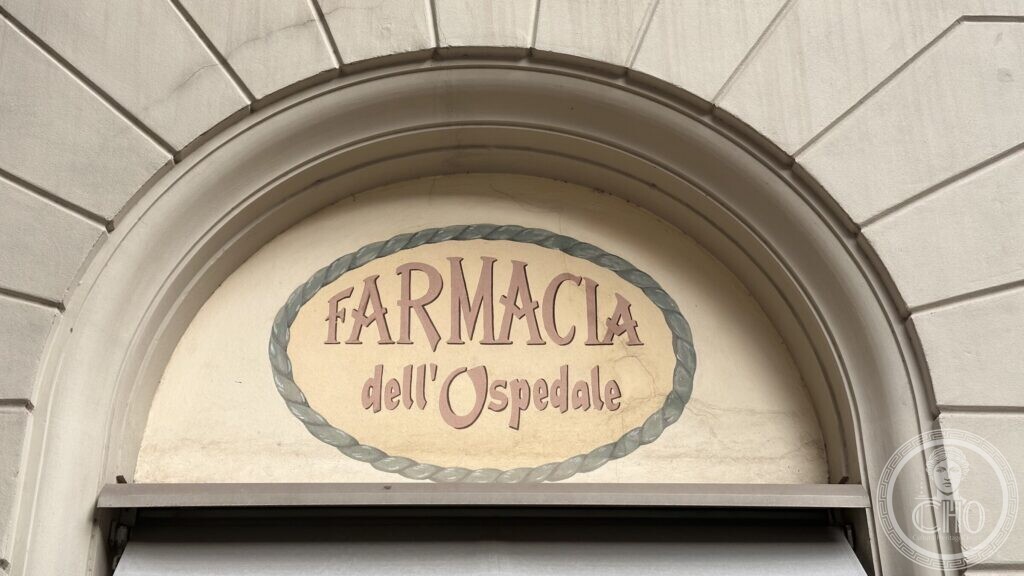
A hundred metres away the same technique is used with far more care. Over the door of the hospital chemist, inside a stone arch, is a painted oval in a frame moulded to look like twisted rope, and inside the oval, in a hand-drawn face with swelling strokes, FARMACIA dell’Ospedale. It is signwriting, not decoration: a professional made those letters, and they have the confidence of someone who did it every week.
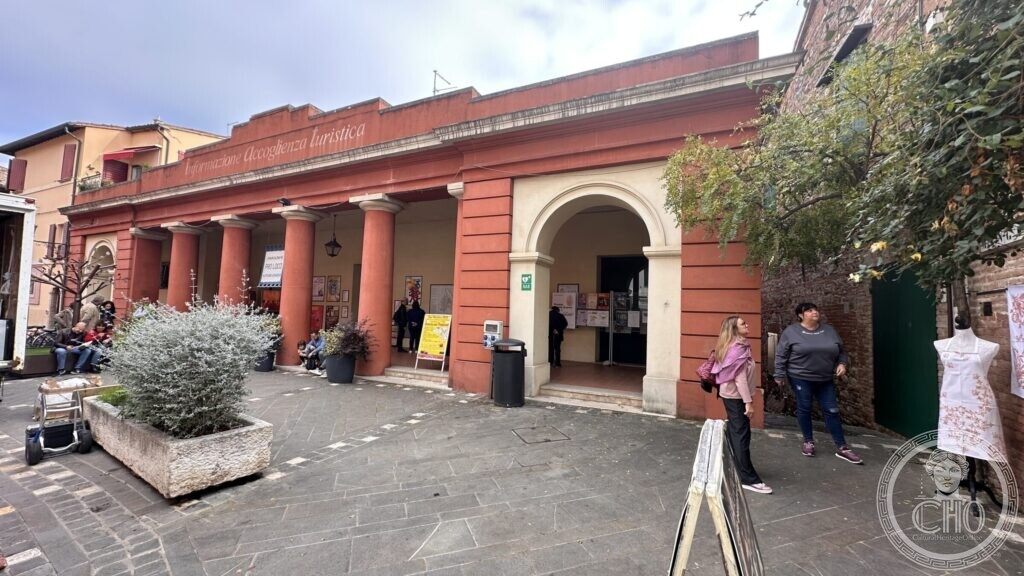
The town does it for itself too. On the red building that houses the Pro Loco, the words Informazione Accoglienza turistica run in a loose painted script across the entablature above the columns — an official function, signed in the same handwriting a shop would use.
Cut into the stone
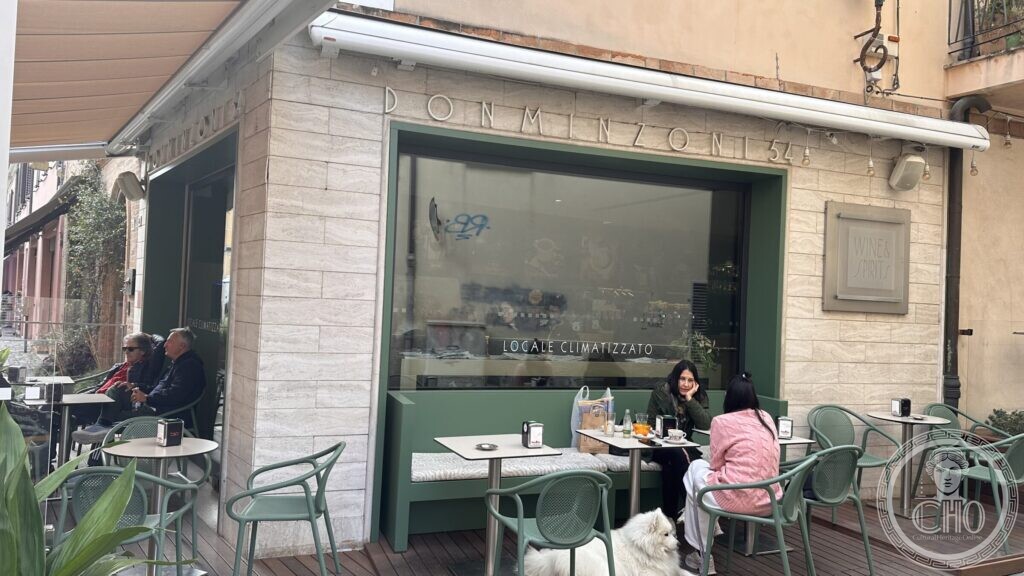
The most expensive way to put a name on a building is to carve it, because you can never change it. On a corner on via Don Minzoni the travertine facing carries DON MINZONI 54 incised in wide-spaced Roman capitals along two faces of the building, above the window of what is now a café with a green-painted front and WINE & SPIRITS on a small plaque beside it. The business inside has changed; the address stays cut in the stone, and the new tenants have kept it and painted around it.
The town does the same thing with its monuments. The Ganganelli arch of 1772–1777 carries its dedication to Pope Clement XIV cut into the attic, and the sentence it carries is one of the more moving pieces of civic lettering in Romagna: the arch that the council had begun to raise to him while he lived, it says, they completed and dedicated to him dead, cum lacrymis, with tears. On via Molari, a marble tablet of 1908 remembers Eduardo Sancisi, who organised the workers of the town, with the Mazzinian motto Pensiero e Azione in a small medallion. Same craft, different budget.
Script in metal, from the age of the cinema
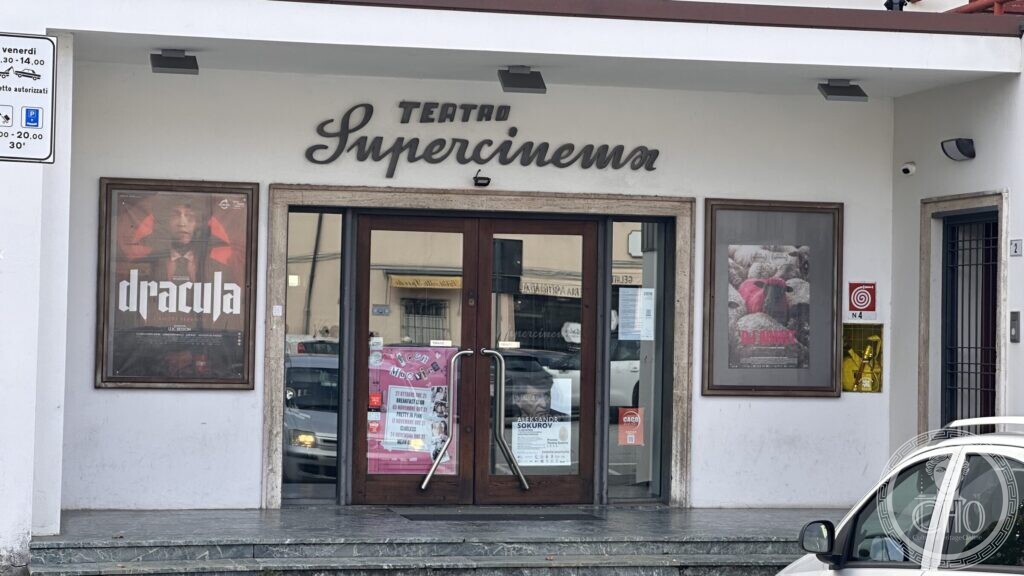
Then the twentieth century arrives, and lettering stops being painted or carved and starts being made: cut from sheet, mounted on standoffs, lit from below. Over the doors of the Supercinema, on the white curved front by the car park, TEATRO in small spaced capitals and Supercinema in a long sloping script, both in dark metal. The cinema is a rationalist building of the interwar years with a bare concrete fly tower, and the script is exactly of its moment: it is the lettering of a film poster, brought up to architectural size.
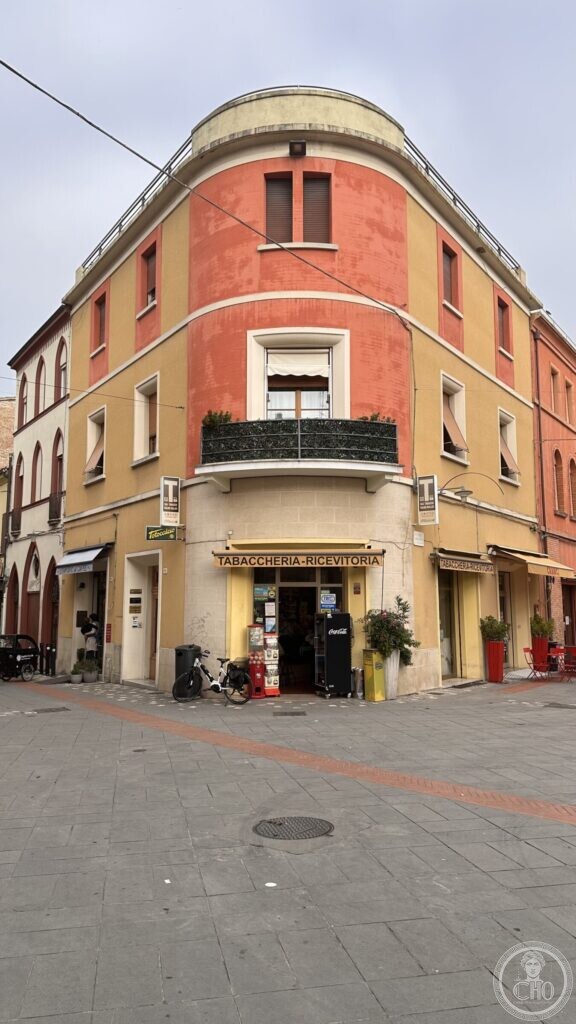
A few streets away the tobacconist keeps the other twentieth-century method: the enamelled plate. Two black-and-white T signs, standardised by the state monopoly, hang from the rounded corner of a 1930s block in ochre and red, above an awning that says TABACCHERIA-RICEVITORIA in the same flat sans-serif the state has used for eighty years. Nobody would call it beautiful. It is nevertheless a historic sign, and it is more honest about what the building is than anything that could replace it.
And the oldest of the lot
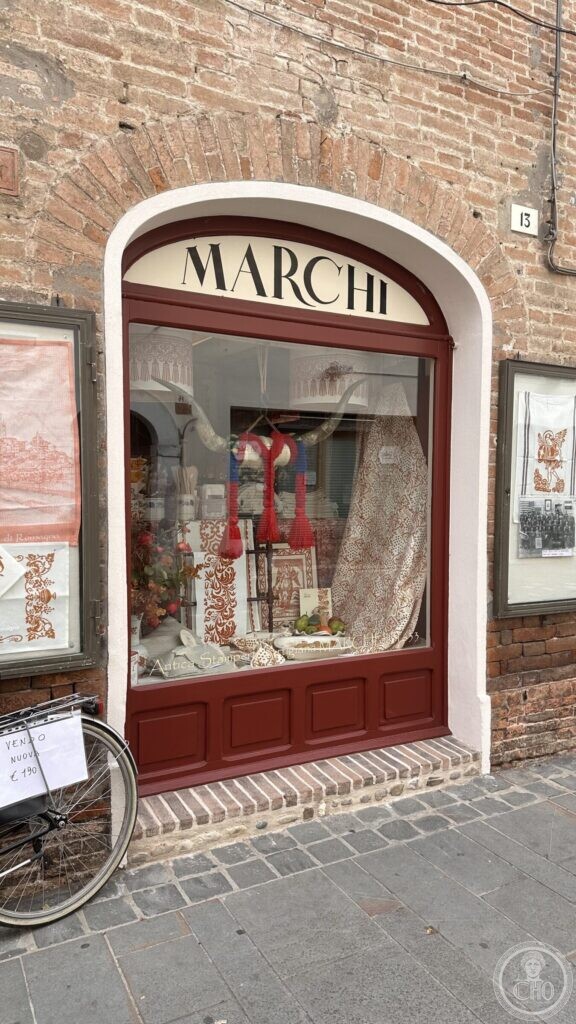
The name on the fanlight of the Antica Stamperia Marchi, in via Cesare Battisti, is black capitals on cream inside a rounded window frame painted dark red. The lettering itself is not old. The business is: it has printed cloth by hand in this town since 1633, with carved wooden blocks and a rust-coloured dye made from iron, and at the back of the shop a wooden wheel the height of the room that a man walks inside to drag a stone slab over the cloth. The sign is modest because it does not have to work hard. Everyone here knows what is behind it.
That is the pattern, and it is the opposite of what a tourist street does. In a town that has been signed by its own tradespeople, the oldest business has the quietest sign and the newest café has the loudest. Nothing about that is planned. It is simply what happens when nobody clears the wall.
Is any of it protected?
We looked, and we did not find. Italy has no general protection for shop signs; some towns list them as botteghe storiche or write them into a plan for the historic centre, and the region of Emilia-Romagna has supported registers of historic businesses. For Santarcangelo we could find no municipal rule on signs and no local register of them online. If one exists, we would like to be corrected: that is a fact worth having on this page, and readers are usually faster than searches.
Meanwhile the practical answer is the one the street already gives. These signs are still up because the businesses under them either never left, or arrived and decided not to scrape the wall. That is a thin kind of protection, and it is the only one they have.
What to look at, in order
- Piazza Ganganelli — the arch with its inscription, and the war memorial of 1925, unveiled 1928
- Via Molari — the painted Caffè Commercio, and the Sancisi tablet of 1908 above the loggia
- Via Cesare Battisti — the Stamperia Marchi: ask to see the mangano
- Via Don Minzoni — the incised address on the travertine corner
- Piazza Marconi — the Supercinema and its metal script
- Via Pascoli — the Palazzo della Poesia, where the name on the building was put there by a street artist and the town kept it
Sources
- S1 — Baines, Phil, and Catherine Dixon. Signs: Lettering in the Environment. Laurence King, 2003. ISBN 978-1-85669-337-0.
- S2 — Bartram, Alan. Fast Forward: Modernist Lettering on Buildings. British Library, 2005. ISBN 978-0-7123-4886-7.
Spotted an error? Write to editorial@culturalheritageonline.com and we correct it the same day.