
Santarcangelo di Romagna, Emilia-Romagna · built 1772–1777 · dedicated in the jubilee year 1775 to a pope already dead
At a glance
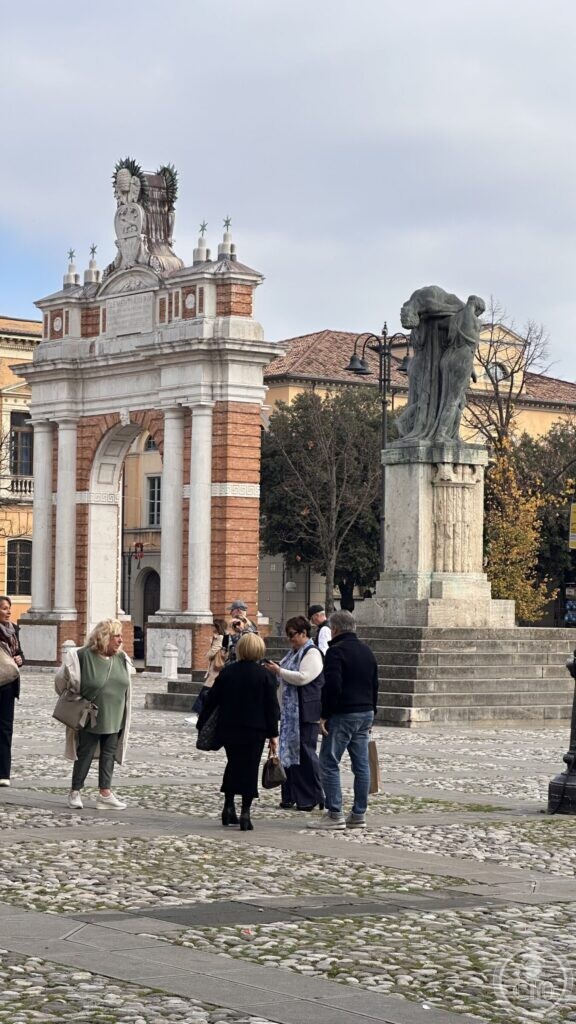
In 1769 a cardinal born in Santarcangelo, Lorenzo Ganganelli, became Pope Clement XIV. The town council and its archpriest set about raising a triumphal arch to him across the Via Emilia, to designs by Cosimo Morelli of Imola, the architect of the Holy See. The pope died in 1774 with the arch unfinished. The inscription on the attic says the rest: begun for him living, completed and dedicated for him dead, cum lacrymis, with tears, in the jubilee year 1775. The great marble statue of the pope blessing that was to stand on top was designed by Canova and never came: it is on Clement’s tomb in Rome.
Key facts
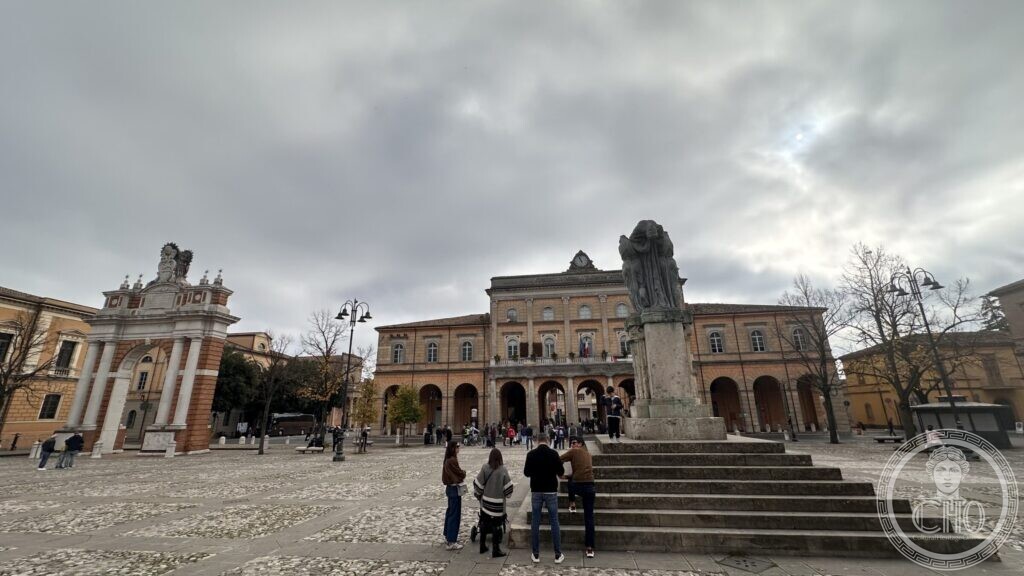
- Where: Piazza Ganganelli, at the head of the square, on the line of the old Via Emilia
- 1769 — Lorenzo Ganganelli of Santarcangelo elected Pope Clement XIV
- 1772–1777 — the arch built to designs by Cosimo Morelli of Imola
- The attic inscription dates the dedication to the jubilee year 1775, after the pope’s death in 1774
- Exposed brick with stone half-columns and a stone pseudo-rustic base; the papal arms on the crown
- Canova’s statue of the pope blessing, meant for the top, went instead to the papal tomb in the basilica of the Santi Apostoli in Rome
- Road traffic passed under it until 1989; the Mille Miglia ran through it
- Every 11 November, for the fair of San Martino, a great pair of ox horns is hung in the opening: if they swing as you pass beneath, the town says your partner’s fidelity is in doubt
- Coordinates: 44.06330, 12.44698

The inscription
On the attic, in Roman capitals, read from the photograph: CLEMENTI XIIII P M / ORDO ET P ARCH ARCVM QVEM / VIVO PONEBAT MORTVO CVM / LACRYMIS PERFECIT DEDIC QVE / ANNO IVB MDCCLXXV. That is: to Clement XIV, Supreme Pontiff, the council and the archpriest completed and dedicated, with tears, the arch they had begun to raise to him while he lived, now that he was dead, in the jubilee year 1775. The abbreviation P ARCH we read as parochus archipresbyter, the parish archpriest; if a reader has the full published text we would be glad to check it.
What you see
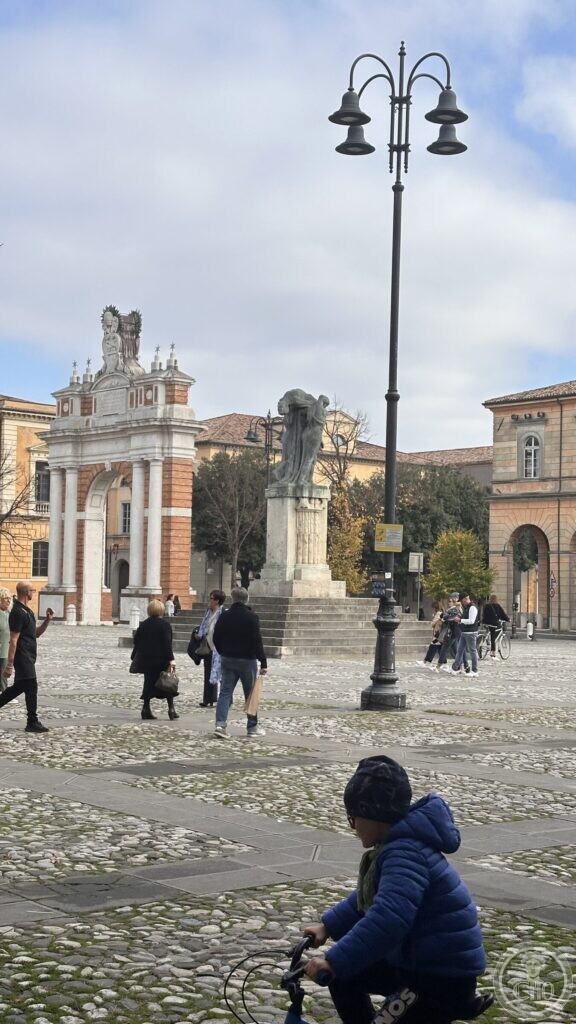
A single wide opening between paired columns, the whole thing in the warm brick of Romagna with the columns, the capitals, the string courses and the base in pale stone. Above the entablature the attic carries the inscription tablet between two blind panels, and above that a broken pediment holds the papal arms with the tiara and crossed keys, flanked by stone finials with stars. Through the opening you see the houses on the far side of the square; from the square you see the arch framing the road out towards the Via Emilia. It is not a big arch, and that is its charm: it is the size of the town that built it.
Photographs
Practical information
- In the open, free, at any hour; the square is pedestrian and the arch can be walked through and round
- The war memorial by Bernardino Boifava stands a few steps away; the hill town and the Malatesta castle begin behind the town hall
- Come on 11 November for the horns
Sources
- Explore Valmarecchia, Arco Ganganelli — built 1772–1777 to honour Clement XIV, elected 1769; designed by «the official architect of the Holy See, Cosimo Morelli from Imola»; the papal arms; the Canova statue now on the tomb in the Santi Apostoli; the San Martino horns; traffic beneath until 1989 and the Mille Miglia
- The attic inscription, transcribed from the photograph of 1 November 2025; the translation and the reading of the abbreviations are ours
Record researched and written by Luigi De Marchi for Cultural Heritage Online, 2026.
Find it on the map
See this place and what’s around it →
📷 Become a Cultural Heritage Online photographer
Share your photos of places: they stay published under your name as the author. The more they're seen, the more you get noticed — and soon a contest will reward the most appreciated photos.
Log in or sign up free to add a photoIs this page about you?
This page is read by travellers and heritage enthusiasts who find it on Google. Tell us how you are connected to this place and we will take it from there.