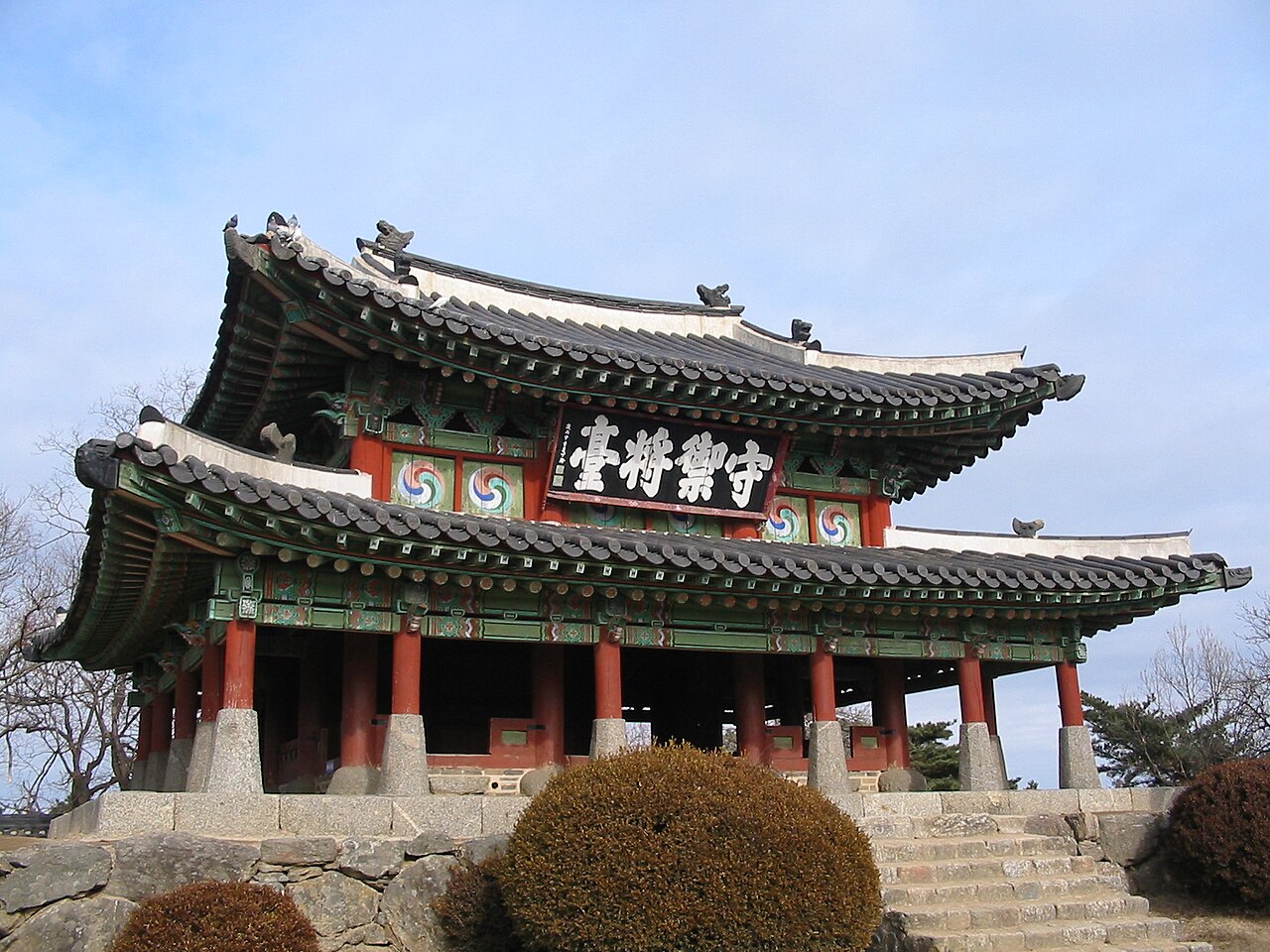
Namhansanseong (남한산성, “South Han Mountain Fortress”), inscribed by UNESCO in 2014, is a mountain fortress on Namhansanseong Mountain (남한산, 522 m elevation) approximately 25 km southeast of central Seoul in Gyeonggi Province — a military fortification constructed on the site of earlier earthwork defences by King Injo (r. 1623–1649 CE) between 1624 and 1626 CE as the primary military refuge for the Joseon royal court in the event of an invasion of Seoul from the north. The fortress’s circuit wall (11.7 km of stone battlement, including the original construction and subsequent extensions to the northeast from 1686 to 1693 CE) encloses the summit plateau of Namhansanseong Mountain and the entire functional infrastructure of a self-sufficient administrative city — the royal temporary palace (行宮, haenggung, reconstructed 2010 CE on original foundations), government buildings, nine temples that served as rear-area logistics depots for monk-soldier units (승군, seunggun, a Joseon-period military institution in which Buddhist monasteries provided organised armed labour and supply services to the state in exchange for protection from official persecution), 80 wells, 45 springs, and 16 reservoirs supplying water for up to 20,000 defenders — designed to withstand an extended siege independent of outside supply lines. The fortress’s Outstanding Universal Value, as defined in the UNESCO inscription, lies in its demonstration of the East Asian mountain fortress tradition (산성, sanseong, a specifically Korean and Chinese defensive strategy of constructing fortified citadels on hilltops to which the civilian population retreats in time of invasion, rather than the European tradition of fortified lowland cities), and in its preservation of multiple phases of construction technology from the 7th-century CE Unified Silla period through the 17th-century Joseon period and the 18th-century Joseon renovation phases.
The southeast Seoul corridor and Hwaseong Fortress circuit Seoul palaces · Hwaseong Suwon · Seolleung royal tombs — 15 to 35 km
Twenty-Five Kilometres northwest of Namhansanseong by road (approximately 40 minutes by express bus or metro to central Seoul from the Namhansanseong entrance), the Seoul royal palace cluster — Gyeongbokgung, Changdeokgung (창덕궁, inscribed UNESCO 1997), Jongmyo Shrine (종묘, inscribed UNESCO 1995) — represents the administrative core that Namhansanseong was designed to protect. The strategic relationship between the three inscribed Seoul-area sites is direct and historical: Namhansanseong was constructed specifically because the Joseon state lacked a mountain fortress within a half-day’s march of Seoul that could serve as a royal refuge in an emergency — the earlier Joseon-period fortresses at Bukhansanseong (북한산성, the northern fortress on Bugaksan mountain immediately north of Seoul, rebuilt in 1711 CE) and Namhansanseong functioned as a paired defence system, with Bukhansanseong protecting against attack from Manchuria via the northern approach and Namhansanseong protecting against attack from the south via the Han River corridor. The 1636 Byeongja Horan (병자호란, “Manchu Invasion of 1636”) — in which the Qing army of 120,000 soldiers under Emperor Hong Taiji crossed the frozen Yalu River in late December and reached Seoul within 12 days before the Joseon court could escape to Namhansanseong by sea (the intended refuge was the Ganghwa Island fortress, which fell to the Qing advance forces before the court’s departure was complete) — tested Namhansanseong as the last-resort refuge it was designed to be. King Injo and the court were besieged on the mountain for 45 days (December 1636 – January 1637) in winter conditions that the fortress’s food and fuel reserves were not designed to sustain for more than 30–40 days; by the time the Qing demanded unconditional surrender, approximately 20,000 soldiers and civilians on the mountain were near starvation. The surrender ceremony (Korean: 삼전도의 항복, “The Surrender at Samjeon-do”) took place at the Samjeon-do surrender platform on the eastern bank of the Han River, where King Injo performed the Chinese surrender ritual of three prostrations and nine head-knockings to the Qing emperor — the most humiliating moment in Joseon royal history, and the event that defines the Byeongja Horan in Korean cultural memory. The surrender site (삼전도비, Samjeondo Stele, on the Han River bank in modern Songpa District, Seoul, approximately 8 km northwest of the Namhansanseong main entrance) is marked by a large stone stele erected by Qing order in 1639 CE inscribed in Manchu, Mongolian, and Chinese praising the Qing victory — the stele was buried twice in the 20th century by Korean nationalists who regarded it as a symbol of national humiliation and was excavated and re-erected in its current position by the Cultural Heritage Administration.
Thirty-Five Kilometres west of Namhansanseong (approximately 45 minutes by bus from the Namhansanseong area to Suwon Station, then 15 minutes walk to Hwaseong Fortress), Hwaseong Fortress (화성, inscribed UNESCO 1997) in Suwon completes the triangle of Joseon military heritage in the Seoul–Suwon–Gyeonggi corridor — a 5.74-km circuit fortress of 1794–1796 CE that demonstrates the most sophisticated integration of Korean, Chinese, and European fortification principles in the Joseon tradition, in contrast to Namhansanseong’s mountain citadel strategy and the palace cluster’s open-city form. The combination of Namhansanseong (mountain retreat fortress, 1626 CE, emergency refuge) and Hwaseong (lowland circuit fortress, 1796 CE, planned administrative and military city) illustrates two distinct responses to the Korean state’s military-strategic situation after the Imjin War and Byeongja Horan disasters. From Suwon, Seoul’s Seolleung Royal Tombs (선릉, in Gangnam, approximately 30 km north, accessible by KTX in 30 minutes or Metro Line 1 in 45 minutes) connects to the Royal Tombs of the Joseon Dynasty UNESCO inscription, completing a four-UNESCO-site day tour possible from a Suwon or Seoul base: Namhansanseong morning → Hwaseong afternoon → Seolleung evening.
Practical information
Namhansanseong Fortress is in Namhansanseong Provincial Park (남한산성 도립공원), Gyeonggi Province, administered by the Gyeonggi Provincial Government. Access from Seoul: Seoul Metro Line 8 to Sanseong Station (산성역), then shuttle bus or 30-minute walk up the mountain road to the North Gate (북문) or Main Gate (수구문) — the shuttle bus operates on weekends and holidays, approximately every 30 minutes from the station exit (check current schedule). The main fortress entrance at the South Gate (남문, Jisagak) is approximately 25 km from central Seoul by road, accessible by car or taxi in approximately 40–50 minutes from the Seoul city centre in non-peak traffic. The fortress circuit walk (11.7 km following the battlement wall, with several steep sections on the mountain ridges) takes approximately 3–4 hours at a hiking pace; a shorter loop covering the core heritage area (the haenggung royal residence, the East Gate, the central government buildings zone, and the traditional market street Namhansanseong-myeon) takes approximately 1.5–2 hours. The Namhansanseong Haenggung (행궁, reconstructed royal temporary palace, open Tuesday–Sunday 10:00–17:00, admission fee) provides interpretation of the 1636 Byeongja Horan siege and the fortress’s construction history in Korean and English. The traditional market street inside the fortress (Namhansanseong-myeon, a concentration of traditional Korean restaurants serving mountain vegetables and bean curd dishes associated with the fortress’s historical provisions) is active daily and is a significant food-tourism destination in the Seoul area. Best visiting season: spring (cherry blossoms along the approach road, late March–April) and autumn (maple and oak foliage on the mountain, October–November). Winter visiting is possible but sections of the circuit wall can be icy; the fortress is historically associated with winter hardship (the 1636 siege was in December–January) and has atmospheric winter photography opportunities.
Frequently Asked Questions
What is the mountain fortress (sanseong) tradition and why is it specifically Korean?
The mountain fortress (산성, sanseong, literally “mountain castle”) is the dominant defensive architectural tradition of the Korean peninsula from the Three Kingdoms period (approximately 1st century BCE–7th century CE) through the Joseon dynasty (1392–1897 CE) — a strategic model that distinguishes Korean military architecture from both Japanese castle architecture (tenshu tower-and-enclosure system on hilltops but optimised for offensive garrison rather than civilian refuge) and Chinese city defence (urban circuit walls defending a lowland administrative centre). The sanseong model is based on the premise that the Korean peninsula’s mountainous terrain — approximately 70% of the peninsula is classified as mountainous — makes it militarily untenable to defend a fixed lowland point against a large invading force from the north (where the principal historical threats to Korea originated: the Chinese Han dynasty, the Sui and Tang dynasties, the Mongols, the Manchu Qing), and that the optimal defensive strategy is to withdraw the civilian population and military forces to a pre-prepared mountain citadel with its own water and food supply, denying the invader the logistical and political fruits of capturing the lowland city while maintaining a defensible military position in the rear. The sanseong strategy worked extremely well against ancient and medieval armies (the Goguryeo kingdom’s defeat of the 612 CE Sui invasion of 1 million men was achieved largely through the sanseong-based “defence in depth” strategy of yielding lowland cities and destroying the invader’s supply lines from mountain positions) and remained theoretically valid through the 17th century against the Manchu Qing army. The failure of Namhansanseong in 1636–1637 was not a failure of the sanseong concept but of the specific logistical preparation — the fortress’s food reserves were insufficient for the actual siege duration, partly because the court expected to be able to re-supply via the Ganghwa Island sea route (blocked by Qing advance forces) and partly because the invasion’s speed (12 days from the Yalu River to Seoul) was far faster than any previous Korean experience with northern invasions. The Joseon court’s military response to the 1636 defeat — a 17th–18th century programme of fortress building and renovation that produced Hwaseong (1796), the renovation of Namhansanseong (1686–1693), and the construction of Bukhansanseong (1711) — represents the most intensive period of Korean military architecture in the sanseong tradition.
How did the monk-soldiers (seunggun) contribute to Namhansanseong’s construction?
The monk-soldiers (승군, seunggun) were armed fighting units organised from the resident populations of Buddhist monasteries, mobilised for state military service during major construction and defence projects of the Joseon dynasty — an institutional paradox within a Confucian state whose official ideology formally subordinated Buddhist religious practice to Confucian social norms, but whose military pragmatism required the Buddhist monastic networks’ organisational capacity and labour reserves. The Joseon state’s relationship with Buddhist institutions was complicated by the dynasty’s founding Confucian ideology (which viewed Buddhist monasteries as socially parasitic, economically unproductive, and theologically incorrect) and the practical reality that Buddhist monasteries were the largest non-agricultural organised labour pools in Joseon society (monasteries maintained populations of hundreds of monks, managed extensive agricultural landholdings, operated trans-regional trading and logistics networks, and had their own internal hierarchy capable of directing collective labour projects). In the Imjin War (1592–1598), the monk-general Seoson Daesa (서산대사,휴정, 1520–1604 CE) organised the first major national monk-soldier army, recruiting approximately 5,000 monks from monasteries across the peninsula for military service against the Japanese invasion — demonstrating the military potential of the monastic networks. At Namhansanseong, the seunggun system was institutionalised in the 17th century: eight Buddhist monasteries were designated as “attached monasteries” (사찰, sachal) of the fortress, each required to maintain a resident military detachment of monk-soldiers for fortress garrison duty, and each assigned specific maintenance responsibilities for sections of the fortress wall. The monks who served at Namhansanseong received official recognition (government certificates exempting their monasteries from certain tax obligations and from harassment by local officials) in exchange for garrison service — a formal acknowledgement of the monks’ military contribution that represented a de facto improvement in the Joseon state’s tolerance of Buddhist institutions, driven entirely by military necessity. The nine temples within the Namhansanseong circuit (of which four survive in various states of preservation, including Janggyeongsaji, Manwolsa, and Beopwansa) were established specifically to house the seunggun garrison, and their locations within the fortress wall were chosen for logistical rather than religious reasons.
What happened to Joseon foreign policy after the 1636 Manchu defeat and the humiliating surrender?
The Joseon state’s response to the 1636 Byeongja Horan defeat and the Samjeondo surrender ceremony (in which King Injo prostrated himself nine times to the Qing emperor on the Han River bank) was a profound reorientation of Korean geopolitical culture that shaped Korean foreign policy for the next 200 years and created intellectual and cultural tensions that persist in Korean historical consciousness to the present. In the immediate aftermath, the Joseon state was compelled to: send two royal princes (the sons of King Injo) as hostages to the Qing capital Mukden (modern Shenyang) for eight years; pay heavy indemnity in grain, silver, and cloth; send annual tribute missions to the Qing court; abandon the alliance with the Ming dynasty (which had sent its armies to defend Korea against Japan in the Imjin War of 1592–1598 and was now being destroyed by the same Manchu forces that had just defeated Joseon); and formally acknowledge Qing suzerainty. The Joseon state’s external compliance with Qing demands was accompanied by an intense internal cultural rejection of Qing legitimacy — Korean Neo-Confucian scholars developed the concept of “Joseon as the last heir of true Chinese civilisation” (소중화, Sojunghwa, “Small Middle Kingdom”), arguing that because the Qing Manchu conquerors were culturally barbarian usurpers who had destroyed the legitimate Ming Chinese civilisation, Korea (which had preserved Confucian cultural norms faithfully) was the only remaining legitimate heir of the civilisation that the Ming had embodied. This Korean cultural self-identification as the guardian of authentic Confucian civilisation against Qing barbarian rule produced a 17th–18th century intellectual renaissance in Joseon Neo-Confucian philosophy, historical writing, and material culture — the sirhak (“practical learning”) movement, the development of Korean vernacular literature (novels in Hangul), Korean Neo-Confucian philosophical debate (the Yi-Ki debates), and the material culture of reconstruction after the Imjin and Byeongja wars. The stone stele at Samjeondo (Samjeondobi) — erected by Qing order to commemorate the defeat and removed by Korean nationalists twice in the 20th century — remains a contested site in Korean public memory, representing simultaneously the historical reality of defeat and the cultural resilience that produced Joseon’s intellectual golden age.
Sources
- S1 — UNESCO World Heritage Centre — Namhansanseong (Ref. 1439) — https://web.archive.org/web/20230601000000/https://whc.unesco.org/en/list/1439/
- S2 — UNESCO World Heritage Centre — Statement of Outstanding Universal Value (Ref. 1439) — https://whc.unesco.org/en/list/1439/
Spotted an error? Write to editorial@culturalheritageonline.com and we correct it the same day.