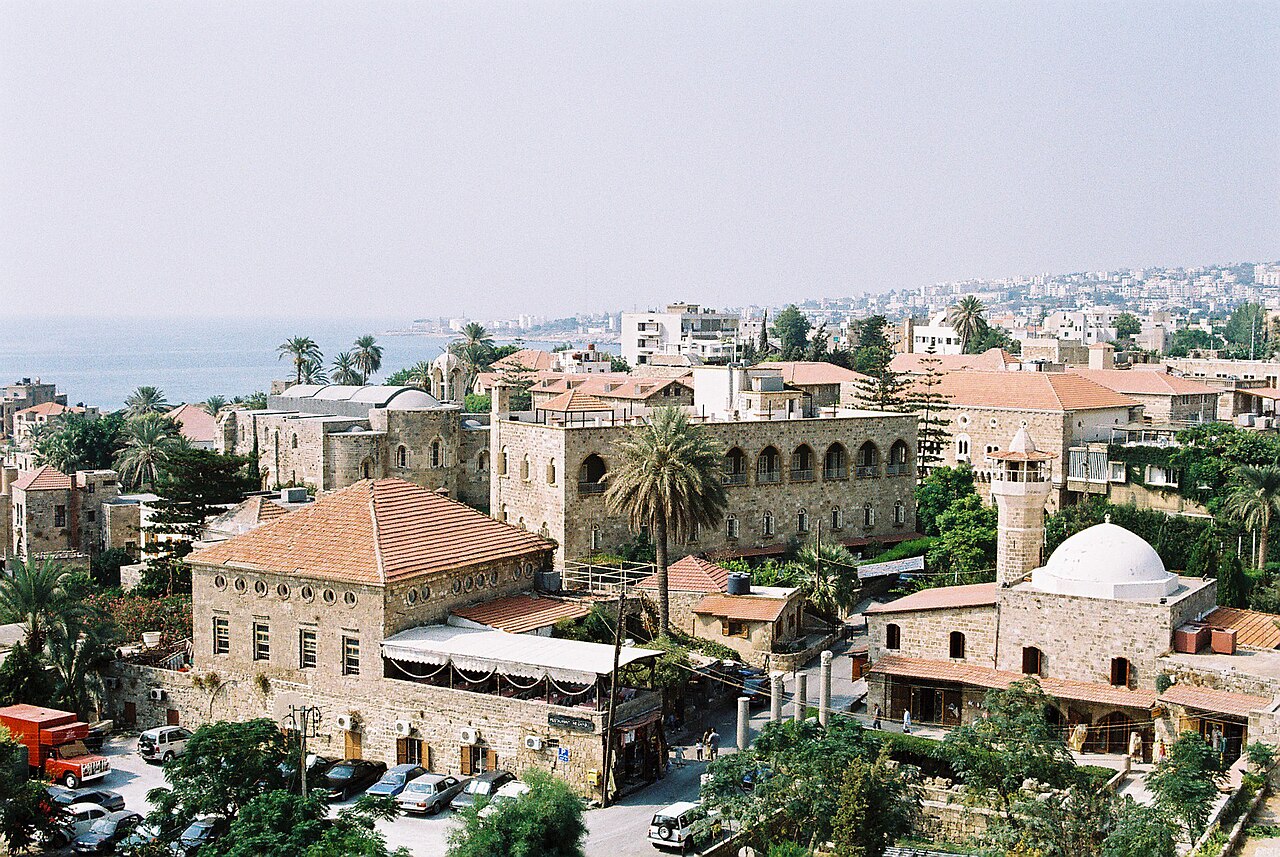
Byblos, inscribed in 1984, is one of the oldest continuously inhabited cities in the world — a Phoenician port on the Lebanese coast occupied since c. 8800 BCE, the city that gave the ancient Greeks the word for book (biblion, from Byblos), the alphabet, and the cedar wood that built the temples of Egypt. Lebanon’s five other inscribed sites — Baalbek’s Roman temples, Tyre, Anjar, and the Qadisha Valley’s cedar forests — form one of the most concentrated heritage landscapes in the Mediterranean.
Byblos: Where the Alphabet Was Born 34 km north of Beirut
Byblos (inscribed in 1984 under criteria (iii) and (vi)) is the city that gave the world the alphabet — not invented there, but transmitted. The Phoenicians of Byblos and the neighbouring Lebanese coast developed the first fully alphabetic writing system (c. 1050 BCE), a consonantal alphabet of 22 letters from which the Greek, Latin, Arabic, Hebrew, and Cyrillic scripts all ultimately descend. The word “alphabet” comes from aleph-bet, the first two letters of the Phoenician script; the word “Bible” comes from the Greek biblion (book), which in turn comes from Byblos — because Byblos was the port through which papyrus from Egypt was exported to the Aegean world. The archaeological tell of Byblos (Jbeil in Arabic, Gebal in Phoenician) documents 11,000 years of continuous human settlement: the Neolithic village (c. 8800 BCE), a Bronze Age Amorite city (c. 3000 BCE that traded cedar wood and bitumen with Egypt’s Old Kingdom), the Phoenician phase (c. 1200–300 BCE, with the royal necropolis of Phoenician kings including Ahiram, whose sarcophagus contains the oldest known complete inscription in the Phoenician alphabet), the Hellenistic city, the Roman city (with a colonnaded street, nymphaeum, and amphitheatre — the most complete Roman civic ensemble in Lebanon), the Crusader castle (1104 CE, built by Raymond of Saint-Gilles from the stones of Roman buildings), and the Ottoman town. The medieval souk of Jbeil, directly adjacent to the archaeological site, has been continuously used for commerce since the Phoenician period.
Baalbek: The Largest Roman Temple Complex in the World 🚗 ~1.5 hrs east via Beirut ring road
Baalbek (inscribed 1984 under criteria (i) and (iv)) is 85 km east of Byblos in the Beqaa Valley — the site of the largest Roman temple complex ever built. The Temple of Jupiter Heliopolitanus (begun c. 16 BCE, substantially completed c. 60 CE) occupied a platform of 88 × 48 metres (larger than two football pitches) supported by the largest dressed stones in the ancient world: the Trilithon, three limestone blocks each weighing approximately 1,000 tonnes, quarried at a site 800 metres away and raised to a height of 7 metres as the base of the podium by means that remain architecturally debated. Six columns of the Jupiter temple survive standing (the original colonnade had 54); each column is 20 metres tall and 2.2 metres in diameter. The adjacent Temple of Bacchus (completed c. 150–200 CE) is the best-preserved Roman temple in existence — better even than the Pantheon in Rome — with its original coffered ceiling, cella doorway (the world’s largest intact Roman doorway, 12.9 metres high), and carved Bacchic reliefs around the exterior. The Baalbek site also contains the circular Temple of Venus (third century CE) and the foundations of a mosque built during the early Islamic period. Baalbek is note: as of 2024, the Beqaa Valley may be subject to travel advisories related to the broader conflict in Lebanon; check current advisories before visiting.
Tyre and Anjar: Phoenician Port and Umayyad Palace 🚗 ~1 hr south to Tyre, ~1.5 hrs via Beqaa for Anjar
Tyre (inscribed 1984 under criteria (iii) and (vi)), 80 km south of Byblos on the Lebanese coast, was the most important Phoenician city from the tenth to fifth centuries BCE — the city from which Carthage was founded (c. 814 BCE), from which the purple dye (Tyrian purple, extracted from the murex snail) that became the colour of Roman imperial power took its name, and which Alexander the Great besieged for seven months (332 BCE) by building a causeway from the mainland to what was then an island city. The archaeological site preserves the most extensive Roman ruins in Lebanon: a hippodrome (the second largest in the Roman Empire, 480 metres long), a triumphal arch, colonnaded streets, necropolis, and aqueduct. Anjar (inscribed 1984 under criteria (iii) and (iv)), 55 km southeast of Byblos in the Beqaa Valley, is the only intact Umayyad palace city in the world — built c. 714–715 CE by the Caliph Walid I on an orthogonal Roman-influenced plan with a main street (decumanus), palace quarter, mosque, baths, and residential district, all within a rectangular walled enclosure of 385 × 350 metres. Anjar was occupied for only a generation before the Abbasid revolution of 750 CE ended the Umayyad dynasty; it preserves the Umayyad architectural vocabulary (pointed arches, carved marble, geometric ornament) in a planning context without later overlay.
Ouadi Qadisha and the Forest of the Cedars of God 🚗 ~1.5 hrs northeast
The Ouadi Qadisha (Holy Valley) and the Forest of the Cedars of God (Horsh Arz el-Rab), inscribed in 1998 under criteria (iii) and (iv), are 70 km northeast of Byblos in the Mount Lebanon range at 2,000 metres — the last remnant of the cedar forests of Lebanon that once covered the entire Mount Lebanon massif and were cut by the Egyptians, Phoenicians, and Romans for construction timber over three millennia. The Arz el-Rab grove (Forest of God) contains approximately 400 ancient cedar trees, some estimated at over 3,000 years old — living trees that may have been seedlings when the Phoenicians of Byblos were exporting cedar to Pharaoh Khufu for the construction of the Old Kingdom pyramid complex. The Qadisha Valley below the cedars is one of the earliest Christian monastic settlements in the world (fourth century CE); approximately 36 monasteries, chapels, and hermit cells carved into the valley cliffs survive, including Deir Qannoubin (the patriarchal monastery of the Maronite Church from 1440 to 1823) and the hermitage of Saydet Hawqa.
Practical information
Byblos (Jbeil) is 34 km north of Beirut on the coastal highway; by car or service taxi from Charles Helou bus station in Beirut, the journey takes 45 minutes. The archaeological site and Crusader castle are open daily; the Roman ruins are within walking distance of the site. Note: Lebanon has experienced significant political and economic instability since 2019 and was affected by the Beirut port explosion (August 2020, damaging many historic buildings in Beirut) and conflict in the south in 2024. Travel to Lebanon, and particularly to the Beqaa Valley (Baalbek, Anjar), requires checking current government advisories. Tyre is in southern Lebanon and has been in a sensitive security area; check current conditions. Byblos town itself has generally remained accessible for tourism throughout recent events.
Frequently Asked Questions
Is Byblos a UNESCO World Heritage Site?
Yes. Byblos was inscribed in 1984 under criteria (iii) and (vi). The inscription covers the archaeological tell of the ancient city, including remains from the Neolithic, Bronze Age, Phoenician, Roman, Byzantine, and Crusader periods. Lebanon has six UNESCO World Heritage Sites in total: Byblos (1984), Anjar (1984), Baalbek (1984), Tyre (1984), Ouadi Qadisha and the Forest of the Cedars of God (1998), and the Rachid Karameh International Fair in Tripoli (2023).
How did Byblos give the world the word “Bible”?
Byblos was the primary port through which Egyptian papyrus was exported to the Aegean world in the Bronze Age; the Greeks called it Byblos (their name for the city) and called the exported writing material biblion (from byblos, Byblos’s product). When books were later written on papyrus scrolls, they took the same name: biblion. A collection of books became ta biblia — “the books” — and the Christian sacred text was called ta biblia in Greek, becoming “Bible” in Latin and all subsequent Western languages. The word “bibliography,” “bibliophile,” and “library” (via Latin bibliotheca) all trace their roots through this Phoenician port.
What are the Trilithon stones at Baalbek and why are they famous?
The Trilithon is a course of three limestone blocks in the western retaining wall of the Temple of Jupiter podium at Baalbek, each measuring approximately 19 × 4.3 × 3.7 metres and weighing between 800 and 1,000 tonnes each. They are the largest dressed stones ever incorporated into a building anywhere in the world; a fourth stone, even larger (approximately 1,200 tonnes), lies partially quarried in the Baalbek quarry nearby (the “Stone of the Pregnant Woman”). The mechanism by which the Romans moved and lifted these blocks — with no wheels or pulleys capable of the load — remains debated; the most accepted explanation involves sledges on a lubricated track, teams of hundreds of men, and a stepped ramp system. The scale of the stones has made them the subject of archaeological pseudoscience claiming alien construction, which the actual engineering evidence does not support.