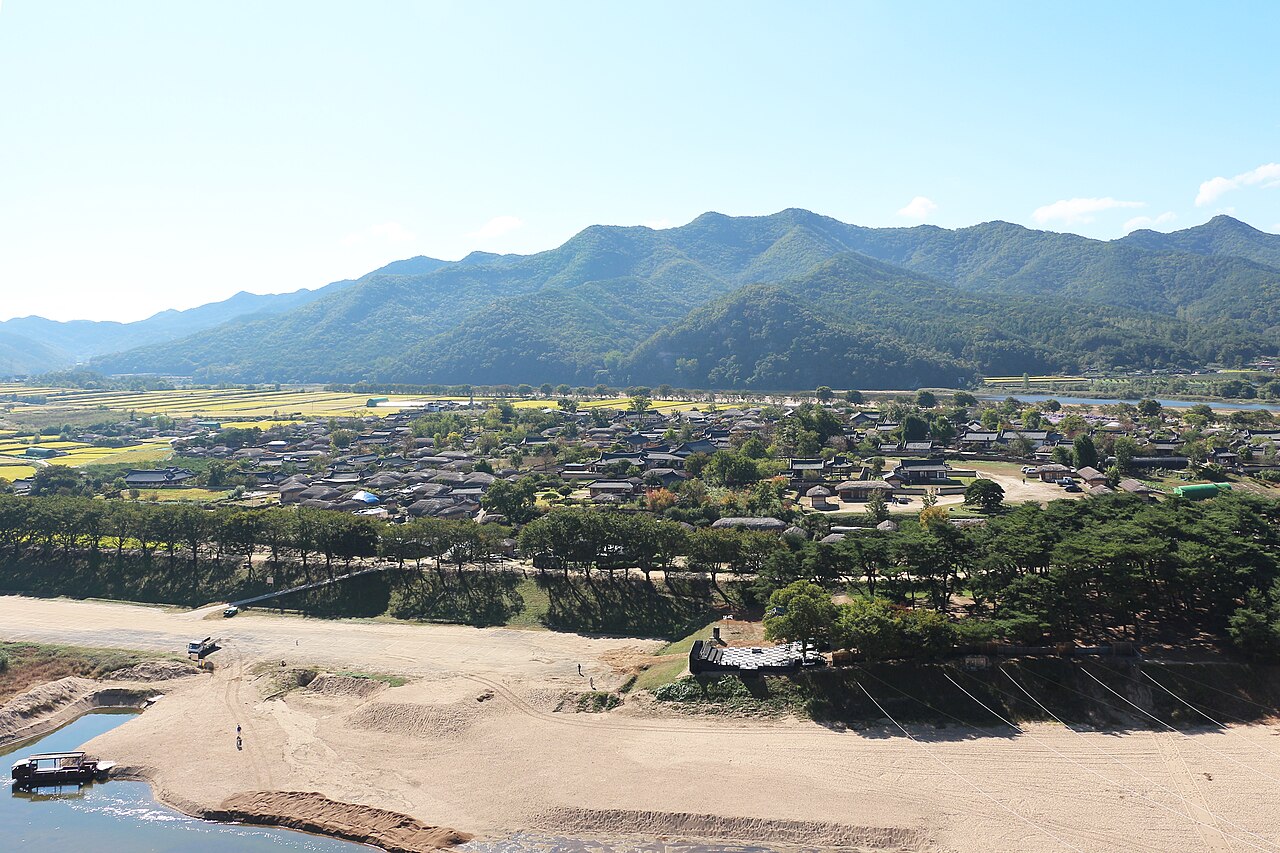
The Historic Villages of Korea: Hahoe and Yangdong, inscribed by UNESCO in 2010, preserve two aristocratic Confucian villages of the early Joseon dynasty — Hahoe (하회마을, “Water-Surrounding Village”, in Andong, North Gyeongsang Province) and Yangdong (양동마을, near Gyeongju, North Gyeongsang Province) — representing the most complete surviving examples of the banban village form (반반마을, a village established and inhabited for centuries by a single aristocratic clan lineage maintaining the Confucian social organisation of the Joseon period: hierarchical spatial arrangement of buildings by rank within the clan, clan-specific shrines and lecture halls, and a surrounding agricultural landscape managed in common by the clan’s commoner tenant farmers). Hahoe is the ancestral home of the Ryu clan of Pungsan (풍산 류씨), which has maintained continuous occupation of the village since the early 15th century, a period of approximately 600 years; the village’s name derives from its location on a large meander of the Nakdong River (낙동강), which bends around the village on three sides creating a near-island setting that was selected for its exceptional pungsu geomantic properties — the river on three sides, the Hwasan mountain ridge behind the north, and the forested mountain Budo on the south bank providing the “facing mountain” (안산, ansan) required by geomantic prescription. Yangdong, approximately 200 km southwest of Hahoe in the Gyeongju valley, is the ancestral home of two intermarried clans — the Won clan of Gyeongju (경주 손씨) and the Yi clan of Yeogang (여강 이씨) — whose intermarrying lineages have jointly occupied the village since the late 15th century; the village is set on the converging spurs of a mountain ridge overlooking the agricultural valley in a layout that places the highest-ranking clan buildings (the head clan’s ancestral shrine, the lecture hall) on the ridge tops and the lower-ranking buildings (farmhouses, tenant commoner dwellings) on the valley floor.
Hahoe’s Andong heritage corridor and the Yangdong-Gyeongju axis Byeongsan Seowon · Dosan Seowon · Yangdong–Gyeongju axis — 5 to 30 km
Five Kilometres west of Hahoe village by river path or road (the walking path along the Nakdong river bank from the Hahoe village entrance to the Byeongsan Seowon takes approximately 45 minutes following the river meander), Byeongsan Seowon (병산서원, inscribed 2019 as part of the UNESCO Seowon Neo-Confucian Academies) is one of the nine Neo-Confucian academies in the 2019 inscription and is architecturally the most photogenic of all the Korean Seowon — a complex of buildings from the early Joseon period (the original academy was established in the 12th century CE as a government school at a different location and relocated to the present Byeongsan site in 1572 CE; the main buildings were completed in 1863 CE) whose lecture hall (만대루, Mandaeru, “Platform for Viewing Ten Thousand Views”, a two-storey wooden pavilion with open lattice sides and a view over the Nakdong River to the Byeongsan cliffs and forested mountains beyond) is considered the masterpiece of Korean wooden academic architecture for the integration of the natural landscape into the building’s visual composition. The Ryu clan of Pungsan (Hahoe’s founding clan) includes among its most distinguished members Ryu Seong-ryong (류성룡, 1542–1607 CE, chief minister of the Joseon state during the Imjin War Japanese invasion of 1592, whose memoir Jingbirok “Book of Corrections” — a first-hand account of the invasion written in retirement at Hahoe — is the most important Korean literary source for the events of the 1592–1598 war); Byeongsan Seowon was founded to honour Ryu Seong-ryong’s memory, and his portrait and ritual vessels are maintained in the academy’s shrine hall. From Hahoe, Dosan Seowon (도산서원, approximately 40 km northeast of Andong city, 55 km from Hahoe, accessible by bus from Andong Bus Terminal in approximately 50 minutes) is the academy dedicated to Yi Hwang (이황, “Toegye”, 1501–1570 CE), one of the two greatest Neo-Confucian philosophers of the Joseon period — his philosophical debate with Ki Daeseung (기대승) on the metaphysical relationship between principle (이, li) and force (기, ki) is the defining intellectual exchange of Korean Neo-Confucian thought. The Dosan Seowon complex is the best-maintained of the nine inscribed Seowon, with a comprehensive museum of Toegye’s manuscripts and the 19th-century-carved portrait of the philosopher (used as the model for the image on the 1,000-won banknote, the most circulated Korean currency denomination). The Andong area concentration of UNESCO heritage — Hahoe village, Byeongsan Seowon, and Dosan Seowon all within a 55-km radius — makes Andong the most heritage-dense provincial city in Korea.
Yangdong village (approximately 15 km north of Gyeongju city, accessible from Gyeongju by bus in approximately 40 minutes or by rental car in 20 minutes) is integrated into the Gyeongju UNESCO heritage corridor that includes the Gyeongju Historic Areas (inscribed 2000) and the Seokguram Grotto and Bulguksa Temple (inscribed 1995) — making the Gyeongju valley the most concentrated UNESCO World Heritage zone in Korea, with three inscriptions within a 20-km radius. Yangdong village differs from Hahoe in several respects that make the pair complementary rather than repetitive: Yangdong’s terrain (ridges and valley rather than Hahoe’s river meander flatland) produces a more dramatic vertical arrangement of traditional buildings visible from the valley approach; the village contains a higher proportion of tile-roofed upper-class buildings (wadang houses, used by the senior clan members) relative to thatched-roofed lower-class buildings (reflecting the higher social standing of the Yangdong founding clans compared to Hahoe); and Yangdong’s proximity to the ancient Silla capital Gyeongju (the Yangdong clans’ earliest documented presence in the valley predates the establishment of Joseon in 1392) gives the village a cultural layering that extends from the Unified Silla period through the Joseon period to the present. The Gyeongju Historic Areas (Tumuli Park, Cheomseongdae Observatory, Wolseong) are approximately 15 km south of Yangdong via Gyeongju city; Bulguksa Temple and Seokguram Grotto are a further 12 km east on Mount Toham. The Oksan Seowon (옥산서원, one of the nine 2019-inscribed Seowon, dedicated to the Neo-Confucian philosopher Yi Eon-jeok, 1491–1553 CE) is approximately 8 km from Yangdong and can be combined with the village visit on the same day from Gyeongju.
Practical information
Hahoe Village (하회마을, Andong): open daily 09:00–18:00 (17:30 last entry), admission fee; the village is a living community (approximately 250 residents, many of the Ryu clan lineage) where traditional houses function as homes and guesthouses. A river ferry (나룻배, narutbae, a flat-bottomed boat propelled by a bamboo pole, approximately 5 minutes) crosses from the Buyongtae cliff opposite the village — the viewing of Hahoe from the cliff top during a river-mist morning is considered the classic landscape photograph of Korean traditional village architecture. The Andong Hahoe Mask Dance (하회별신굿탈놀이, inscribed on UNESCO’s Intangible Cultural Heritage list 2022) is performed on Saturdays and Sundays at the village’s outdoor performance stage (check current schedule at the Andong City Tourism website). Access to Hahoe from Andong city: bus from Andong Bus Terminal (approximately 40 minutes, services roughly hourly). Andong city is connected to Seoul by KTX (approximately 2 hours from Seoul Station to Andong Station, frequent service). Yangdong Village (양동마을, near Gyeongju): open daily 09:00–18:00 (17:30 last entry), admission fee; the village’s traditional houses are visible from the walking trail through the ridge, with the Muheondan (무첨당, a 15th-century aristocratic house open to visitors) and the Hyangdan (향단, a 16th-century medical care house built by Yi Eon-jeok) as the primary architectural highlights. Access from Gyeongju: bus from Gyeongju Bus Terminal (approximately 40 minutes) or taxi from Gyeongju city (approximately 20 minutes). Best visiting season: spring (May, the ridge paths bloom with azalea and iris) and autumn (October–November, the zelkova and gingko trees around the Yangdong houses turn gold). Both villages are active communities — respectful behaviour in residential areas, no photography of residents without consent.
Frequently Asked Questions
What is a ban-ban village and what distinguishes the Joseon aristocratic village from a typical Korean settlement?
A banban village (반반마을, also written as “clan village” in English-language heritage documentation) is a settlement established and maintained by a single aristocratic yangban clan lineage as the collective ancestral home of that clan, following a Confucian model of social organisation in which the physical environment of the village encodes the hierarchical relationships within the clan and the Confucian values (loyalty, filial piety, propriety, righteousness, integrity) that define the clan’s identity. The key features that distinguish a banban village from a typical Korean rural settlement are: single-clan identity (the founding and numerically dominant family is of one clan, with their commoner tenants and craftspeople living in the village’s lower or peripheral zones — the geographic hierarchy of the village mirrors the social hierarchy of its residents, with the clan head’s house at the highest, most geomantically propitious location, and commoner housing in the valley or peripheral zones); ancestral infrastructure (every banban village has a clan ancestral shrine, 종사 or 종묘, where the clan’s founding ancestors are ritually honoured at the seasonal ceremonies that are obligatory under Confucian family practice, and a lecture hall or Seowon where the clan’s sons study the Confucian classics and prepare for the civil service examinations that determine government appointment and social standing); landscape selection (the village site is chosen by geomantic assessment to ensure the maximum of natural protection and auspicious orientation — this produces the characteristic backdrops of forested mountain ridges, curving rivers, and south-facing orientation visible at both Hahoe and Yangdong); and material continuity (the houses, gardens, and ceremonial buildings of a well-maintained banban village represent the accumulated material culture of the clan over 400–600 years, unlike typical rural Korean settlements where structures were periodically replaced — the oldest surviving buildings in Hahoe and Yangdong date to the 15th–16th centuries CE, making them the oldest continuously inhabited domestic buildings in Korea). The banban village form is specific to the Joseon period: it emerged from the Confucian social reorganisation of the 14th–15th centuries that replaced the Buddhist-influenced mixed-settlement patterns of the Goryeo dynasty with a Confucian kinship-based settlement model, and it survived the Japanese colonial period largely because the colonial administration found the clan-based village social organisation administratively convenient.
What is the Hahoe mask dance and what do the masks represent?
The Hahoe Byeolsingut Talnori (하회별신굿탈놀이, “Hahoe Special Village Ritual Mask Dance”), inscribed on UNESCO’s Intangible Cultural Heritage list in 2022, is a shamanistic theatrical performance using carved wooden masks representing social archetypes of the Joseon period — the most historically significant of Korea’s mask dance traditions, preserved continuously in Hahoe village for approximately 700 years (the masks are dated to the 12th century CE by Korean cultural heritage assessments, predating the Joseon dynasty and making them the oldest surviving wooden theatrical masks in Korea). The dance series comprises eleven separate mask characters: the Imae (양반, a vain aristocrat), the Seonbi (선비, a pompous scholar), the Butneomi (부네, a concubine-class woman), the Halmi (할미, an elderly commoner woman), the Jung (중, a Buddhist monk breaking his vows), the Baekjeong (백정, a butcher — the lowest caste in Joseon social hierarchy), the Chamssi (참시, a young woman), the Gaksi (각시, a newly married woman), and others. The dramatic structure involves interactions between the characters that satirise the pretensions of the yangban aristocracy, the hypocrisy of the Buddhist clergy, and the rigid social hierarchy of Joseon society — a form of licensed social commentary through theatrical performance that was tolerated by the ruling class partly because the performances were held during the irregular “special ritual” (별신굿, byeolsingut) festivals called to appease village spirits in years of hardship, giving the satirical performance a ritual context that deflected direct political criticism. The twelve masks used in the performance (twelve original masks survive in the Andong National Folk Museum) are carved from alder wood and painted with natural pigments; the masks are kept in the village’s mask storage building (탈집, taljip) and brought out only for performances, treated as sacred objects rather than theatrical props. The mask dance performance in Hahoe takes place in the village’s open performance area near the central grove on Saturdays and Sundays during the regular tourist season (April–October); the Andong Mask Dance Festival (안동 국제 탈춤 페스티벌), held annually in late September/early October, includes full performances of the Hahoe mask dance alongside mask dance traditions from other Korean regions and international mask theater groups.
How did the Yangdong founding clans organise their village’s spatial hierarchy?
Yangdong village’s spatial organisation follows a rigorous application of the Confucian hierarchical principle that governs banban village layout — the Won clan of Gyeongju (경주 손씨) and the Yi clan of Yeogang (여강 이씨), who intermarried in the late 15th century and co-inhabited the village under a shared clan governance system, allocated the ridge-top positions on the three converging spurs of the Seolchangsan mountain to the senior lineages of both clans, with the highest and most geomantically prominent positions given to the clan head’s houses and ancestral shrines, and the valley floor and lower slopes given to the junior lineages and commoner tenants. The physical hierarchy is immediately visible on the approach to Yangdong: on the central ridge, the Muheondan (무첨당, the Won clan head’s house, 15th century, one of the oldest surviving domestic buildings in Korea) and the Yi clan’s Hyangdan (향단, built 1540 CE by Yi Eon-jeok, the philosopher-politician who later became the first Korean Confucian thinker inscribed in the royal Confucian academy, with the garden wall enclosing a rare surviving example of a Joseon-period domestic medicinal herb garden) occupy the high ground; on the adjacent ridges, the tile-roofed houses of other senior lineage members form the middle zone; and the thatched-roof houses of junior lineage members and tenants occupy the valley floor. The lecture hall (수졸당, Sujoldang, and the adjacent Ganghajeong pavilion) is positioned on a ridge spur above the valley, providing the elevation appropriate to an educational function in the Confucian hierarchy (scholars above farmers). The village’s 54 traditional buildings (out of approximately 160 structures currently standing) are classified as nationally important cultural properties, with the two clan head houses (Muheondan and Hyangdan) designated as Treasure-class properties — the highest Korean heritage designation below National Treasure. The preservation of Yangdong’s spatial hierarchy across 500 years is attributed to the continuous residence of the founding clan descendants (Won clan members still live in Muheondan and participate in the village’s ancestral ritual ceremonies) and to the strict building regulations imposed by the clan governance system that prohibited construction outside the established spatial zones without clan approval.
Sources
- S1 — UNESCO World Heritage Centre — Historic Villages of Korea: Hahoe and Yangdong (Ref. 1324) — https://web.archive.org/web/20230601000000/https://whc.unesco.org/en/list/1324/
- S2 — UNESCO World Heritage Centre — Statement of Outstanding Universal Value (Ref. 1324) — https://whc.unesco.org/en/list/1324/
Spotted an error? Write to editorial@culturalheritageonline.com and we correct it the same day.