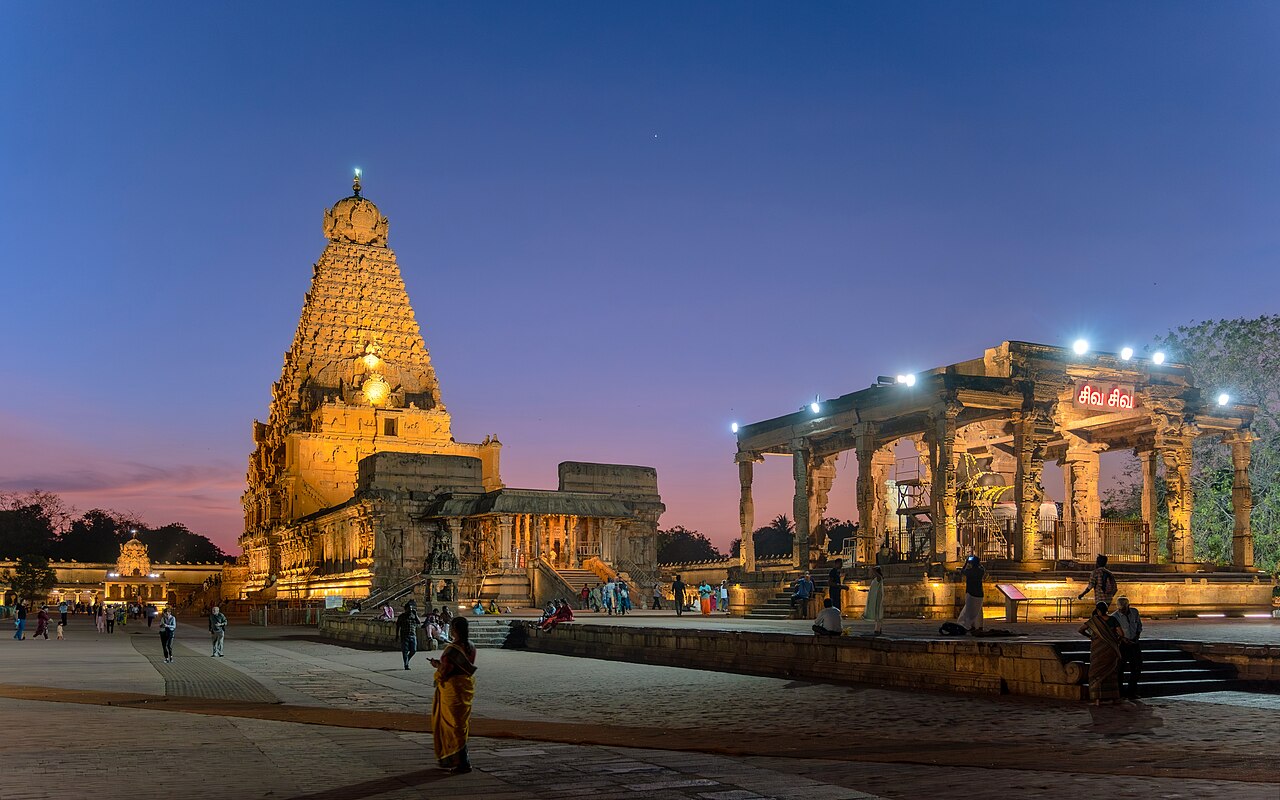
The Great Living Chola Temples, inscribed by UNESCO in 1987 (Brihadeeswarar Temple at Thanjavur) and extended in 2004 (Brihadeeswarar Temple at Gangaikonda Cholapuram and Airavatesvara Temple at Darasuram), are three Chola dynasty Tamil Shaivite temples of the 11th–12th centuries CE in Tamil Nadu that represent the apex of Dravidian temple architecture and are designated “Living Temples” because all three remain in continuous daily worship rather than being museum monuments — functioning Hindu temples where puja (ritual worship) is performed daily by hereditary priests in the tradition that has continued without interruption for approximately 1,000 years. The Brihadeeswarar Temple at Thanjavur (Peruvudaiyar Kovil, “the great temple of the supreme lord”, built 1003–1010 CE by Raja Raja Chola I — the greatest emperor of the Chola dynasty, who also conquered Sri Lanka and parts of Southeast Asia) is the defining monument: its 66-metre vimana (the main sanctum tower in the Dravidian architectural tradition) was the tallest structure in South India for approximately three centuries after its construction, and is capped by a single monolithic granite cupola of approximately 80 tonnes (how this cupola, weighing more than the entire weight of the steel structure of a Boeing 747, was raised to 66 metres in 1010 CE without modern machinery remains unclear — the principal hypothesis involves a 6.4 km ramp of compacted earth along which the cupola was rolled to the top of the tower, a construction logistics feat comparable to the raising of the Egyptian pyramid capstones). The vimana’s shadow is said never to fall on the ground at noon (this is the legendary description — the tower’s design geometry means that in the latitude of Thanjavur, at noon on certain equinox dates, the shadow does fall within the tower’s own footprint, creating the visual impression of a shadowless tower).
The three Great Chola Temples and the Tamil Nadu Chola heritage circuit Thanjavur · Gangaikonda Cholapuram · Darasuram · Mahabalipuram · Chidambaram — 0 to 200 km
The Brihadeeswarar Temple at Thanjavur (the primary UNESCO monument, in the centre of Thanjavur city, within a large compound — approximately 240 m × 120 m — enclosed by thick granite walls with a subsidiary shrine sequence that reads as a gallery of Chola-period sculptural programmes) is the starting point for any Chola temple circuit. The principal sanctum (the Shiva lingam called Peruvudaiyar, “the great lord”, the lingam itself approximately 3.66 m in height within the sanctum, the tallest Shiva lingam in a south Indian temple of its period) is surrounded by a covered ambulatory path lined with 108 Chola-period stone inscriptions (some of the most important primary historical documents of the Chola period, recording the donations of Raja Raja I and his successors, the land grants to temple servants, and the details of the temple’s daily ritual programme). The nandis (sacred bull figures of Shiva’s vehicle) in the compound include a monolithic Nandi of approximately 6 m in length — one of the largest Nandi sculptures in India. The Brihadeeswarar Temple at Gangaikonda Cholapuram (approximately 70 km north of Thanjavur, built 1030–1035 CE by Rajendra Chola I after his celebrated “North Campaign” in which the Chola army marched to the Ganges and returned with sacred Ganga water to fill a constructed pool — the “Gangaikondacholapuram” (“the city of the Chola who took Ganga”) was built as a new capital city of which almost all non-temple elements have disappeared) is slightly smaller (55 m vimana) but considered by many architectural historians the more aesthetically refined of the two Brihadeeswarar temples — the Gangaikondacholapuram vimana has a subtly curved profile (compared to the strictly vertical Thanjavur vimana) that gives it a graceful dynamic quality, and the stone sculptures in the recesses of the outer walls (particularly the Nataraja and Ardhanari panels) are among the finest Chola stone sculptures in existence. The Airavatesvara Temple at Darasuram (approximately 4 km from Kumbakonam, approximately 35 km from Thanjavur, built by Rajaraja Chola II in the 12th century CE) is the smallest of the three Great Living Temples (approximately 24 m vimana) but the most intricately ornamented — the entrance “chariot” mandapa (the pillared hall whose outer base is designed as the wheels and frame of a stone chariot, equivalent to the stone chariot at Hampi built 400 years later in the same tradition) contains a set of steps at its southern end carved from a single stone that ring like bells when struck (the “Manimandapam” or “musical steps”, a Chola-period example of the acoustic phenomenon also seen in the Hampi Musical Pillars).
Chidambaram (approximately 65 km east of Gangaikondacholapuram, on the Coromandel Coast) is the site of the Nataraja Temple (not UNESCO inscribed but of equal Chola-period significance — the temple of Shiva as Nataraja, the Cosmic Dancer, the central theological icon of Shaivite Tamil devotion since the Chola period; the gold-roofed gopura towers visible from kilometres away) and is the essential fourth point of the Tamil Nadu Chola heritage circuit. Mahabalipuram (UNESCO 1984, approximately 160 km northeast of Thanjavur on the Bay of Bengal) completes the Tamil Nadu coastal UNESCO sequence from the 7th-century Pallava foundations at Mahabalipuram through the 11th-century Chola apogee at Thanjavur to the 16th-century Nayak Dravidian elaborations in Madurai (not UNESCO inscribed).
Practical information
Thanjavur is 344 km south of Chennai (approximately 6 hours by road or train). The Brihadeeswarar Temple in Thanjavur is accessible by walking or auto-rickshaw from Thanjavur’s railway station (approximately 2.5 km). Thanjavur Railway Junction has direct trains from Chennai (approximately 6 hours), Tiruchirapalli (1 hour), and Madurai (3 hours). The Brihadeeswarar Temple is open daily 06:00–12:00 and 16:00–20:30 (closed midday as an active temple). Admission to the outer compound and the ASI museum is free; the inner sanctum has a dress code (dhoti or lungi for men, saree or churidar for women). The Gangaikondacholapuram Brihadeeswarar Temple is approximately 70 km north of Thanjavur by road (1.5 hours), with limited public transport — a hired car from Thanjavur is the practical option. The Airavatesvara Temple at Darasuram is 35 km from Thanjavur, accessible from Kumbakonam (which is on the main Chennai–Thanjavur rail route). Best visiting months: October–March (Tamil Nadu’s northeast monsoon ends October–November, bringing cooler and clearer conditions; February–March for the Maha Shivaratri festival at Brihadeeswarar, when the temple is spectacularly lit at night). Visit the temples at dusk or dawn when the ritual puja activity is visible — the evening puja at Brihadeeswarar Temple with the Chola-period music in the temple hall is the most atmospheric cultural experience in Tamil Nadu.
Frequently Asked Questions
Who was Raja Raja Chola I and why did he build the Brihadeeswarar Temple at Thanjavur?
Raja Raja Chola I (Tamil: இராஜராஜ சோழன், “King of Kings, Chola”, born approximately 947 CE, reigned 985–1014 CE) was the greatest emperor of the Chola dynasty and one of the most significant rulers in South Asian history — the emperor who transformed the Chola kingdom from a regional power in the Kaveri delta of Tamil Nadu into an imperial power that controlled most of peninsular India south of the Krishna river, Sri Lanka (conquered 993 CE), the Maldives, and the Andaman and Nicobar Islands, and established diplomatic and trade relations across maritime Southeast Asia. His military campaigns (conducted systematically over his three-decade reign, documented in the temple inscriptions at Thanjavur which list his conquests — the Annal of Raja Raja, one of the most detailed primary historical sources for the political geography of 10th–11th century South India) included the defeat of the Western Ganga, Chalukya, and Rashtrakuta successor states of Karnataka, the conquest of Kerala, the first Chola military intervention in Sri Lanka (979 CE, the destruction of the Sinhalese capital Anuradhapura), and the dispatch of a naval expedition to the Malay Peninsula. The Brihadeeswarar Temple at Thanjavur was built not merely as an act of religious devotion but as an explicit statement of imperial achievement — the temple was dedicated in 1010 CE at the culmination of a major campaign of conquests, with the dedicatory inscriptions recording that Raja Raja “gave (to the Lord of the temple) all the wealth of the countries he conquered”. The temple’s specific features as an imperial monument include: its scale (the largest temple in South India at the time of construction — the 66-metre vimana visible from kilometres away in the flat Kaveri delta landscape, an imperial landmark equivalent to the dome of St. Peter’s in Rome or the minaret of the Qutb Minar in Delhi); its decorative programme (the outer wall niches contain stone sculptures of Shiva in all his manifestations — the complete theological programme of Shaivite iconography in one stone surface, a theological encyclopaedia carved in granite at imperial scale); and its endowment (Raja Raja donated approximately 200 kg of gold, thousands of silver and gold objects, hundreds of precious stones, and extensive land grants to support the temple’s ritual and maintenance costs in perpetuity — the temple inscriptions recording these donations are the most detailed financial document of any pre-modern Indian institution). The temple’s construction logistics remain a matter of active scholarly debate: the vimana reaches 66 metres in 13 progressively smaller stories (each story slightly smaller than the one below, creating the pyramidal profile of the Dravidian vimana), with the final monolithic granite cupola block of approximately 80 tonnes placed at the summit. The most widely accepted hypothesis for the cupola raising is a ramp — a 6.4 km compacted earth ramp at a slope of approximately 1:60 along which the cupola was rolled on rollers from the ground to the top of the tower — but no physical evidence of the ramp has been found, and the mathematical analysis of the ramp hypothesis raises questions about the structural strength of compacted laterite soil under the weight of the 80-tonne block. The mystery remains genuinely open: the 1010 CE Chola engineers solved a construction logistics problem that modern engineers, equipped with cranes rated at 1,000+ tonnes, would approach very differently.
What makes these temples “Living Temples” and how is the 1,000-year worship tradition maintained?
The designation “Great Living Chola Temples” rather than simply “Chola Temples” reflects a fundamental distinction that UNESCO considered essential to the Outstanding Universal Value of the inscription: all three temples are not museum monuments but functioning religious institutions where the ritual programme of daily puja (worship) has been maintained in continuous succession for approximately 1,000 years, by hereditary priestly families (archakas and pandits) who have performed the same rituals in the same order using the same ancient Tamil liturgical texts (the Tevaram hymns of the Nayanmars, the Tamil Shaivite saint-poets of the 7th–9th centuries CE, which are the foundational texts of Tamil Shaivite devotional tradition) for a millennium. The daily ritual schedule at the Brihadeeswarar Temple at Thanjavur (where the schedule is the most extensively documented) includes six daily puja services from early morning (approximately 05:30) to late evening (approximately 21:00), each involving the bathing of the lingam with water, milk, curd, honey, and other ritual substances; the application of vibhuti (sacred ash) and sandalwood paste; the offering of flowers, food, and incense; the waving of lamps (aarti); and the recitation of the Tevaram hymns. The hereditary nature of the priestly roles (the families responsible for specific ritual functions at the Brihadeeswarar Temple can document their priestly lineages to appointments made in the original Chola-period temple establishment records — the temple inscriptions record the names and responsibilities of specific priestly families, and their descendants still hold those same responsibilities) means that the ritual tradition is transmitted through a specific institutional continuity rather than being a reconstructed approximation of historical practice. The management of the living ritual tradition alongside the UNESCO conservation requirements creates specific challenges: the daily application of vibhuti, sandalwood paste, oil, and other substances to stone surfaces that are also internationally significant archaeological objects (the stone sculptures on the Thanjavur vimana outer wall, for example, are among the most important collections of Chola-period stone sculpture in the world and are deteriorating as a result of exposure to ritual substances applied over centuries); the access of pilgrims (the Brihadeeswarar Temple attracts approximately 3 million visitors per year, of whom a significant proportion are Hindu pilgrims participating in the ritual rather than heritage tourists) to the inner sanctum creates crowd management and surface preservation challenges; and the authority over the temple’s management (split between the Tamil Nadu Hindu Religious and Charitable Endowments Department, which administers the financial and physical management of the temple, and the hereditary priestly families, who control the ritual programme) is a source of ongoing legal and administrative disputes that the Heritage Management Plan negotiated with UNESCO attempts to navigate.
EXCERPT: Great Living Chola Temples, UNESCO-inscribed in 1987 and 2004, are three Tamil Shaivite temples of the 11th–12th centuries still in daily active worship — the 66-metre Brihadeeswarar vimana at Thanjavur built by Raja Raja Chola I in 1010 CE with an 80-tonne capstone of unknown raising method, Gangaikondacholapuram’s subtly curved tower, and Darasuram’s bell-ringing stone steps.
META: UNESCO World Heritage Sites near Great Living Chola Temples Tamil Nadu India: Group of Monuments at Mahabalipuram 300 km northeast (UNESCO 1984), Hampi Group of Monuments 600 km northwest (UNESCO 1986) — Tamil Nadu UNESCO heritage circuit from Mahabalipuram Pallava foundations to Thanjavur Chola apex, Dravidian temple architecture sequence.
Sources
- S1 — UNESCO World Heritage Centre — Great Living Chola Temples (Ref. 250) — https://web.archive.org/web/20230601000000/https://whc.unesco.org/en/list/250/
- S2 — UNESCO World Heritage Centre — Statement of Outstanding Universal Value (Ref. 250) — https://whc.unesco.org/en/list/250/
Spotted an error? Write to editorial@culturalheritageonline.com and we correct it the same day.