The Royal Tombs of the Joseon Dynasty, inscribed by UNESCO in 2009, comprise 40 individual tombs in 18 separate locations spread across a radius of approximately 100 kilometres from Seoul. They contain the remains of all 27 Joseon dynasty kings and their principal queens, built between 1408 and 1966 — the last for Empress Sunjeong, who died that year as the last member of the royal house. UNESCO described the series as “the most complete and well-preserved series of royal tombs in the world.” Among them is the tomb of King Sejong the Great at Yeoju, the monarch responsible for creating the Korean Hangul alphabet, which 80 million people continue to use.
How the Tombs Were Designed and Why They All Look Different From the Outside Multiple sites within 100 km of Seoul, South Korea
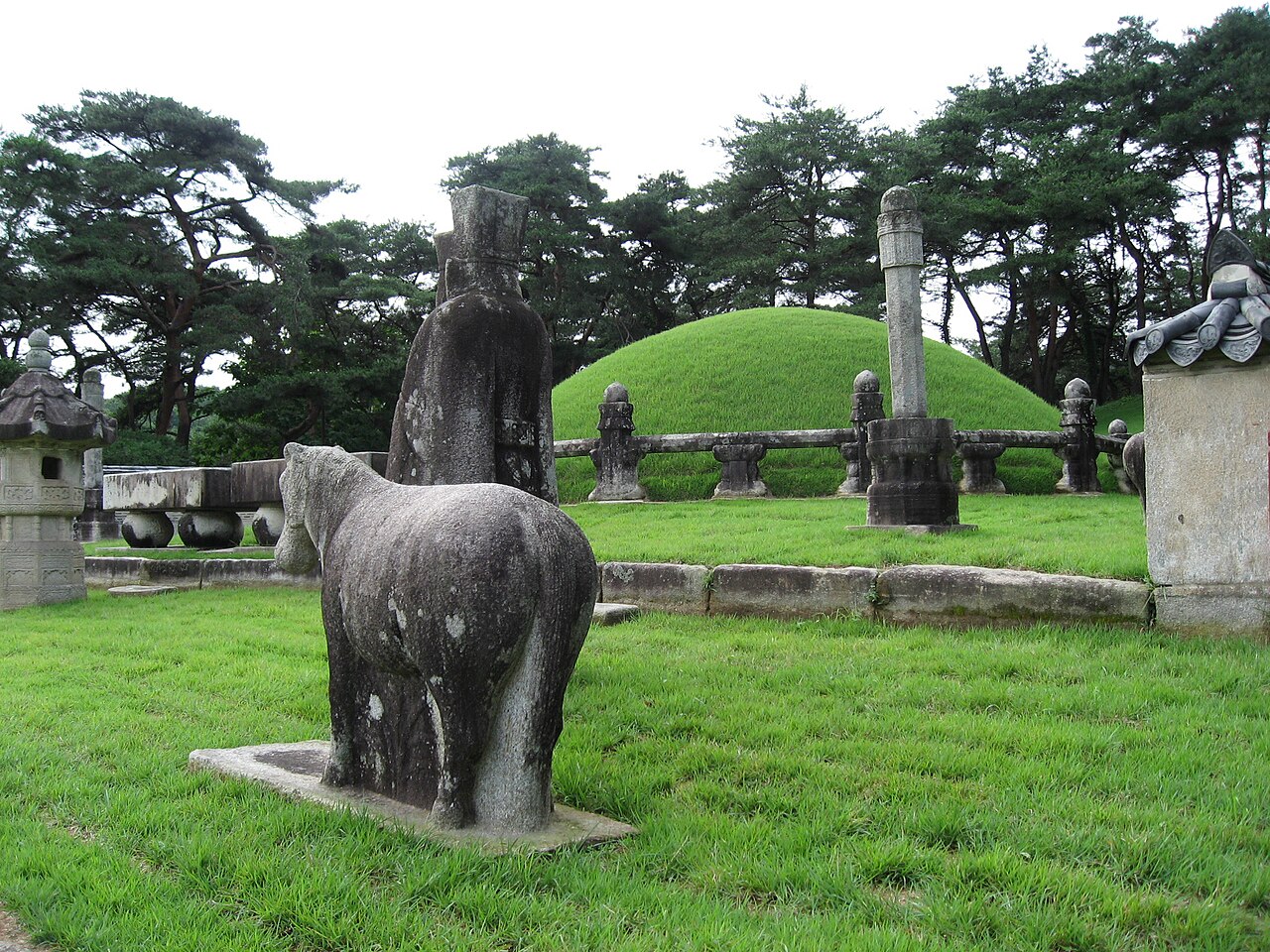
Each of the 40 Joseon royal tombs (neung) follows a standardised layout derived from Confucian and geomantic principles, yet no two sites are identical — the topography, the relationship between the burial mound and the surrounding landscape, and the number of adjacent burial mounds (some kings and queens are buried separately; some share a compound; some sites contain two or three mounds in close proximity) produce considerable variety. The core layout is consistent: a circular earthen burial mound (bong), typically 5 to 10 metres high, set on a gentle south-facing slope with higher ground behind it and an open prospect or watercourse in front. This configuration follows the geomantic principle of baesanimsu — mountain at the back, water or open ground at the front — which was understood to concentrate beneficial energies around the burial.
In front of each burial mound, a T-shaped ritual building (jeongja-gak, or simply the “T-shrine”) provides a covered space for the ancestral offerings presented at each anniversary of the king’s death. The approach from the entrance gate follows a straight stone-paved path flanked by stone figures: in sequence, sheep, horses, civil officials, and military officials, all carved in a stylised court manner. The number and arrangement of these stone figures follows a protocol based on the status of the occupant. The entire tomb compound is enclosed by a low stone wall. The burial mound itself is not accessible — a low railing rings its base — but can be viewed from the ritual building area at close range.
The 18 tomb locations are distributed across the greater Seoul metropolitan area and Gyeonggi province, with clusters at Guri (east of Seoul), Goyang (northwest), Seocho-gu (within the city), Paju (north toward the DMZ), and several rural sites further from the capital including Yeoju (60 kilometres southeast). A few tomb sites contain multiple neung within the same fenced complex, which makes them efficient to visit; others are isolated individual tombs requiring a dedicated trip. The largest cluster open to visitors is Donggureung in Guri, which contains nine royal tombs in a single forested compound and represents the most concentrated UNESCO tomb experience available in one site.
The tradition of burial mound construction at these sites spans 558 years (1408 to 1966), yet the consistent application of the standard design means that a visitor who understands one tomb can read all the others. The differences are in scale, in the quality of the stone carving, in the size of the compound, and in the individual history of the occupant. The most famous individual tomb within the inscription is Yeong Neung at Yeoju, the tomb of King Sejong — not because of its architectural distinction but because of who is buried there.
King Sejong’s Tomb and the Alphabet He Invented Yeong Neung, Yeoju, Gyeonggi-do — 60 km southeast of Seoul
King Sejong the Great reigned from 1418 to 1450 and is the most consistently venerated figure in Korean history, appearing on the 10,000 won banknote and lending his name to the Sejong Center for the Performing Arts in Seoul, the administrative city of Sejong, and numerous institutions across Korea. The basis for this status is concrete: during his reign, the Joseon court produced an unprecedented range of intellectual and practical achievements, the most significant of which was the creation of Hangeul, the Korean alphabet.
Before Hangeul, Koreans wrote using Chinese characters (hanja) adapted to represent Korean words and sounds — a system poorly suited to Korean phonology, which is structurally unrelated to Chinese. Chinese characters are logographic (each character represents a word or morpheme, not a sound); Korean is an agglutinative language with complex verb endings and a sound system that differs substantially from Chinese. The mismatch meant that only the educated elite who had learned Chinese writing could be literate, while the majority of the Korean population had no accessible writing system for their own language.
Hangeul was created by Sejong and a committee of scholars working in the Hall of Worthies (Jiphyeonjeon), a royal research institute he established. The alphabet was promulgated in 1446 in a document called Hunminjeongeum (The Correct Sounds for the Instruction of the People), which explained both the new letters and the phonological principles behind them. Hangeul consists of 24 letters: 14 consonants and 10 vowels. The consonant letters were designed to represent the shape of the speech organs when producing each sound — the tongue, lips, and throat in different configurations — making the system partially iconic rather than arbitrary. Linguists have consistently rated Hangeul among the most phonetically rational writing systems ever created for any language. The system can represent every sound in spoken Korean with high precision using a small number of characters, and it can be learned to functional reading level in a matter of hours, which was precisely the point.
Sejong’s tomb was not always at Yeoju. It was originally constructed at a different site in 1450, shortly after his death. In 1469, during the reign of his grandson Yejong, the tomb was relocated to its current location in Yeoju after court geomancers determined that the original site had unfavourable characteristics. The move of an established royal tomb was an unusual act requiring significant political and logistical investment; the fact that it was carried out suggests the geomantic concerns were treated with considerable seriousness. The current Yeong Neung compound also contains the adjacent tomb of Queen Soheon, Sejong’s principal queen. Hwaseong Fortress, another UNESCO World Heritage site, is approximately 30 kilometres south of the main Seoul-area tomb cluster.
Practical information
The most accessible single-site visit for the Joseon Royal Tombs inscription is Donggureung in Guri City (40 minutes from central Seoul by subway and bus), which contains nine tombs in one forest compound and is open Tuesday to Sunday, 09:00 to 18:00 (17:30 in winter). Admission is 1,000 KRW for adults. Yeong Neung in Yeoju is best reached by bus from Yeoju City; the compound is open on the same schedule as Donggureung and admission is the same. The Korean Cultural Heritage Administration website (heritage.go.kr) maintains an interactive map of all 18 tomb locations with transport information. Most tomb sites are tranquil and uncrowded outside of public holidays; the forest setting of the larger compounds makes them significantly more atmospheric than the standard palace site experience. The Korea National Heritage Complex (formerly the Cultural Heritage Administration) offers free guided tours in English at Donggureung on weekends. A combined itinerary pairing Donggureung with the nearby Guri riverside park makes a full-day excursion from Seoul. Hwaseong Fortress in Suwon — another UNESCO site — is approximately 30 kilometres south of the main Seoul tomb cluster and can be combined in a single day by car or by using the Suwon rail connection.
Frequently Asked Questions
Why were all 40 Joseon royal tombs built within approximately 100 kilometres of Seoul?
The proximity of all Joseon royal tombs to the capital Hanyang (present-day Seoul) reflects a combination of religious obligation, practical logistics, and geomantic selection criteria. Confucian ancestral rites required the reigning king to perform ceremonies at the royal tombs at prescribed intervals — on the death anniversaries of his predecessors and at seasonal ritual moments. These visits needed to be manageable within the constraints of royal travel, which involved large retinues and considerable ceremony, without being so distant as to be impractical. A tomb within a day’s travel of the capital allowed the ritual calendar to be maintained without prolonged royal absence from the court. At the same time, geomantic selection limited the available sites: a royal tomb required a specific landscape configuration (the baesanimsu arrangement, with a sheltering mountain behind and open ground in front), which could not be found everywhere. The combination of proximity to Seoul and the right geomantic landscape features confined the selection zone to the mountain-ringed terrain within the Han River basin and surrounding Gyeonggi province. The one exception that required a tomb relocation — Sejong’s tomb, moved from its original site to Yeoju in 1469 — illustrates how seriously the site-selection criteria were enforced: when the original location was deemed geomantically deficient, the tomb was moved even though relocation was logistically complex and dynastically unusual. The 100-kilometre radius that contains all 40 tombs is therefore not an administrative decision but the natural result of applying consistent criteria for a dynasty centred on a fixed capital for five centuries.
How was Hangeul received when King Sejong introduced it, and why did Chinese characters (hanja) continue to be used for centuries afterward?
The reception of Hangeul in 1446 was not uniformly enthusiastic. The Confucian scholar-officials (yangban) who dominated the Joseon bureaucracy had invested decades in mastering Chinese writing and classical Chinese composition — the skills required to pass the civil service examinations (gwageo) that controlled access to government positions. For this class, Hangeul represented a potential devaluation of their cultural capital: if a simple phonetic alphabet could make literacy accessible to everyone, the elite distinction conferred by mastery of classical Chinese would diminish. Some scholars opposed the alphabet on these grounds, arguing that Korea should not deviate from the writing system shared with China. Sejong’s response, preserved in the Hunminjeongeum text, was direct: he argued that the mismatch between the Chinese writing system and the sounds of Korean was a practical problem for the common people, who needed to be able to write and read without years of classical study. The alphabet was initially used for government documents intended for public circulation, vernacular literature, practical manuals (including agricultural and medical texts), and women’s writing — contexts where the practical advantages of a phonetic system mattered more than classical prestige. Chinese characters continued as the prestige writing system for official and scholarly documents until the late 19th and early 20th centuries. The full adoption of Hangeul as the primary written form of Korean — to the near-exclusion of hanja — occurred over the 20th century, with the Japanese colonial period (which promoted Japanese writing) paradoxically accelerating Korean attachment to Hangeul as a marker of national identity.
What does “geomancy” (pungsu or feng shui) actually require for a royal tomb site, and how did it affect where the Joseon tombs were built?
Pungsu (the Korean term for what is more widely known internationally by its Chinese name, feng shui) is a practice of reading landscape to identify locations that concentrate beneficial natural energies (gi) and protect against harmful ones. For a royal tomb, the central criterion was the baesanimsu configuration: a south-facing slope with a substantial mountain (or ridge) rising behind the site to the north, a lower flanking ridge on each side (like two embracing arms), and open ground or a watercourse in front to the south. This configuration was understood to channel and retain beneficial gi at the burial site, which would in turn benefit the dynasty through the spiritual connection between the entombed ancestor and the living royal line. The preferred mountain behind the tomb was a specific category of landform — not simply any hill, but a formation with a particular profile and mass considered most beneficial. The court employed specialists in pungsu analysis (ji-gwan) whose assessments of candidate sites were taken seriously at the highest political level. The relocation of Sejong’s tomb in 1469 was based on ji-gwan assessment that the original site had a deficiency in one of the required landscape features. In practical terms, the pungsu requirements for royal tomb siting functioned as an environmental filter that consistently selected for forested, well-drained hillside locations with mountain backing — landscape types that also happen to be ecologically productive and visually peaceful. The Joseon royal tombs are therefore, partly as a result of their site-selection criteria, among the best-preserved pieces of forested landscape within the greater Seoul metropolitan area, their 5 to 10 hectare compounds protected from development by their royal and heritage status for more than 500 years.
Sources
- S1 — Korea Heritage Service (formerly Cultural Heritage Administration) — Royal Tombs of the Joseon Dynasty — https://english.cha.go.kr/
- S2 — Cultural Heritage Administration of Korea — The Royal Tombs of the Joseon Dynasty, Hollym, Seoul, 2010, ISBN 978-1565913226
Spotted an error? Write to editorial@culturalheritageonline.com and we correct it the same day.