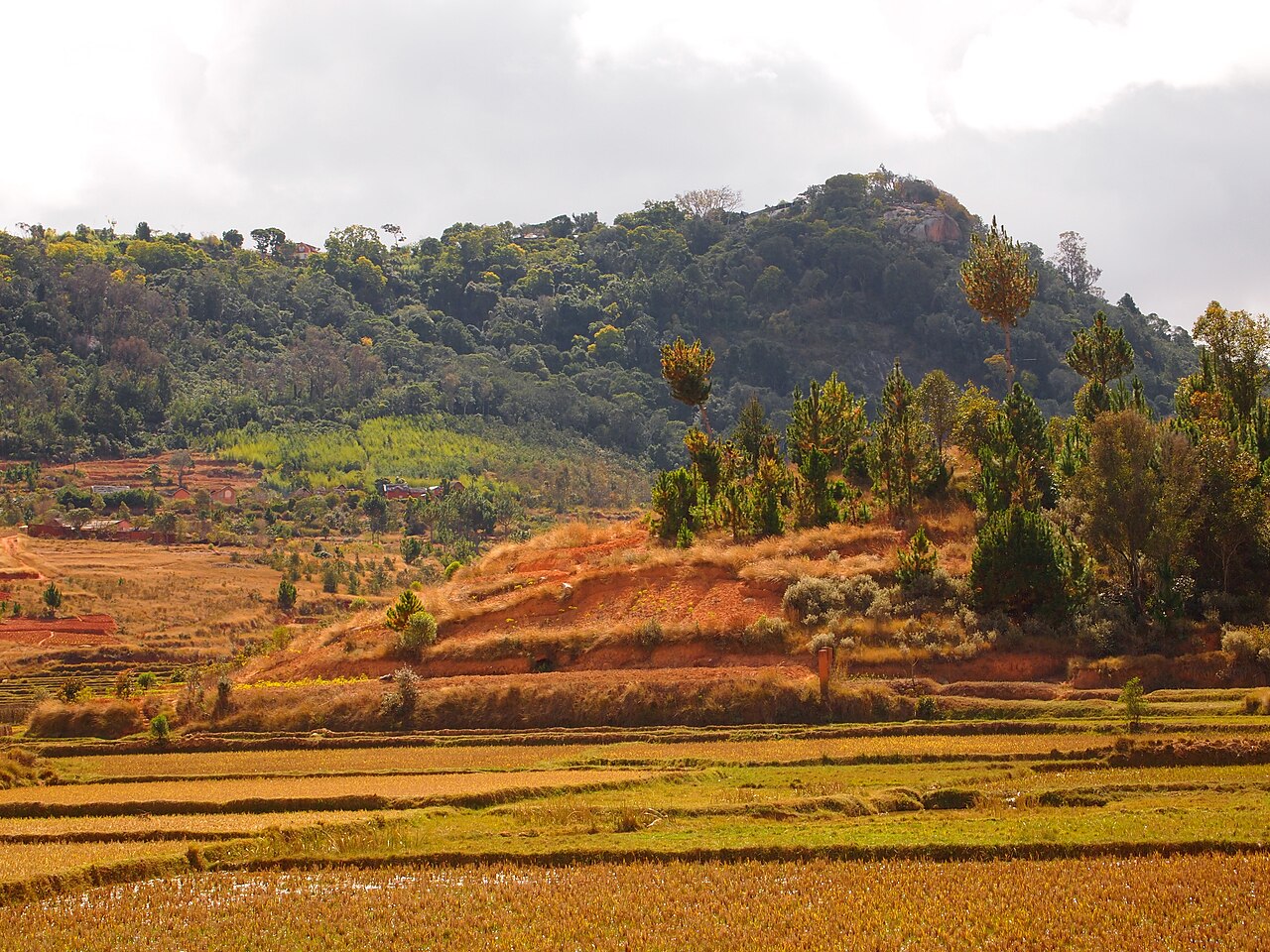
Ambohimanga is a forested hill in the central highlands of Madagascar, 22 kilometres north of Antananarivo, where the royal palaces of the Merina kingdom were built and where the most sacred site in the country still draws pilgrims from across Madagascar and the Malagasy diaspora. Inscribed by UNESCO in 2001 as Madagascar’s only cultural World Heritage Site, it combines royal architecture of the 18th and 19th centuries with a living tradition of ancestral veneration that has continued uninterrupted for more than 500 years.
The origin of the kingdom Imerina highlands, 22 km north of Antananarivo
The name Ambohimanga translates from Malagasy as “blue hill” or “beautiful hill” — ambohi meaning hill,
By the 17th century the political centre of the Merina had shifted to Antananarivo, the current capital, but Ambohimanga retained a status of a different kind: not primarily administrative but sacred. It was the ancestral seat, the origin point, the hill to which the royal dead returned. When in 1794 King Andrianampoinimerina — whose name translates roughly as “the prince in the heart of Imerina” — made Antananarivo his political capital and began the project of unifying all the highland chieftaincies under Merina rule, he did not abandon Ambohimanga. He built his principal royal palace there, on the highest point of the forested hill, and continued to sleep there in preference to Antananarivo until his death in 1810. In Merina tradition, the two sites are understood as complementary: Antananarivo as the seat of government and commerce, Ambohimanga as the seat of spiritual authority and royal ancestry.
Andrianampoinimerina’s unification of Imerina was the political precondition for everything that followed in Malagasy history. Under his son and successor Radama I (r. 1810–1828), the Merina kingdom extended its control to the coast and entered into formal diplomatic relations with the British Empire, which recognised Radama as “King of Madagascar” in 1817. The London Missionary Society established schools and printing presses under Radama I, producing the first written form of the Malagasy language. By the mid-19th century, the Merina state controlled roughly two-thirds of Madagascar. The French colonisation that followed — the kingdom was abolished and the queen exiled in 1896 — was experienced as a rupture not only of political sovereignty but of the sacred order centred on sites like Ambohimanga. The French colonial administration twice attempted to ban pilgrimage to the hill, recognising correctly that it functioned as a focal point of Malagasy identity and resistance. Both bans failed.
The architecture of sacred royalty Royal Rova and living pilgrimage site
The summit of Ambohimanga is enclosed within a royal precinct called a Rova — the same term used for the larger and more elaborate royal complex in Antananarivo that burned in 1995. The Ambohimanga Rova is protected by a defensive wall built from undressed stone, its single original entrance now flanked by the most iconic object on the site: the Firarazana, a stone disk 3.2 metres in diameter, approximately 1.2 metres thick and weighing an estimated five tons. This disk was rolled across the entrance gate each evening to seal the royal hill from dusk until dawn, a practice requiring the coordinated effort of forty men. One of the original disks is still in place at the gatehouse, worn smooth at its contact points from centuries of use. It remains one of the most striking physical demonstrations of royal power in Madagascar — the creation of a night-world sealed from the profane, accessible only through royal permission.
Inside the Rova, the royal palaces occupy the highest ground. The Mahitsielafanjaka — which translates as “one who reigns justly and for a long time” — is the wooden palace of Andrianampoinimerina, built in the traditional Malagasy style with carved wooden columns and a floor raised above the ground on stone stilts. The interior is modest by European royal standards: a single main room with the king’s sleeping platform in the northeast corner (the most sacred direction in Malagasy cosmology), cooking area, and storage. Cattle horns and other offerings accumulate in the northeast corner around the sleeping platform, brought by pilgrims who come to pray to the king’s ancestral spirit. Andrianampoinimerina’s remains are interred within the palace, making it simultaneously a royal residence, a mausoleum, and an active altar.
A second palace on the site dates from the reign of Queen Ranavalona I (r. 1828–1861), who reversed her predecessor’s pro-British policies and expelled Christian missionaries from Madagascar. Her palace at Ambohimanga is built partly in stone, a later architectural element, and contains a bath that was filled with sacred water for royal use. Within the Rova there is also the Imasoandro, a sacred spring whose water was used for ritual bathing and purification — its name means “eye of the sun” — and several royal tombs surrounded by standing stones.
The site is managed jointly by the Malagasy state (through the Ministry of Culture) and traditional custodians, the Ampanjaka, who are hereditary guardians carrying knowledge of the ritual protocols that govern conduct on the hill. Both secular and sacred management systems are simultaneously active, and the relationship between them is sometimes complex. What is clear is that Ambohimanga functions: it is not a preserved monument but a living site, visited by Malagasy people year-round for purposes of prayer, healing, ancestral communication and petition. The offerings left in the northeast corners of the palaces — rum, honey, silver coins, fabric — are not historical curiosities but current practice, renewed each week.
Practical information
Ambohimanga is 22 kilometres north of Antananarivo and accessible in 30 to 45 minutes by taxi-brousse (shared minibus) from the northern taxi-brousse station in the capital. Private taxis and organised tours are also available from any Antananarivo hotel. The road is tarred for most of its length, and the approach to the hill itself is well-signed. Entrance fees are paid at the gate, and a guide is obligatory for access to the Rova — this is both a practical requirement and a meaningful one, since much of what makes the site significant is explained by the contextual knowledge the guides carry.
The summit is open daily, though mornings on weekdays are quieter than weekend afternoons when local family groups come to pray. The walk from the main entrance gate to the summit takes approximately 20 minutes on a well-maintained path through light forest. The descent on the western side of the hill offers views over the surrounding agricultural land of the Imerina highlands — a patchwork of rice paddies, eucalyptus stands, and red-earth roads.
Photography within the Rova requires advance permission and payment of an additional fee. The northeast corners of the palaces, where ancestral altars are maintained, should not be photographed without explicit permission from the guide and the custodians present. The site is a functioning place of worship, and the protocols governing it reflect that status. Modest dress is appropriate, and behaviour during any ceremony or prayer session observed should be respectful and quiet.
Frequently Asked Questions
What is the significance of the ancestral veneration practised at Ambohimanga?
Ancestral veneration is not a peripheral or archaic element of Malagasy culture at Ambohimanga — it is the site’s central and continuous function. In Malagasy traditional religion, the dead (Razana) do not depart from the world of the living but continue to be present within it as active agents capable of helping or harming the living depending on whether they are properly honoured. The royal ancestors at Ambohimanga — primarily Andrianampoinimerina — are understood as particularly powerful Razana whose intercession can help with illness, fertility, business difficulties, legal problems and other concerns that bring people from across Madagascar to pray here.
The practice involves bringing offerings — typically rum (locally made, poured on the altar or onto the ground), honey, silver coins, and sometimes red cloth — and making requests while facing the northeast (the direction of the ancestors in Malagasy cosmology). Prayers are spoken aloud, sometimes at length. There is no fixed liturgy; the approach is personal and direct. The Ampanjaka custodians mediate access to the most sacred areas of the Rova and can conduct intercessions on behalf of petitioners who are not familiar with the correct protocols. The pilgrimage to Ambohimanga from other parts of Madagascar is a significant undertaking — people come from Tamatave, Fort Dauphin, Diego Suarez, and from the diaspora in France and Réunion — and reflects the degree to which the site functions as a national sacred centre rather than a local shrine.
How did French colonialism affect Ambohimanga and the Merina monarchy?
The French colonisation of Madagascar was completed militarily in 1895–96. Queen Ranavalona III, the last Merina monarch, was deposed and sent into exile in Algiers, where she died in 1917. The Merina monarchy was formally abolished, traditional chiefly authority was suppressed, and a French colonial administration established that governed the island until independence in 1960. The abolition of the monarchy was experienced by the Malagasy, and especially the Merina, as a catastrophic rupture — not only political but cosmological, since the king or queen was understood as the mediator between the human world and the ancestral powers that governed it.
Ambohimanga became a focal point of this disruption. The French colonial government, recognising that the hill functioned as a centre of Malagasy identity and potential resistance, twice attempted to ban or severely restrict pilgrimage to the site — once in the late 19th century and again in the early 20th. Neither prohibition was effectively enforceable: people continued to come, using secondary paths through the forest when the main approach was controlled. The 1947 Malagasy uprising against French rule, one of the bloodiest colonial suppressions in African history (estimates of the dead range from 11,000 to 90,000), was followed by a period in which many traditional practices associated with Malagasy sovereignty were further restricted. After independence in 1960, Ambohimanga was gradually restored as a national site, and since UNESCO inscription in 2001 it has been the subject of conservation work focused on the wooden palace structures, which are vulnerable to termite damage and humidity.
What is the relationship between Ambohimanga and the Antananarivo Rova?
The two royal enclosures are complementary rather than competing sites, understood in Merina tradition as carrying different but related sacred functions. The Antananarivo Rova — located on the highest hill of the capital, dominating the city — was the seat of government and ceremonial state power from the reign of King Andrianjaka in the early 17th century onwards. It was expanded substantially by successive monarchs, particularly Queen Ranavalona I, and by the mid-19th century contained an impressive complex of wooden and stone palaces, chapels, and tombs. The Antananarivo Rova was devastated by fire in November 1995 — an accidental blaze that destroyed most of the wooden structures and left only the stone shells of the later buildings. Reconstruction has been ongoing since the late 1990s, funded partly by international donors.
Ambohimanga was never the administrative capital in the same sense, but it has always been considered the spiritually senior site — the origin point of Merina royal authority, the hill where the first kings were buried, and the place to which royal power was understood to return when it was not actively exercised in the city. Andrianampoinimerina’s choice to build his personal palace at Ambohimanga while governing from Antananarivo expresses this relationship clearly. In Merina tradition, a king who neglected Ambohimanga was a king who had lost touch with the source of his authority. The UNESCO inscription of Ambohimanga in 2001 — rather than the more visually dramatic Antananarivo Rova — reflects this understanding: it is the origin, not the administrative expression, that carries the deepest heritage value.
Sources
- S1 — Bloch, Maurice. Placing the Dead: Tombs, Ancestral Villages and Kinship Organization in Madagascar. Seminar Press, 1971. ISBN 978-0-12-809150-0.
- S2 — Larson, Pier M. History and Memory in the Age of Enslavement: Becoming Merina in Highland Madagascar, 1770-1822. Heinemann, 2000. ISBN 978-0-325-00254-5.
Spotted an error? Write to editorial@culturalheritageonline.com and we correct it the same day.