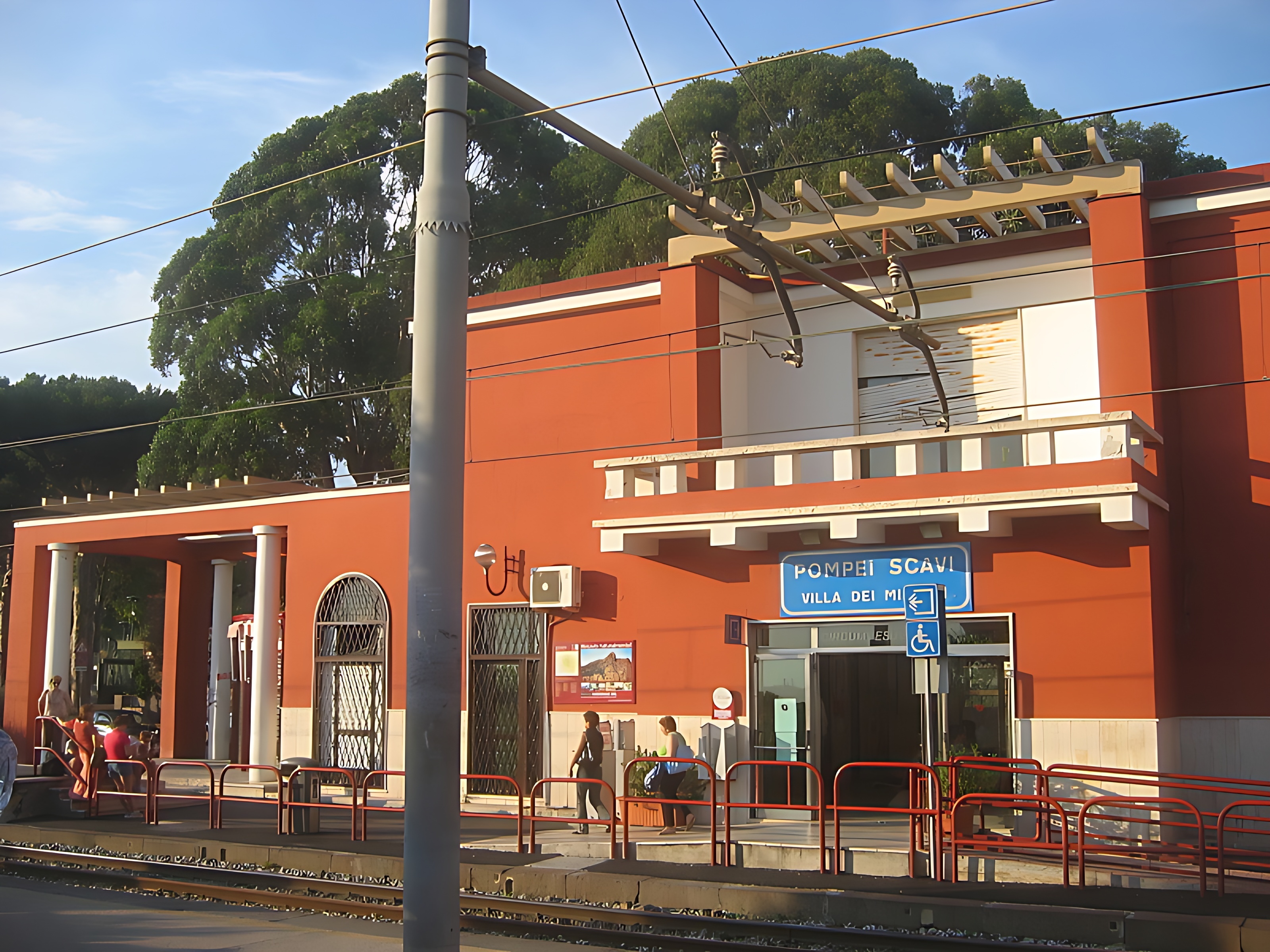
The Pompei Scavi–Villa dei Misteri railway station was designed by engineer and architect Marcello Canino in 1932. Constructed to facilitate access to the ancient Roman archaeological site near the Villa dei Misteri, the station represents Canino’s contribution to public infrastructure design during the interwar period.
Canino’s station projects, including this one at Pompeii along with Sant’Agnello and Castellammare di Stabia, formed a significant portion of his professional practice. The architect drew influence from Gustavo Giovannoni’s theoretical work and the architectural movements developing in Rome during the 1920s and 1930s. His designs for public buildings and transport facilities conveyed clarity of form and rational planning characteristic of the period.
About Marcello Canino
Marcello Canino (1895–1970) was an Italian architect and civil engineer active primarily between the 1920s and 1940s. He served as professor of Architectural Composition at the University of Naples from 1936 to 1965 and as dean of the Faculty of Architecture from 1941 to 1952. His work encompassed villas, public buildings, monuments, and infrastructure projects across Campania and southern Italy.
Details
- Designer: Marcello Canino, engineer and architect
- Year completed: 1932
- Location: Pompeii, near Villa dei Misteri archaeological site, Campania
- Function: Railway station serving the ancient Roman site
- Architectural context: Rationalist design of the Italian interwar period
Frequently asked questions
Who designed the Pompei Scavi station?
Marcello Canino, an Italian engineer and architect active between the 1920s and 1940s, designed the station in 1932.
What was the station’s purpose?
The railway station was built to provide access for visitors traveling to the archaeological excavations of the ancient Roman city of Pompeii and the Villa dei Misteri site.
What architectural movement influenced the design?
Canino’s work reflected the Rationalist principles and urban planning theories of his era, informed by the cultural movements and theoretical studies prominent in Rome during the 1920s and 1930s.