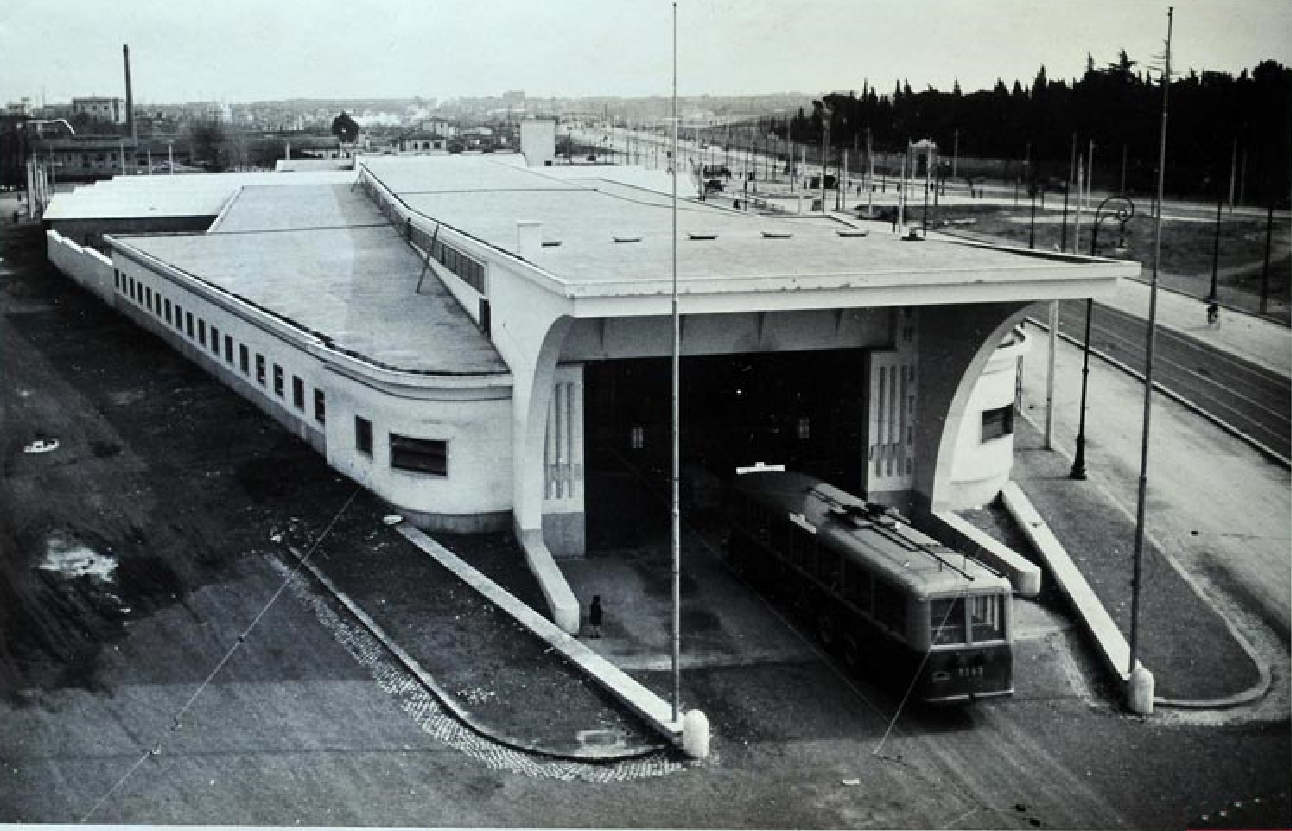
The Filorimessa Atac is a trolleybus depot designed by architect Mario Loreti and completed in Rome in 1937. Built for the city’s public transport operator, the structure represents the functional modernism prevalent in Italian architecture during the interwar years.
Mario Loreti (1898–1968) was a Roman engineer and architect who earned his degree in civil engineering in 1921. Beyond this depot, his extensive practice encompassed residential and institutional commissions across Rome, including the Hotel Mediterraneo on Via Cavour—constructed for the 1942 Universal Exhibition—multiple residential palazzos on Corso Trieste and Via Chiana, and the religious complex of Sant’Orsola in Via Livorno with its school and church, designed in 1936.
About the Building
The Filorimessa Atac serves as a working example of specialized infrastructure design from Rome’s modernization period. Its architectural approach reflects the rationalist principles embraced by Italian architects of the era, balancing utilitarian requirements with contemporary design sensibilities.
Details
- Architect: Mario Loreti
- Year completed: 1937
- Location: Rome, Italy
- Function: Trolleybus (filobus) depot and maintenance facility
- Client: ATAC (Azienda Tramvie e Autobus del Comune di Roma)
Explore more: 509 heritage places in Roma
Frequently asked questions
Who designed the Filorimessa Atac?
The building was designed by Mario Loreti, a Roman architect and engineer who graduated in civil engineering in 1921 and developed an extensive practice in Rome.
What was the building’s original purpose?
The Filorimessa Atac was built as a depot and maintenance facility for Rome’s trolleybus (filobus) fleet operated by the municipal transport authority.
What architectural movement does it represent?
The building exemplifies the functionalist modernism characteristic of Italian interwar architecture, emphasizing practical design adapted to specialized industrial and transport needs.
Sources
- S1 — Ciucci, Giorgio. Gli architetti e il fascismo: architettura e città 1922-1944. Einaudi, 2002. ISBN 978-88-06-16310-5.
- S2 — Nicoloso, Paolo. Mussolini architetto: Propaganda e paesaggio urbano nell'Italia fascista. Einaudi, 2008. ISBN 978-88-06-19086-6.
Spotted an error? Write to editorial@culturalheritageonline.com and we correct it the same day.