
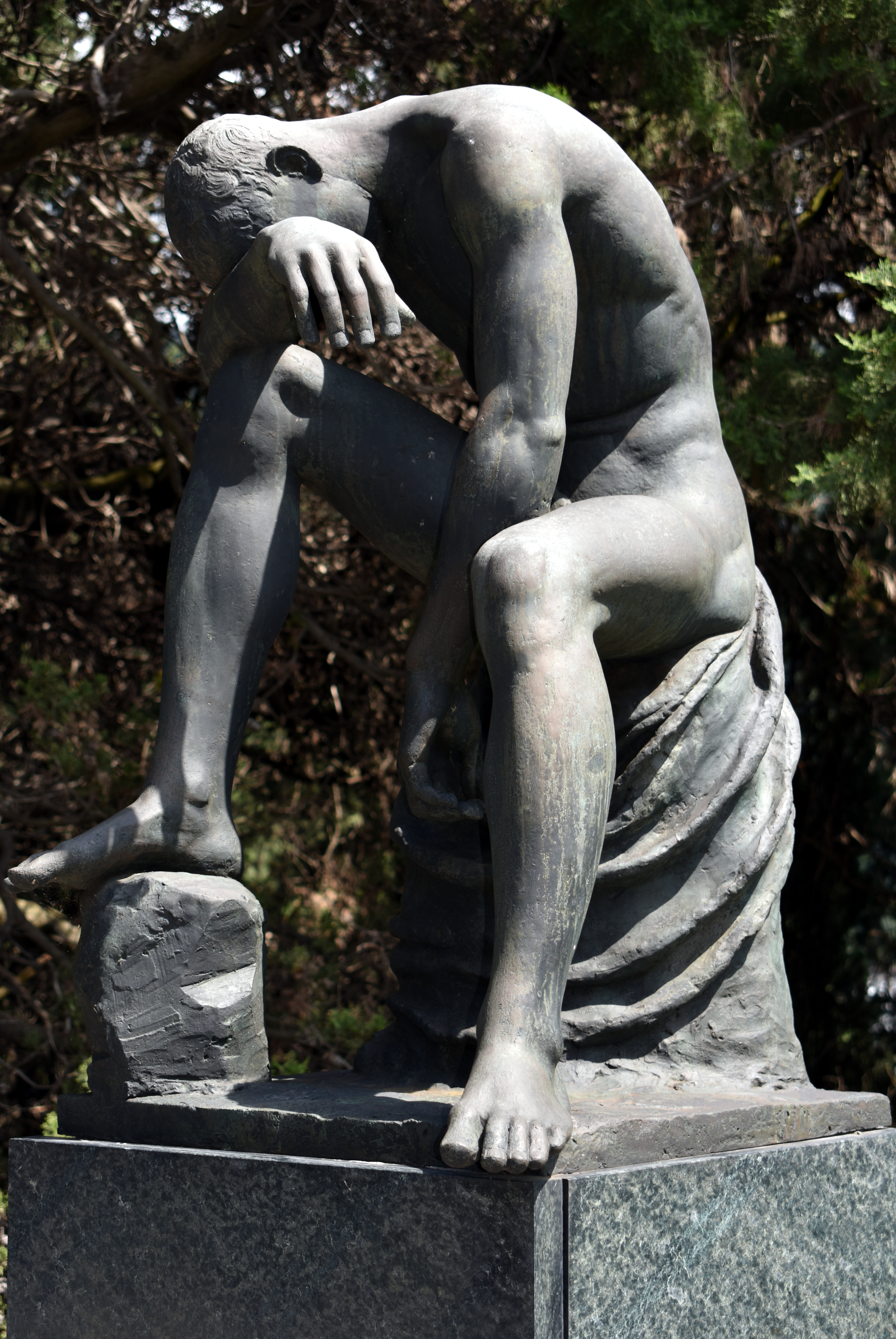
Il custode del Sepolcro is a sculptural work by Italian artist Guido Galletti, created in 1939 and installed at the Germani tomb in Staglieno Cemetery, Genoa.
Galletti (1893–1977) was a prolific sculptor whose work ranged from Symbolism in his early career to increasingly simplified formal approaches influenced by Northern European sculptors including Constantin Meunier and Jacques Lipchitz. His presence on the Italian art scene was substantial: he exhibited regularly at the Venice Biennale from 1930 to 1948 and at the Rome Quadriennale from 1935 to 1959. Internationally, his work was shown in Paris (1925), Barcelona (1929), Vienna (1935), Brussels (1935), and Zurich (1940).
About Guido Galletti
Born in London in 1893 and active primarily in Genoa, Galletti developed a distinctive artistic trajectory spanning several decades. His evolution moved from symbolic and intimate subjects toward formal simplification and the influence of modernist sculptural language. Beyond funerary commissions, he is widely recognised for the Cristo degli abissi (1954), a monumental bronze figure submerged off San Fruttuoso near Camogli, which attracts both pilgrims and divers.
Details
- Creator: Guido Galletti
- Date: 1939
- Location: Germani tomb, Staglieno Cemetery, Genoa
- Medium: Sculpture
- Type: Funerary monument
Frequently asked questions
Who was Guido Galletti?
Guido Galletti (1893–1977) was an Italian sculptor born in London who spent most of his career in Genoa. He exhibited regularly at major Italian exhibitions including the Venice Biennale and Rome Quadriennale, as well as internationally in Paris, Vienna, Brussels, and other European cities.
Where is this sculpture located?
The work is installed at the Germani tomb within Staglieno Cemetery in Genoa, a historic burial ground in Liguria.
What artistic movements influenced Galletti’s work?
Galletti’s sculpture evolved from Symbolism and intimism toward formal simplification, drawing influence from Northern European modernists including Constantin Meunier and Jacques Lipchitz.
Sources
- S1 — Sborgi, Franco. Staglieno e la scultura funeraria ligure tra Ottocento e Novecento. Artema, 1997. ISBN 978-88-8052-009-2.
- S2 — Bossaglia, Rossana. Il Déco italiano: fisionomia dello stile 1925. Rizzoli, 1988. ISBN 978-88-17-24017-8.
Spotted an error? Write to editorial@culturalheritageonline.com and we correct it the same day.


