
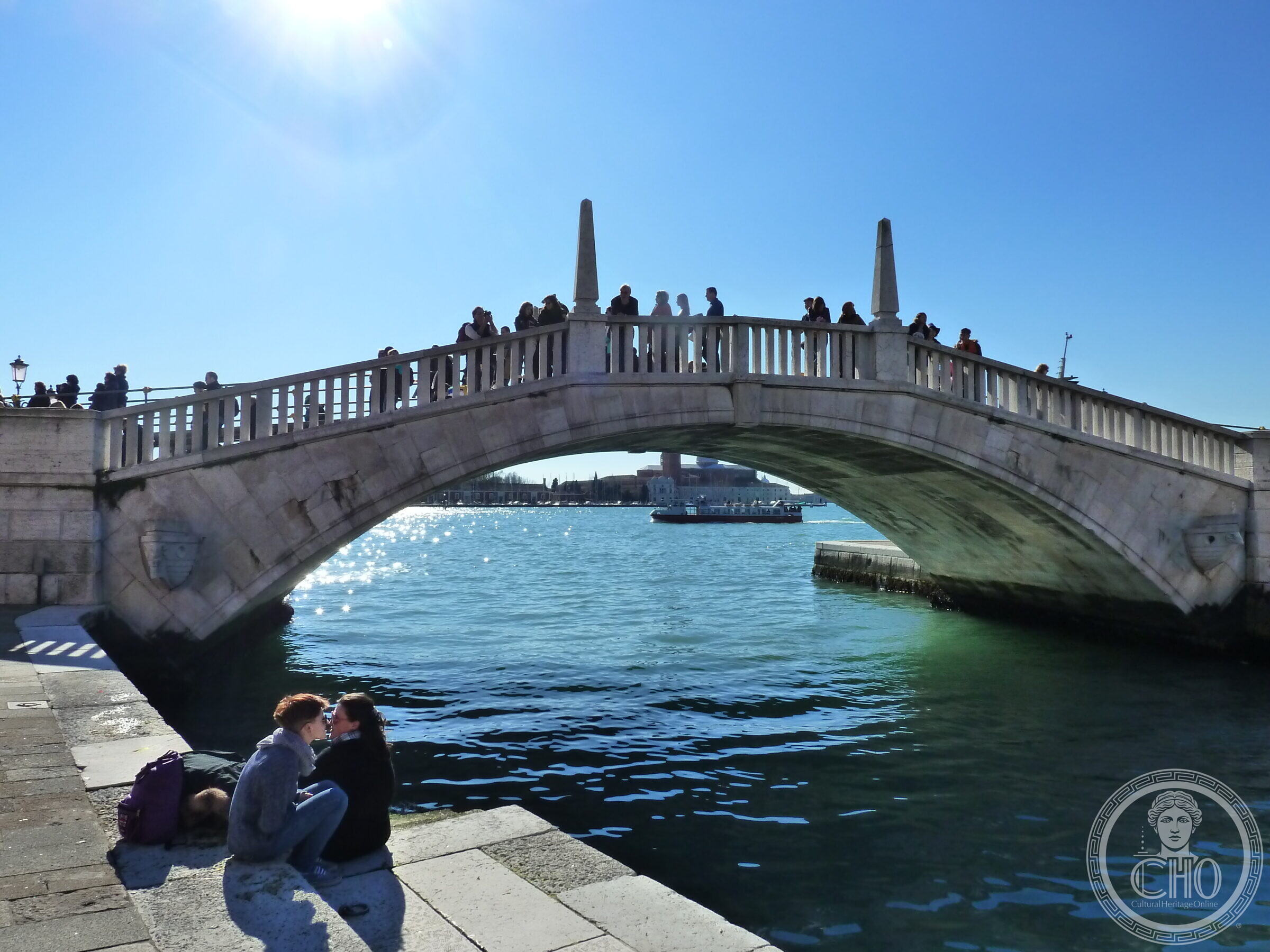
A single arch of Istrian stone thrown across the Arsenal canal in 1936, in place of a revolving iron bridge. On each flank the architect had the prow of an ancient warship carved.
At a glance
The Ponte San Biasio delle Catene carries the waterfront across the mouth of the Rio de l’Arsenal, joining the Riva de la Cà di Dio to the Riva San Biagio. It is also called the Ponte de l’Arsenal, which is why it is easily confused with the wooden bridge in front of the Arsenal gate, three hundred metres upstream. This one is white stone, it springs straight out of the water, and it was built in 1936 — one piece of the largest reshaping of the Venetian waterfront in the twentieth century.
Key facts
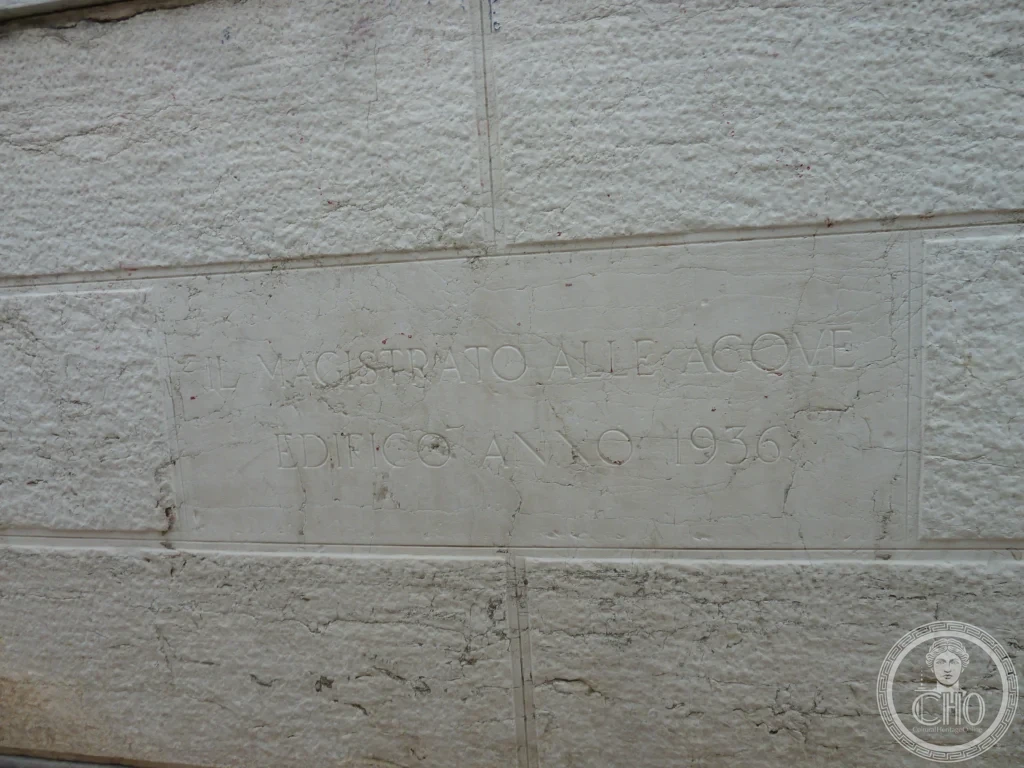
- Built: 1936. A plaque at the foot of the bridge reads MAGISTRATO ALLE ACQUE EDIFICÒ ANNO 1936
- Architect: Duilio Torres (Venice, 1882 – Venice, 1972)
- Sculpture: two trireme prows with their rams, by Angelo Franco (Venice, 1887 – Milan, 1961)
- Structure: brick and stone, faced with Istrian stone, the parapet bands surmounted at the centre by four spires
- It replaced: a nineteenth-century revolving iron bridge
- It spans: the Rio de l’Arsenal, between Riva de la Cà di Dio and Riva San Biagio, Castello
- Also called: Ponte de l’Arsenal, Ponte di San Biagio de le Catene
History
For centuries this stretch of Castello was a working shore: a long line of squeri and boatyards between the Arsenal and the Biennale gardens. In 1933 the city began to clear it and build a monumental quay in its place, 850 metres of it, finished after five years and inaugurated on 23 March 1937. It was named the Riva dell’Impero, after the empire Mussolini had just proclaimed; since the war it has been the Riva dei Sette Martiri.
Duilio Torres took up an idea that went back to the Napoleonic plans for the city and had been put forward again in the master plan of 1886: to carry the Riva dei Giardini on along the canale di San Marco. Two new crossings were needed. In 1936 he built this one in Istrian stone, taking out the revolving iron bridge of the previous century; in 1937 he built the Ponte dei Giardini, also in Istrian stone, with sculpture by Napoleone Martinuzzi.
A bridge removed not because it was ugly or unsafe, but because it no longer did its job well: the iron span had to be swung open for every masted boat. What replaced it is fixed, and high enough not to need opening.
What you see
One arch, rising straight from the water on both banks, faced in the white Istrian stone that Venice has used for its water-line for five hundred years. The parapet is a run of turned balusters; where the bands meet at the crown, four stone spires stand up against the sky, and they are what lets you pick this bridge out from a distance.
The part worth walking down to the water for is on the flanks. Set into each spandrel, just above the springing of the arch, is the prow of a trireme complete with its ram — the horizontal strakes of the hull, and the round eye that ancient ships carried at the bow. They are the work of Angelo Franco, and they are easy to miss from the bridge itself: you have to be on the fondamenta, below, looking up.
The name
San Biasio — San Biagio — is the name of the riva the bridge reaches. Delle catene, of the chains, is older than any of the stone: it recalls the chains that held up the wooden bridge that stood here before, when it was opened to let ships through.
See the place
Getting there
Walk east along the Riva degli Schiavoni from Piazza San Marco, about ten minutes past the Ponte de la Pietà and the Ponte de la Cà di Dio. The nearest stops are Arsenale and San Zaccaria. It is a public crossing, open at all hours; the steps are shallow but there are steps.
Nearby
- Ponte de l’Arsenal o del Paradiso, the wooden bridge at the Arsenal gate.
- Ponte de la Veneta Marina, the next bridge east, where the Riva dei Sette Martiri begins.
- The Venice Arsenal, whose canal this bridge crosses.
- The Bridge of Sighs, fifteen minutes west along the same waterfront.
Sources
- Conoscere Venezia, Ponte de l’Arsenal o San Biagio, sul Rio de l’Arsenal — the 1936 plaque, Duilio Torres as architect, Angelo Franco’s two trireme prows, the four spires, the replacement of the nineteenth-century revolving iron bridge, and the Riva dell’Impero works, citing the Comune di Venezia.
- G. P. Meneghin, I ponti di Venezia — Ponte San Biasio delle Catene — stone, 1936, the earlier iron opening bridge, and the chains of the old wooden bridge (after Rizzo, 1984).
- Treccani, Dizionario Biografico degli Italiani, s.v. Duilio Torres — born Venice 14 August 1882, died Venice 1972; the Riva dell’Impero works of 1936–38 and the bridges over the rio dell’Arsenale and the rio di S. Giuseppe.
- Italian Wikipedia, Riva dei Sette Martiri — the squeri cleared, construction from 1933, the inauguration of 23 March 1937, the length of 850 metres, and the change of name. The article cites the Ministero dei lavori pubblici, La nuova «Riva dell’Impero» a Venezia, Annali dei lavori pubblici, XV/6, June 1937.
- Italian Wikipedia, s.v. Angelo Franco — Venice 1887 – Milan 1961.
- OpenStreetMap — coordinates.
Gallery
Find it on the map
See this place and what’s around it →Record researched and written by Stefano Vigolo for Cultural Heritage Online, 2026.
📷 Become a Cultural Heritage Online photographer
Share your photos of places: they stay published under your name as the author. The more they're seen, the more you get noticed — and soon a contest will reward the most appreciated photos.
Log in or sign up free to add a photoRequest to use these images
Each photograph is by the person named on it. Cultural Heritage Online is the seller: it runs the payment, handles tax and delivers the file, and the photographer receives 70% of the price net of tax. Buying gives you the right to use the image in your own project — a website, an article, a presentation — with the file and a written licence. Read the Terms of Sale.
What you receive. The file as it is held in our archive: the photographer's own original, without the Cultural Heritage Online watermark, unretouched and not enlarged. This is a working archive built over many years by many people, so the files differ — some were taken recently, others years ago with the equipment of their time. Older pictures are usually smaller: a camera from fifteen or twenty years ago simply recorded fewer pixels than a phone does today, so the resolution is lower and the print comes out smaller. We say so rather than hide it. The size, weight, format and year of each one are printed below it, and the print size is given at 300 dpi. Nothing is upscaled to make a number look better. Where the picture on this page has been cropped for the layout, the file you receive is the full frame, which may be wider or taller than what you see here.
Ponte San Biasio delle Catene
Photo: Stefano Vigolo
€3.00
4000 × 3000 px · JPG · 4.8 MB
prints 34 × 25 cm at 300 dpi · taken 2014
Ponte San Biasio delle Catene
Photo: Stefano Vigolo
€3.00
4000 × 3000 px · JPG · 3.5 MB
prints 34 × 25 cm at 300 dpi · taken 2011