
A lyric drama woven with comedy: noh and kyōgen performers have refined this theatrical tradition for centuries, combining masked actors, poetic language, and precise gesture to explore the human condition.
In UNESCO’s words
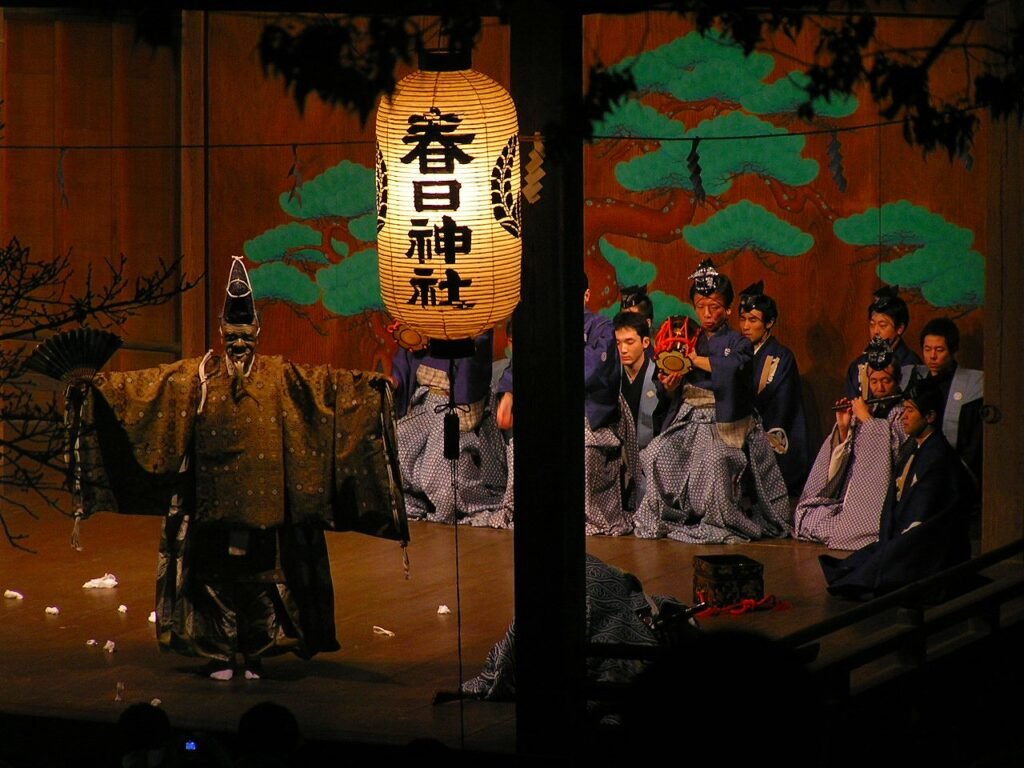
Nôgaku theatre had its heyday in the fourteenth and fifteenth centuries, but actually originated in the eighth century when the Sangaku was transmitted from China to Japan. At the time, the term Sangaku referred to various types of performance featuring acrobats, song and dance as well as comic sketches. Its subsequent adaption to Japanese society led to its assimilation of other traditional art forms. Today, Nôgaku is the principal form of Japanese theatre and has influenced the puppet theatre as well as Kabuki. Often based on tales from traditional literature, Nôgaku theatre integrates masks, costumes and various props in a dance-based performance. Moreover, this theatre requires highly trained actors and musicians. Nôgaku encompasses two types of theatre: Noh and Kyôgen, which are performed in the same space. The stage projects into the audience and is linked by a walkway to a “hall of mirrors” backstage. In Noh, emotions are represented by stylised conventional gestures. The hero is often a supernatural being who takes on human form to narrate a story. The distinctive masks for which Noh is renowned are used for the roles of ghosts, women, children and old people. Kyôgen, on the other hand, relies less on the use of masks and is derived from the humorous plays of the Sangaku, as reflected in its comic dialogue. The text is written in ancient language and vividly describes the ordinary people of the twelfth to sixteenth centuries. In 1957 the Japanese Government designated Nôgaku as an Important Intangible Cultural Property, which affords a degree of legal protection to the tradition as well as its most accomplished practitioners. The National Noh Theatre was founded in 1983 and stages regular performances. It also organizes courses to train actors in the leading roles of the Nôgaku.
Official description, UNESCO Intangible Cultural Heritage List — Nôgaku theatre
At a glance
Nôgaku is the principal form of Japanese theatre, comprising two complementary types: Noh and Kyôgen, performed in the same space. Noh is a dance-based performance that integrates masks, costumes and props to tell stories often drawn from traditional literature, with emotions conveyed through stylised conventional gestures. Kyôgen, derived from the humorous plays of ancient Sangaku, uses comic dialogue and relies less on masks. Both require highly trained actors and musicians.
Origins & history
Nôgaku originated in the eighth century when Sangaku—a Chinese performance tradition featuring acrobats, song, dance and comic sketches—was transmitted to Japan. Through adaptation to Japanese society, Sangaku assimilated other traditional art forms and evolved into Nôgaku, which reached its height in the fourteenth and fifteenth centuries. The form has since influenced puppet theatre and Kabuki.
The practice
Noh performances feature actors wearing distinctive masks for roles such as ghosts, women, children and old people. The stage projects into the audience and connects via a walkway to a backstage area called the hall of mirrors. In Noh, the hero is often a supernatural being taking human form to narrate a story. Kyôgen performers speak comic dialogue written in ancient language that vividly describes ordinary people from the twelfth to sixteenth centuries.
Cultural significance
In 1957, the Japanese Government designated Nôgaku as an Important Intangible Cultural Property, providing legal protection to the tradition and its most accomplished practitioners. The National Noh Theatre, founded in 1983, stages regular performances and organizes courses to train actors in leading roles, ensuring the continuation of this classical art form.
Key facts
- Country: Japan
- Inscribed: 2008
- UNESCO list: Representative List of the Intangible Cultural Heritage of Humanity
- UNESCO reference: 00012
- UNESCO vocabulary: Masks; Theatre; Vocal music
- Map: not shown — UNESCO’s official description of this element names no locality, and a living tradition is practised across a community, not at one address.
Where to experience it
Nôgaku theatre remains a living tradition in Japan, with the National Noh Theatre offering regular performances and training courses for actors seeking to master the demanding roles. Visitors can witness both Noh and Kyôgen performances, where highly trained actors and musicians bring to life stories drawn from traditional literature through stylised gestures, distinctive masks, and elaborate costumes. The tradition continues to be performed and taught by accomplished practitioners, ensuring that this principal form of Japanese theatre—which has influenced puppet theatre and Kabuki—passes to new generations of performers.
Sources & resources
- UNESCO — official element page: Nôgaku theatre
- UNESCO — open data record: Intangible Heritage List, reference 00012
- UNESCO — official video: UNESCO film on this element — embedded on this page
- UNESCO — official photograph: Nôgaku plays vividly depict supernatural beings and ordinary people centuries ago, distinguished through various masks used for the roles of ghosts, heroes, men and women, children and old people. The principal form of Japanese theatre, Nôgaku has influenced puppet theatre as well as Kabuki. — National Noh Theatre
- Reference — Wikipedia (secondary): N%C5%8Dgaku — consulted as a secondary reference, not as confirmation
- Cultural Heritage Online: Our archive and city guides

Sources
- S1 — Keene, Donald. Nō and Bunraku: Two Forms of Japanese Theatre. Columbia University Press, 1990. ISBN 978-0-231-07418-6.
- S2 — Rath, Eric C. The Ethos of Noh: Actors and Their Art. Harvard University Asia Center, 2004. ISBN 978-0-674-01397-1.
Spotted an error? Write to editorial@culturalheritageonline.com and we correct it the same day.