
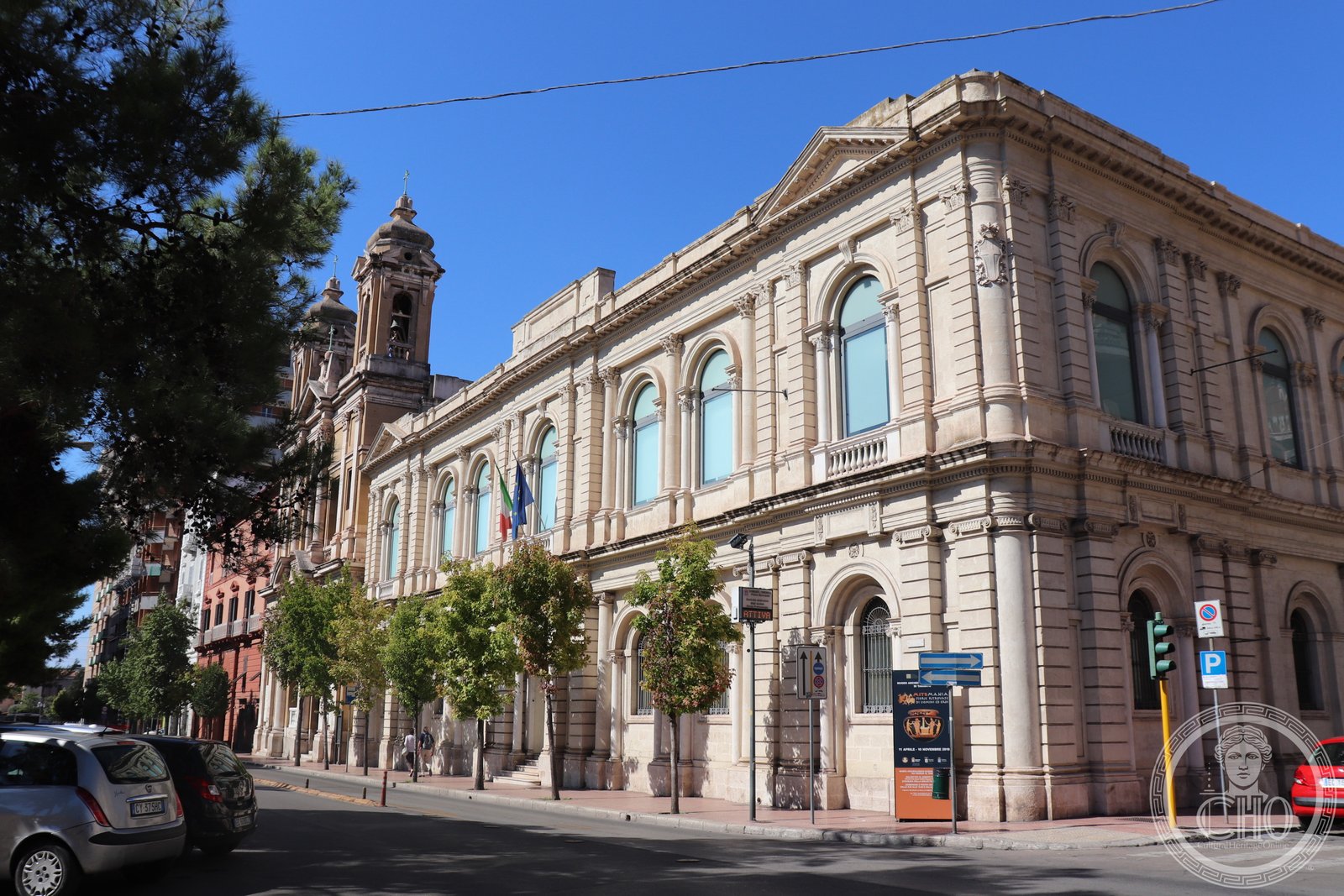
One of Italy’s most significant repositories of Magna Graecia antiquities, housing artifacts spanning from the Paleolithic era through the Greco-Roman period across three floors of scholarly arrangement and expanding collections.
At a glance
MArTA holds one of the largest collections of material culture from ancient Magna Graecia. Operated by the Ministry for Cultural Heritage and Activities as an institute with special autonomy since 2014, the museum occupies the former 18th-century Convent of San Pasquale di Baylon. Its galleries chronicle the archaeology of Taranto and the broader Puglia region through carefully arranged finds and interpretive displays.
History
Founded in 1887, the museum was established on the conviction that Taranto’s archaeological heritage warranted dedicated institutional stewardship. Archaeologist Luigi Viola envisioned it as a Museum of Magna Graecia, though its scope expanded to document the full archaeological record of Taranto and Puglia.
Closed in the early 1960s for major renovation, the museum reopened on 4 April 1963 with President Antonio Segni in attendance. Following another closure from 2000 onwards for restoration, partial exhibitions were mounted at Palazzo Pantaleo. The museum fully reopened to the public on 20 December 2007 after comprehensive renovation and expansion, with the prehistoric gallery added in summer 2016.
What you see
The mezzanine level hosts temporary exhibitions and conference facilities. The first floor presents the Greco-Roman section, focusing on the society and material life of ancient Taranto. The second floor, inaugurated in 2016, contains the prehistoric collection spanning the Paleolithic and Bronze Age periods across the Apulian territory.
Cultural significance
MArTA preserves the archaeological continuum of southern Italy from earliest human settlement through classical antiquity. Its collection of Magna Graecia artifacts—pottery, metalwork, sculpture, and decorative objects—illuminates the sophistication and trade networks of Greek colonies in the region. The museum serves as essential documentation of how ancient Taranto functioned as a major Mediterranean power.
Key facts
- Address: Via Cavour, 10, 74100 Taranto
- Coordinates: 40.47338330157915, 17.23854124546051
- Phone: 099 4532112
- Website: https://museotaranto.beniculturali.it/it/
- Status: Ministry-operated museum with special autonomy
Practical information
Opening hours and current admission details are available on the official website. The museum is located in central Taranto and is accessible by public transport. Guided visits and educational programs may be arranged; contact the museum directly for information on group tours or special exhibitions.
Getting there
MArTA is situated at Via Cavour, 10 in Taranto’s city center. The site is served by local bus routes and is within walking distance of Taranto’s historic districts. Limited parking is available nearby; check current conditions before visiting.
See the place
Sources & resources
Find it on the map
See this place and what’s around it →Historical events at this place (1)
📷 Become a Cultural Heritage Online photographer
Share your photos of places: they stay published under your name as the author. The more they're seen, the more you get noticed — and soon a contest will reward the most appreciated photos.
Log in or sign up free to add a photoIs this page about you?
This page is read by travellers and heritage enthusiasts who find it on Google. Tell us how you are connected to this place and we will take it from there.