

A 6.2 kilometre route links five Art Deco landmarks built between 1929 and 1930, from a black and gold tower to a lakeside planetarium.

A route through the city’s Deco decade
Chicago’s Art Deco monuments do not form a museum district. They sit among older commercial blocks and later office towers, built in a burst between 1929 and 1930 when the city’s architects applied modern geometry and new materials to skyscrapers, trading halls and civic buildings. The route described here covers 6.2 kilometres and takes about 200 minutes on foot. It follows five stops, each a landmark of the period and still in use.
What distinguishes Chicago’s Deco from that of New York or Miami is its commercial scale. These are not small facades; they are whole city blocks, a 37-storey tower, a 44-storey exchange building, a 45-storey office block over an opera house. The ornament is carved stone, terracotta and bronze, not painted plaster. The dates are tight: every building on this walk opened between May 1930 and November 1930, designed as the economy collapsed.
Carbide & Carbon Building
The Carbide & Carbon Building stands at 230 North Michigan Avenue, a 37-storey high-rise built in 1929. It was designed by the Burnham Brothers — Daniel Burnham Jr. and Hubert Burnham, sons of the planner of Chicago — for the Union Carbide and Carbon Corporation. The tower is clad in polished black granite at the base rising into dark green and gold terracotta, capped with gold leaf. A popular legend holds that the green-and-gold scheme evokes a champagne bottle wrapped in gold foil; the architects left no record confirming it.
Converted to a hotel in 2004, the building remains one of the city’s most recognisable Deco landmarks. From the street it presents a base of black granite and bronze framing the entrance, then a shaft of deep green terracotta running the full height, then a crown finished in 24-carat gold leaf that catches the sun above Michigan Avenue. Stylised chevrons and metalwork ornament the facade, which was cleaned after decades of city soot to recover its colour.
Merchandise Mart
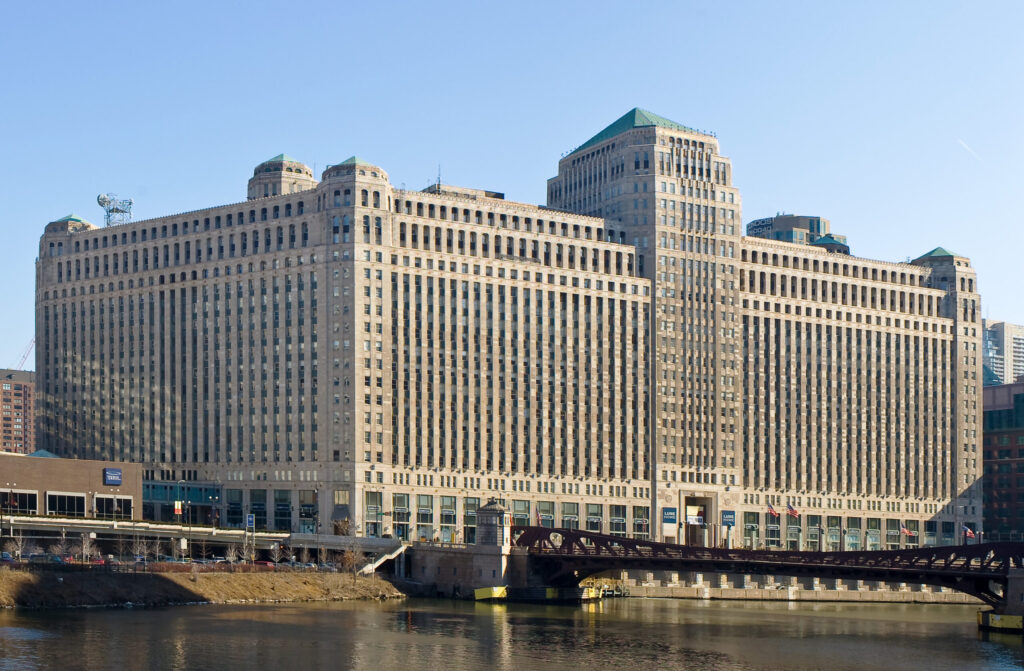
The Merchandise Mart occupies an entire city block along the Chicago River, its eighteen-storey base crowned by a twenty-five-storey central tower reaching 340 feet. With 6.2 million square feet of floor space following a 1977 expansion, it long functioned as the city’s wholesale trade nerve centre. Today the building operates as a mixed-use commercial complex known as theMART, concentrating contract furniture showrooms, technology firms, television studios, retail outlets, and event spaces under one roof.
Construction began on 16 August 1928, driven by Marshall Field & Company’s ambition to bring thirteen scattered wholesale warehouses under a single roof. The building opened on 5 May 1930, briefly holding the record as the world’s largest structure by floor area until the Pentagon was completed in 1943. In 1945 the Kennedy family purchased the building, retaining ownership until 1998 when Vornado Realty Trust acquired it for 550 million dollars. The exterior presents ribbon piers of light-coloured limestone rising vertically through the facade, the restrained geometry of American Art Deco at its most self-confident.
Civic Opera Building
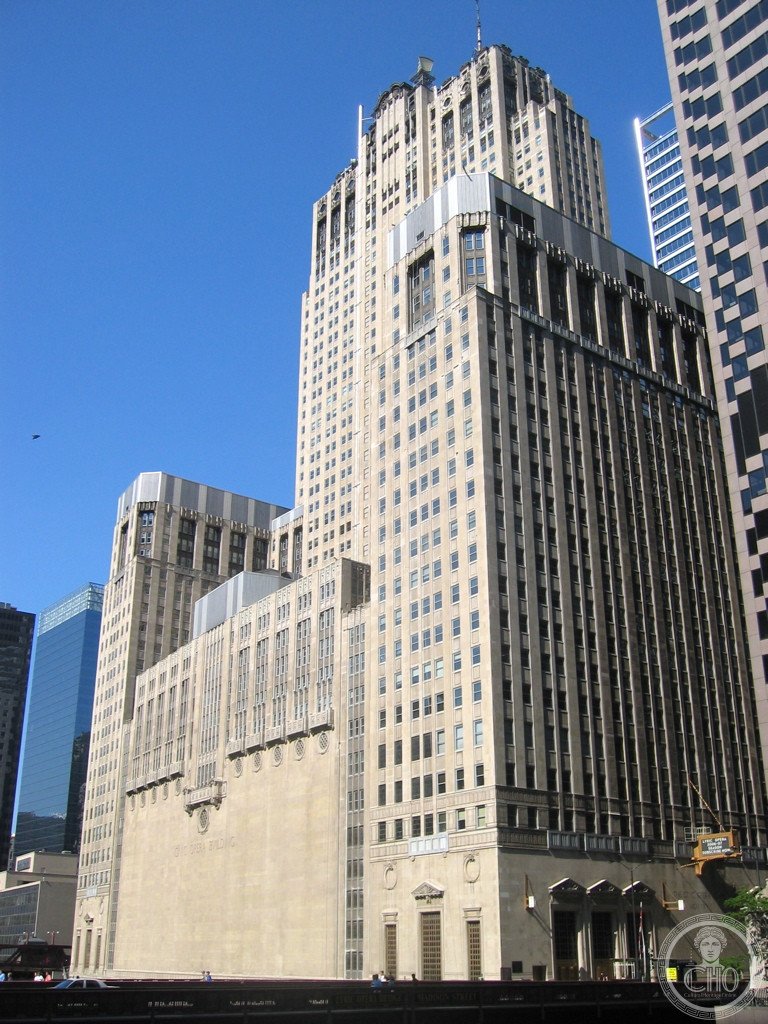
The Civic Opera Building at 20 North Wacker Drive was completed in 1929 for Samuel Insull, the Chicago utilities magnate. Designed by Graham, Anderson, Probst & White, it combines an approximately 3,500-seat opera house at its base with a 45-storey office tower rising above. The office rents were intended to support the opera’s operating costs. Insull’s holding companies collapsed in 1932, but the building survived his fall and today houses the Lyric Opera of Chicago in a hall that remains the second-largest opera auditorium in North America.
Construction began in 1928 and the building opened in November 1929, weeks after the stock market crash. Insull had arrived in Chicago in 1892 as Thomas Edison’s former secretary and built a utilities empire across the Midwest. The solution he and his architects devised was commercially ingenious: build the opera house as the base and auditorium of a major office tower, so that office rents would cross-subsidise performance costs indefinitely.

Chicago Board of Trade Building
The Chicago Board of Trade Building rises 44 storeys, about 605 feet, at the foot of the LaSalle Street canyon in the Loop. Built in 1930 to designs by Holabird & Root, it was the tallest building in Chicago until 1965 and remains one of the city’s defining Art Deco skyscrapers. It was raised for the Chicago Board of Trade, the grain and commodities exchange that has occupied the site since 1885, and it still functions as a trading and office building.
The building steps back as it rises, narrowing to a pyramidal cap. The limestone front is carved with stylised figures, and a great clock flanked by hooded statues dominates the entrance. At its summit stands a 31-foot aluminium statue of Ceres, the Roman goddess of agriculture. The Board of Trade has stood at the foot of LaSalle Street since 1885, when a building by William W. Boyington occupied the site and was for a decade the tallest in Chicago. That structure was demolished in 1929, and Holabird & Root’s replacement was completed in 1930.
Adler Planetarium
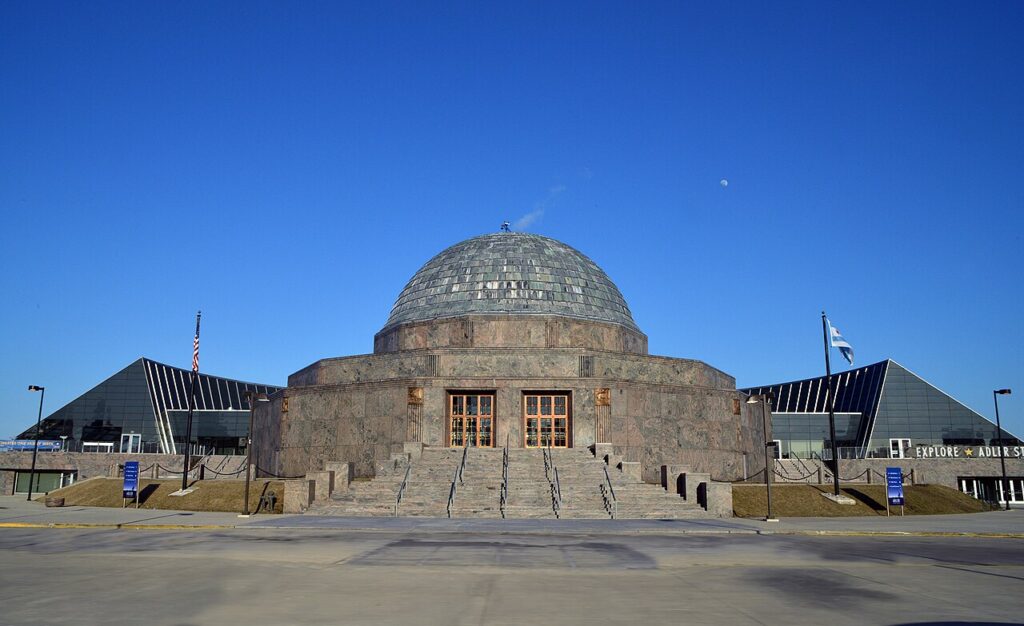
The Adler Planetarium opened in May 1930 as the western hemisphere’s first planetarium, a gift from Max Adler. Architect Ernest Grunsfeld Jr. designed a twelve-sided drum of rainbow granite stepped to a dome, with bronze zodiac plaques by Alfonso Iannelli marking the corners. It sits on the lakefill point of Northerly Island, a peninsula that now stages the skyline’s most photographed sweep. The planetarium steps have become a vantage point for viewing the city.
Iannelli’s bronze signs and the constellations on the bronze doors carry the building’s astronomical program. The 1991 glass underground wing preserved the original silhouette. The Adler is public astronomy’s American cradle and a National Historic Landmark, deco civic architecture on the lakeside. Today it is open daily, with rotating sky shows in the domed theatre. Wednesday evenings offer free admission for Illinois residents, and the museum campus walk closes at dusk with the steps facing the skyline.
Walking the route
The full walk is 6.2 kilometres and takes about 200 minutes. The stops run in this order: Carbide & Carbon Building on North Michigan Avenue, Merchandise Mart at 222 Merchandise Mart Plaza, Civic Opera Building at 20 North Wacker Drive, Chicago Board of Trade Building on LaSalle Street, and Adler Planetarium on Northerly Island. The first four cluster in the Loop and near the river; the planetarium extends the route to the lakefront.
All five buildings are open to the public in some form, though access varies. The Merchandise Mart operates as a commercial complex with showrooms; the Civic Opera Building hosts performances by the Lyric Opera. The 146 bus serves the planetarium campus from State Street, and lakefront trail cyclists can ride to the door. Walking the route in that order keeps the skyscrapers in a continuous sequence before the open ground of the lakefront.
The full route, with the order of the stops and the distances, is on the Chicago Art Deco: a walk through 1920s and 1930s landmarks page.
Sources
- Carbide & Carbon Building · https://culturalheritageonline.com/places/carbide-carbon-building/
- Merchandise Mart · https://culturalheritageonline.com/places/merchandise-mart/
- Civic Opera Building (1929), Chicago · https://culturalheritageonline.com/places/civic-opera-building-1929-chicago/
- Chicago Board of Trade Building · https://culturalheritageonline.com/places/chicago-board-of-trade-building/
- Adler Planetarium, Chicago · https://culturalheritageonline.com/places/adler-planetarium-chicago/
- Chicago Art Deco: a walk through 1920s and 1930s landmarks · https://culturalheritageonline.com/itineraries/chicago-art-deco-walk/
Spotted an error? Write to the editors and we correct it the same day.
At auction this weekArt Deco glass, lighting and furniture are sold at auction every weekPieces from the 1920s and 1930s are open for bidding today on Catawiki, where an expert checks each lot before it goes live.See what is open on Catawiki →


Advertisement. Pictured, from the Cleveland Museum of Art (CC0) and not for sale: three pieces of Lalique glass, 1920 to 1931. How we handle this