

Trieste, the Lido, Milan, Turin, Florence, Rome, Palermo: 2,217 kilometres of road and seven buildings that show how one style travelled from the Adriatic to Sicily, and what it looked like in each place it landed.
One style, seven different answers
Italian Liberty was never a single school. Between roughly 1895 and 1915 the same vocabulary — the whiplash line, the floral relief, the iron balcony, the polychrome tile — was used in Trieste under the Habsburgs, in the bourgeois blocks of Turin, on a beach hotel in the lagoon and in a Palermo hotel built by a family of tuna merchants. Each city took what it needed from Vienna, Brussels and Paris and bent it to local stone, local craftsmen and local money.
The Grand Tour route gathers seven of those answers. It is not a walk; it is 2,217 kilometres of road and about thirty-five hours of driving, and it works best read as a set of comparisons rather than as a single itinerary to be done in one go.
Trieste, where the Secession arrived by sea
Casa Bartoli faces Piazza della Borsa, in the part of Trieste that was still the Habsburg Empire’s main port when the building went up in 1906. Max Fabiani, born in 1865 near San Daniele del Carso, had trained at the Vienna Polytechnic and worked as an assistant to Otto Wagner before coming back to design here. The result is a corner building with a reinforced-concrete frame — unusual enough in 1906 to be worth mentioning — under a facade of diamond-patterned render, with four stone columns of acanthus leaves running down it and green iron railings on the balconies.
The programme was commercial from the start. The lower three floors held the depot of Antonio Bartoli & Figlio and a row of shops; a glazed winter-garden verandah on the third floor held a kosher restaurant serving the city’s Jewish community; the apartments were above. In the 1930s the original entrance on the left flank was closed and moved to a side wall, with a shop taking the old opening. The building still does roughly what it was built to do.
The Lido, a hotel built for a season
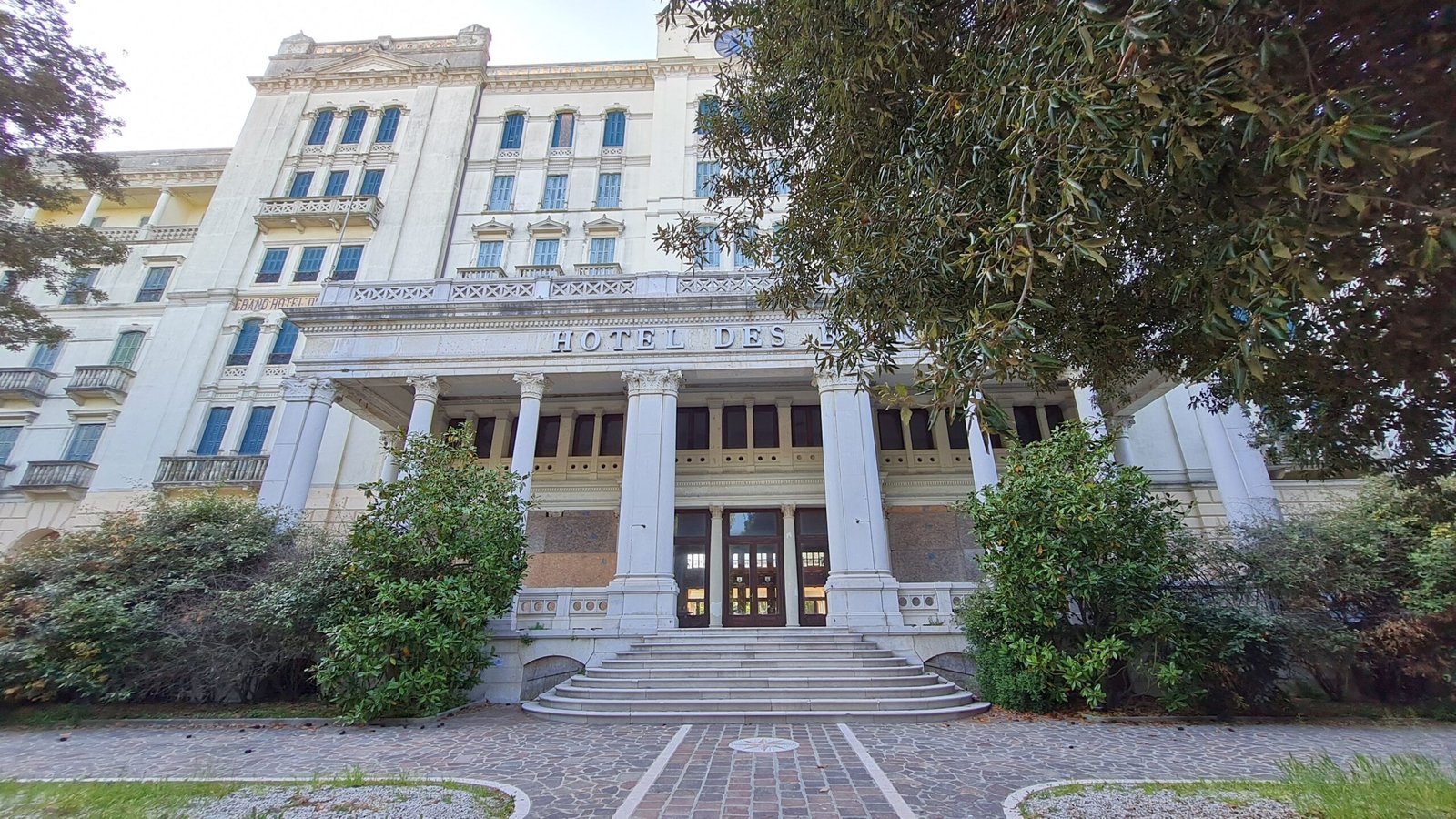
The Grand Hotel des Bains opened at seven in the evening on 5 July 1900, designed by the brothers Raffaello and Francesco Marsich. A six-storey central block, two five-storey wings stepping forward on a raised entrance platform carried by ten columns, a park of mature trees on the landward side: the scale was theatrical on purpose, because the hotel was competing for the European summer season. It had electric light, telephones, hydraulic lifts, private bathrooms and refrigerated storage, which in 1900 was a serious list.
Thomas Mann stayed here in the summer of 1911 and left with the notes that became Death in Venice, published the following year; Luchino Visconti filmed the novella here in 1971. The hotel has been closed since 2010, its conversion into flats interrupted, and a restoration of about two hundred million euros was announced in 2025 with COIMA and Eagle Hills as investors.
Milan and Turin, the argument on the mainland
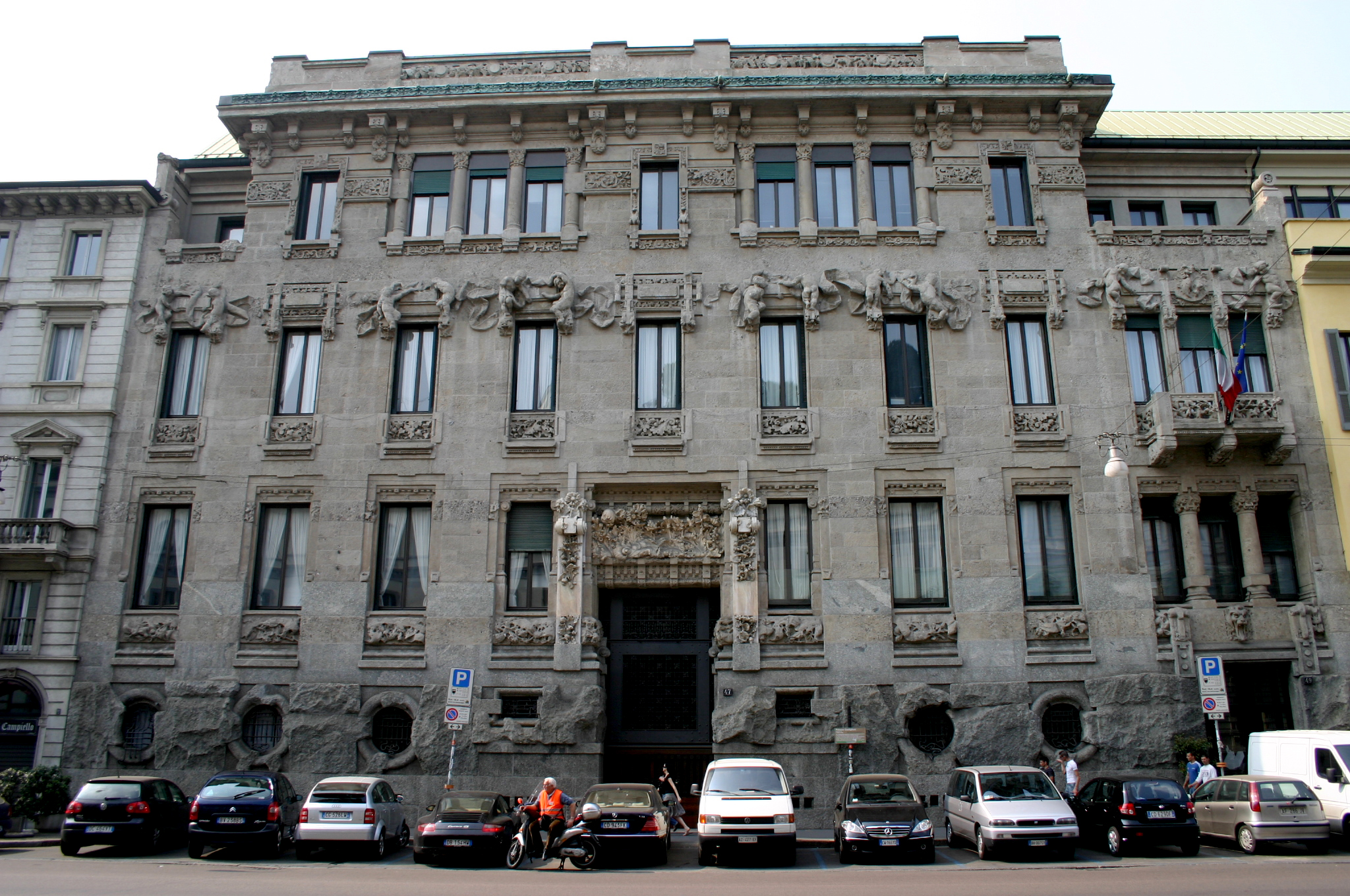
Palazzo Castiglioni is the building that made the Milanese case in public. Sommaruga designed it for the Castiglioni family between 1901 and 1903 and finished it in 1904, on Corso Venezia, with sculpted figures and floral relief running across the whole front as one gesture. The academic establishment called the figures barbaric; the argument was settled in favour of the building, which became the measure for Milanese Liberty for the next twenty years. It came through the bombing of August 1943 and the speculative rebuilding that erased much of bourgeois Milan in the 1960s, and it is now a private residence with offices on the lower floors.
Turin answered with a house rather than a palace. Casa Fenoglio-Lafleur was built in 1902 at the corner of Corso Francia and Via Principi d’Acaja, in Cit Turin, by Pietro Fenoglio, who was thirty-seven and had already designed more than a hundred villas and palazzi in the city. The curved bay window, the polychrome floral panels and the wrought-iron balcony are his signature compressed into one corner. A French entrepreneur named Lafleur bought it shortly after it was finished and lived there until he died, which is where the second half of the name comes from. Cit Turin is still the densest Liberty district in Italy: dozens of named buildings within a few blocks, almost all inhabited, almost none ticketed.

Florence, one facade against the Renaissance
Casa-Galleria Vichi at Borgo Ognissanti 26 is the exception that proves how local the style was. Giovanni Michelazzi graduated in Florence in 1901 and built his career on villas in the outskirts; this tall, narrow front on a Renaissance street, finished around 1911, is the building Luca Quattrocchi’s 1993 monograph calls his masterpiece. Carved stone reliefs and ironwork in floral and vegetal motifs cover it from the ground floor up. In Turin or Milan an Art Nouveau facade competes with others; here it competes with Brunelleschi, and it survived the anti-Liberty backlash of the 1950s and 1960s that took down much of Michelazzi’s other work.
Rome, a quarter built as a stage set
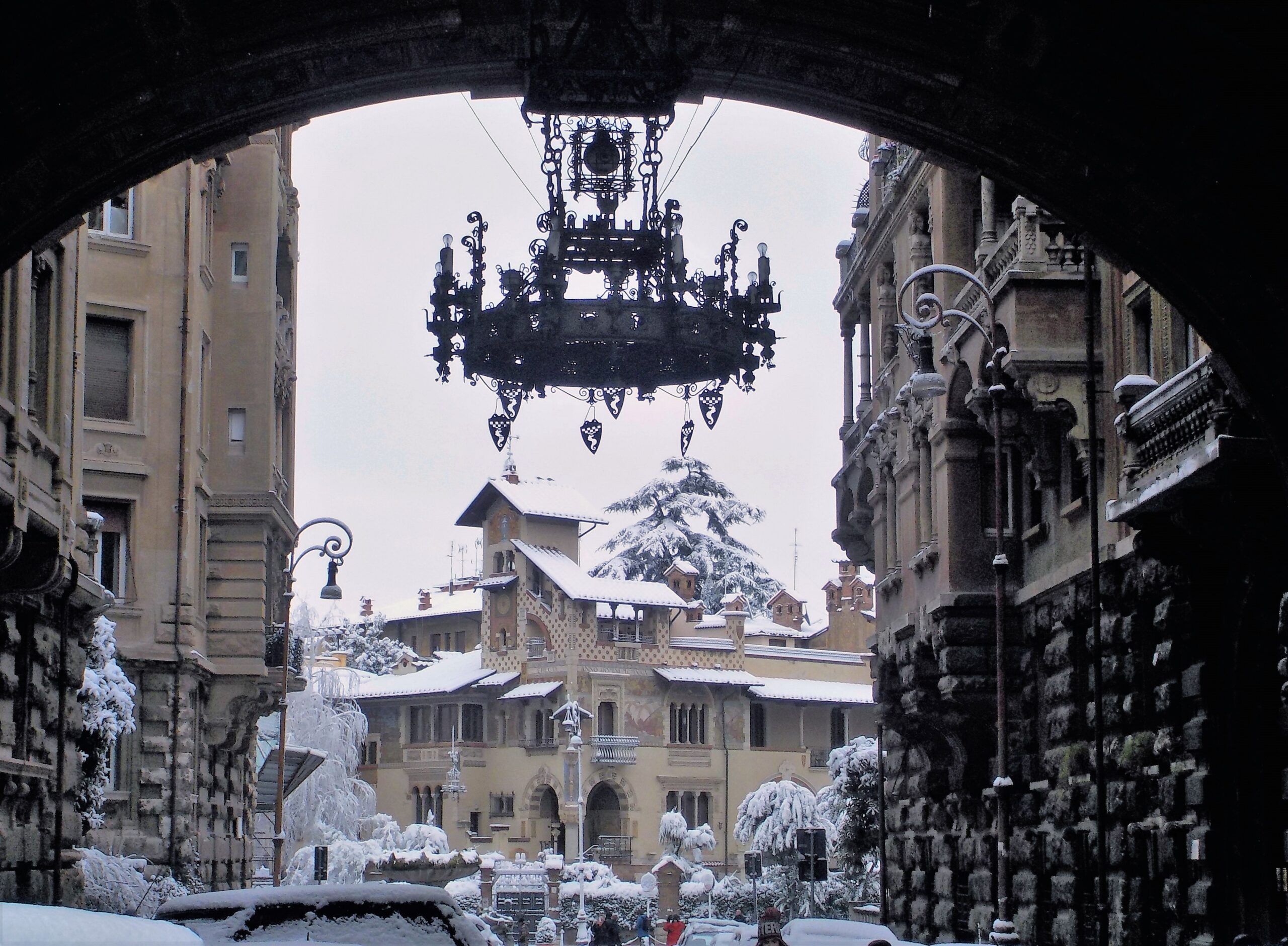
Rome did not do single buildings in this style, it did a whole enclave. The Coppedè District was commissioned in 1915 by the Società Anonima Edilizia Moderna of the Cerruti brothers and designed by the Florentine Gino Coppedè, who had already built Castello Mackenzie in Genoa. You enter from Via Tagliamento through a monumental arch with a wrought-iron chandelier hanging over the street, and the centre is Piazza Mincio, with the Fontana delle Rane of 1924 and its twelve frogs around an upper bowl. Around it are about seventeen palazzine and twenty-six villini: the Palazzo del Ragno with its spider, the Villino delle Fate with frescoes and mosaics drawn from Dante, Petrarch and Florentine civic memory, Liberty ornament laid over medieval revival and quotations from Egyptian, Assyrian and Etruscan decoration.
Coppedè died in September 1927, before the quarter was finished. His workshop and collaborators completed it, with Paolo Emilio André directing the works. It is one of the most photographed corners of Rome and one of the few places in the city where you can walk through a single architect’s imagination for twenty minutes without paying a ticket.
Palermo, the Florios’ hotel
The route ends in Sicily, at Villa Igiea, on the Acquasanta promontory north of Palermo. Ignazio Florio Jr bought the property from a retired British admiral and first thought of turning it into a sanatorium — the name comes from Hygeia, the Greek goddess of health. The family changed its mind and built a grand hotel instead, with Ernesto Basile designing the interiors between 1898 and 1900. The Sala Basile, its dining room, is covered in the Floralia frescoes of Ettore De Maria Bergler, goddesses and garlands and Sicilian flora, with carved woodwork by Vittorio Ducrot’s workshop. The hotel is still a hotel, now run by Rocco Forte.

How to use the route
Seven stops, 2,217 kilometres, about thirty-five hours of driving if you do it in one line. The order on the Italian Liberty Grand Tour page runs north-east to south: Trieste, the Lido, Milan, Turin, Florence, Rome, Palermo. Most of the buildings are exteriors visible from the street; the two hotels are working hotels and the Coppedè quarter is a residential district, so the visiting is done on the pavement, at reasonable hours, without ringing bells. The three northern cities — Milan, Turin and the Lido — can be done in two days by train, which is the practical version of this route for most readers.
Sources
- Casa Bartoli, Trieste · https://culturalheritageonline.com/places/casa-bartoli/
- Grand Hotel des Bains, Lido di Venezia · https://culturalheritageonline.com/places/grand-hotel-des-bains/
- Palazzo Castiglioni, Milano · https://culturalheritageonline.com/places/palazzo-castiglioni-milano/
- Casa Fenoglio-Lafleur, Torino · https://culturalheritageonline.com/places/casa-fenoglio-lafleur-torino/
- Casa-Galleria Vichi, Firenze · https://culturalheritageonline.com/places/casa-galleria-vichi/
- Quartiere Coppedè, Roma · https://culturalheritageonline.com/places/quartiere-coppede-roma/
- Villa Igiea, Palermo · https://culturalheritageonline.com/places/villa-igiea/
- Italian Liberty — The Grand Tour · https://culturalheritageonline.com/itineraries/liberty-grand-tour/
Spotted an error? Write to [email protected] and we correct it the same day.


