

The last great wing of the Habsburg palace, planned for the imperial family and finished a decade before the monarchy ended. It never became a residence. Since 1928 it has housed Vienna’s ethnographic museum, today the Weltmuseum Wien.
At a glance
The Corps de Logis is the square block at the Ringstraße end of the Neue Burg, the curved wing of the Hofburg that closes the Heldenplatz. It belongs to the “Imperial Forum” that Gottfried Semper and Carl von Hasenauer designed for the Hofburg from 1869, a vast plan of which only part was built. The wing went up between 1881 and 1907, and its glass-roofed arcaded courtyard was completed in 1909 to plans by Friedrich Ohmann. Meant for representative imperial rooms, it filled instead with collections, and in 1928 the Museum für Völkerkunde opened here. Renamed Weltmuseum Wien in 2013, the museum reopened after a full redesign in 2017.
Key facts
- Where: Neue Burg, Hofburg, Heldenplatz, 1010 Vienna (Innere Stadt), Austria
- Protection: listed monument of the Bundesdenkmalamt (object ID 50462), “Museum für Völkerkunde (heute Weltmuseum Wien)”
- Design: part of the Imperial Forum plans of Gottfried Semper and Carl von Hasenauer
- Built: 1881–1907; arcaded courtyard completed by 1909 (Friedrich Ohmann)
- Size: a roughly square, four-storey block about 70 metres on each side
- Façade sculpture: statues by Edmund Hellmer, Carl Kundmann and Viktor Tilgner, among others
- Museum here since: 1928 (Museum für Völkerkunde; Weltmuseum Wien since 2013)
- Coordinates: 48.205144, 16.36335 · open in Google Maps
History
By the middle of the nineteenth century the Hofburg was too small for the court. It lacked large apartments for state guests and for the emperor’s children once they had households of their own. Semper and Hasenauer’s answer, drawn up between 1869 and 1871, was the Imperial Forum: two great curved wings facing each other across the Heldenplatz, a throne-room wing between them, and triumphal arches over the Ringstraße linking the palace to the two new court museums. Only the museums and one wing, the Neue Burg, were built. Construction of the Neue Burg began in 1879 and was completed only after the First World War.
The Corps de Logis, the block where the Neue Burg turns towards the Ringstraße, went up between 1881 and 1907. According to the Weltmuseum, it was originally intended to hold representative rooms of the imperial family. Instead it became the first part of the Neue Burg to be used for collections. The Fideikommiss library, the private library of the imperial house, moved into its ground floor in 1901–1903; then came the objects Archduke Franz Ferdinand had brought back from his journey around the world, and from 1908 his Este art collection.
After the First World War the Natural History Museum, short of space, moved its ethnographic department here, where it was merged with Franz Ferdinand’s collections. The Museum für Völkerkunde opened in the Corps de Logis in 1928. Its holdings go back much further: the museum dates the start of the imperial ethnographic collections to objects from James Cook’s voyages bought at auction in London in 1806, and the oldest pieces, including the Mexican feather headdress, were already in the Habsburg collection at Ambras Castle in the sixteenth century. The museum joined the Kunsthistorisches Museum group in 2001, took the name Weltmuseum Wien in 2013, and reopened on 25 October 2017 after a redesign by Ralph Appelbaum Associates and Gareth Hoskins Architects.
What you see
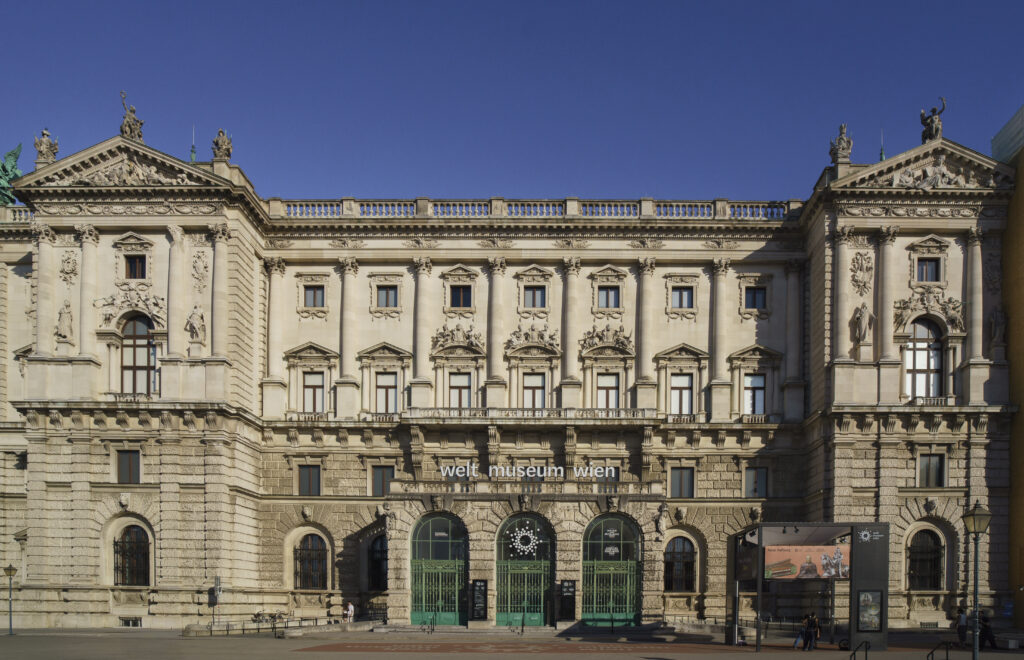
The photograph shows the front of the Corps de Logis in full sun. The lower zone is heavy rusticated stone, with round-arched windows behind iron grilles. At its centre three tall arched doorways with green iron gates form the museum entrance, and above them the words “welt museum wien” are set in small lower-case letters across the stone.
Above the base the facade changes character. Corinthian pilasters run through the upper floors, and between them the windows carry small pediments and carved decoration. The two ends of the front step forward as pavilions, each crowned by a triangular pediment filled with relief figures and topped by statues; a balustrade runs along the roofline between them. The heritage listing identifies the statues as allegories of civic virtues, answered by reliefs of the virtues of rulers in the pediments. Inside, out of sight in this view, is the arcaded courtyard, framed by Serlian arches on Tuscan columns below and Ionic columns in the mezzanine.
Practical information
- The Weltmuseum Wien is open to visitors; check the museum’s website for current hours, exhibitions and tickets.
- The permanent exhibition occupies fourteen rooms on the mezzanine of the Corps de Logis.
- The Corps de Logis and the Neue Burg also house the Kunsthistorisches Museum’s arms and armour collection and a reading room of the Austrian National Library.
- The exterior can be seen from the Heldenplatz and the Burggarten side at any time.
Getting there
The Hofburg is in the centre of Vienna, on the Ringstraße. Trams on the Ring stop at Burgring, a short walk away. The nearest underground station is Volkstheater (line U3), a few minutes’ walk across the Ring. From Stephansplatz the walk through the old town takes about fifteen minutes.
Nearby
- The Heldenplatz and the Äußeres Burgtor, the palace gate onto the Ringstraße, directly in front of the Neue Burg.
- The Imperial Treasury in the Swiss Wing of the Hofburg, about 200 metres away.
- The Imperial Apartments and Sisi Museum in the older parts of the Hofburg.
- The Natural History Museum across the Ringstraße, the court museum where the ethnographic collections were kept before 1928.
Sources
- Bundesdenkmalamt, list of protected monuments in Vienna, Innere Stadt (as published in the Denkmalliste for Innere Stadt, E–He): object 50462, the Corps de Logis with the Weltmuseum, description of the facade, statues and arcaded courtyard; the Neue Burg entry, begun 1879 and completed after the First World War.
- Wien Geschichte Wiki, “Corps de Logis” and “Neue Burg”, City of Vienna: construction 1881–1907, Ohmann’s courtyard, the Fideikommiss library, the 1928 museum, the Imperial Forum plans.
- Wien Geschichte Wiki, “Weltmuseum Wien”: the 1876 origins at the Natural History Museum, the 2001, 2013 and 2017 dates, the redesign architects.
- Weltmuseum Wien, “History of the museum”: the 1806 Cook purchase, the original purpose of the Corps de Logis, the 1928 opening, the 2013 renaming.
Find it on the map
See this place and what’s around it →📷 Become a Cultural Heritage Online photographer
Share your photos of places: they stay published under your name as the author. The more they're seen, the more you get noticed — and soon a contest will reward the most appreciated photos.
Log in or sign up free to add a photoIs this page about you?
This page is read by travellers and heritage enthusiasts who find it on Google. Tell us how you are connected to this place and we will take it from there.