
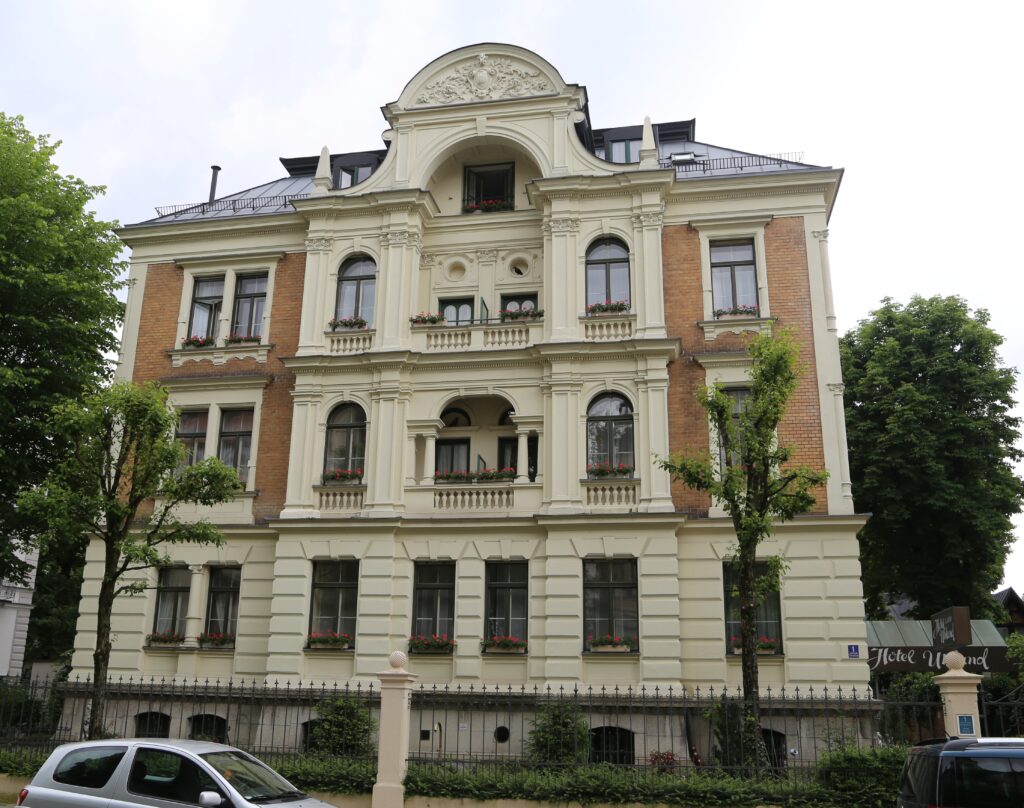

One of three houses that the architect Franz Kil built in the same year at the top of Uhlandstraße, on the edge of the Oktoberfest meadow. The Bavarian monument list calls it richly articulated Neo-Renaissance; since 1955 it has been the Hotel Uhland.
At a glance
Uhlandstraße is a short residential street in the Ludwigsvorstadt, running down towards the Bavariaring and the Theresienwiese. Its first houses went up at the end of the 1880s, when this part of Munich was being built over with apartment houses and villas for the middle class. Number 1 was designed in 1889 by Franz Kil, who in the same year built the paired houses at numbers 3 and 5 across the way. It is entered in the Bavarian list of monuments under the number D-1-62-000-7083, described as Neurenaissance, reich gegliedert. The house became a hotel in 1955.
Key facts
- Where: Uhlandstraße 1, 80336 Munich (Ludwigsvorstadt)
- Architect: Franz Kil
- Built: 1889
- Style: Neo-Renaissance
- Protection: Baudenkmal, Bavarian monument list no. D-1-62-000-7083
- Current use: Hotel Uhland, founded in the building in 1955, according to the hotel
- Coordinates: 48.134130, 11.555029 · open in Google Maps
History
In the 1880s the land between the old city and the Theresienwiese, the meadow where the Oktoberfest has been held since 1810, filled up with new streets. Uhlandstraße, named after the poet Ludwig Uhland, was one of them. Its houses were built within a few years of each other and several of them survive: the monument list records Kil’s numbers 1, 3 and 5, all dated 1889; number 2, a German Renaissance house of 1896 by Wilhelm Spannagel; and number 7, a free-standing house in the forms of late Baroque palace architecture by August Thiersch, of about 1891. Together they still form a group of listed late nineteenth-century houses at the head of the street.
Of Franz Kil himself we have found little beyond these entries; the list credits him with all three 1889 houses at the head of the street. According to the hotel, the house was turned into a hotel in 1955. The hotel also reports that the facade received a Munich facade award, and that the house has won a special prize in the city’s balcony-flower competition every year since 2004; we have not found either independently confirmed.
What you see
The front is symmetrical and built around a strong central bay. The ground floor is all in cream-painted rustication, with broad bands and a row of rectangular windows. Above it the two outer bays are faced in warm orange-brown brick, framed by cream stucco strips and plain window surrounds, while the centre is entirely in cream stucco. There, round-arched windows sit between pilasters, balconies with stone balusters run across the first and second floors, and the middle of the second floor opens into a small arched loggia supported on slender columns.
The central bay climbs past the eaves into a tall gable with a deep round-headed niche and a window at its back, crowned by a curved pediment filled with carved scrollwork around a small cartouche. Pointed finials stand at its shoulders. Behind, a mansard-like roof carries dormers. In the photograph every window has a box of red geraniums. The house stands back from the pavement behind an iron fence on a low stone wall, with stone gate posts topped by balls; the hotel sign is at the right-hand corner.
Practical information
- The house is a working hotel; the facade is fully visible from Uhlandstraße.
- Walk the whole street: numbers 3, 5 and 7 opposite are listed too, and number 7 by August Thiersch faces the Bavariaring.
- During the Oktoberfest (late September to early October) the area is very crowded.
Getting there
The nearest U-Bahn station is Theresienwiese (U4/U5), about five minutes on foot. Munich Hauptbahnhof is about fifteen minutes’ walk to the north-east, and the old town around Marienplatz about twenty-five.
Nearby
- St Paul’s Church, whose neo-Gothic tower rises over the north end of the Theresienwiese.
- The Theresienwiese, at the end of the street.
- The Bavaria statue and the Ruhmeshalle on the terrace above the west side of the meadow.
Sources
- Bayerisches Landesamt für Denkmalpflege, Denkmalliste München: entry D-1-62-000-7083, Hotel Uhland, Neurenaissance, reich gegliedert, 1889 von Franz Kil, and the neighbouring entries for Uhlandstraße 2, 3, 5 and 7, as transcribed in Wikipedia (de), Liste der Baudenkmäler in der Ludwigsvorstadt. The entry can be checked in the Bayerischer Denkmal-Atlas.
- Hotel Uhland, official site: 1889, Franz Kil, listed status, hotel founded 1955, the facade award and the flower-competition prizes (the hotel’s own account).
- OpenStreetMap / Nominatim: position returned as Hotel Uhland, 1, Uhlandstraße, Ludwigsvorstadt, München.
- We found only these sources for the building; the monument list is the one independent of the owner.
Find it on the map
See this place and what’s around it →📷 Become a Cultural Heritage Online photographer
Share your photos of places: they stay published under your name as the author. The more they're seen, the more you get noticed — and soon a contest will reward the most appreciated photos.
Log in or sign up free to add a photoIs this page about you?
This page is read by travellers and heritage enthusiasts who find it on Google. Tell us how you are connected to this place and we will take it from there.