In 1924, in the artisan enclave of Geneva, Swiss visionary Arnold Schweitzer acquired the historic Fabrique Genevoise de Crayons. Rebranding the manufacture as Caran d’Ache—in tribute to famed French political satirist Emmanuel Poiré, who drew under the Russian pseudonym for pencil (*karandash*)—Schweitzer forged a world-renowned temple of fine writing instruments, inventing the clutch pencil and the water-soluble wax pastel to revolutionize the fine arts.
The Geneva Manufacture: From Cedar Wood to the Fixpencil
Geneva’s heritage of precision watchmaking and artisanal goldsmithing provided the ideal technological soil for fine stationery. In 1924, investor Arnold Schweitzer consolidated local pencil-making ateliers along the River Arve, determined to elevate utilitarian graphite into a luxury art form. In 1929, Caran d’Ache patent-engineered a monumental mechanical innovation: the Fixpencil, the world’s very first clutch pencil featuring a patented collet mechanism that held interchangeable leads securely without wooden sharpening.
Shortly thereafter, in 1931, the maison introduced Prismalo, the world’s first water-soluble colored pencils, immediately adopted by fine artists, botanical illustrators, and architects across Europe. By uniting mineral pigment chemistry with Swiss mechanical tolerances, Caran d’Ache transformed drawing from a static sketch into a fluid, watercolor-like medium.
The Ecridor Guilloché and the Thônex Ateliers
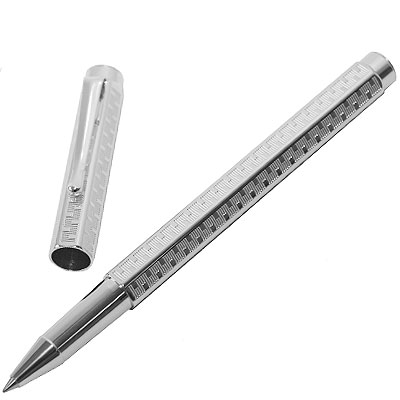
In 1947, Caran d’Ache unveiled its definitive ballpoint masterpiece: the Ecridor. Crafted with an unmistakable hexagonal brass barrel, finished in rhodium, silver, or gold, and engraved with intricate guilloché patterns inspired by classic Swiss horology, the Ecridor became a permanent fixture of international diplomacy, architecture, and luxury design.
Operating from its expansive manufacturing ateliers in Thônex on the outskirts of Geneva, Caran d’Ache remains one of the rare independent family-owned Swiss manufactures. As it celebrates a century of unbroken artistry, every pencil and gold pen nib continues to embody the immaculate standards of Geneva craftsmanship.
Caratteristico artigianato dell'intaglio e disegno d'arte
Immagini d'archivio storico dell'Istituto Luce che celebrano la minuzia artigianale, la dedizione al dettaglio e la precisione del lavoro manuale applicato alle arti visive. (Fonte: Archivio Storico Istituto Luce Cinecittà)
Interactive 360° Heritage View: Caran d'Ache Historic Manufacture & Geneva Ateliers
Historical Location: Chemin du Foron 19, 1226 Thônex, Geneva, Switzerland (Coordinates: 46.195, 6.208)