
The city marks its own Art Nouveau route with red medallions set into the pavement. Follow them and you notice something the ticket queues hide: most of Barcelona’s Modernisme is a doorway, a balcony rail or a bench, and almost all of it is free.
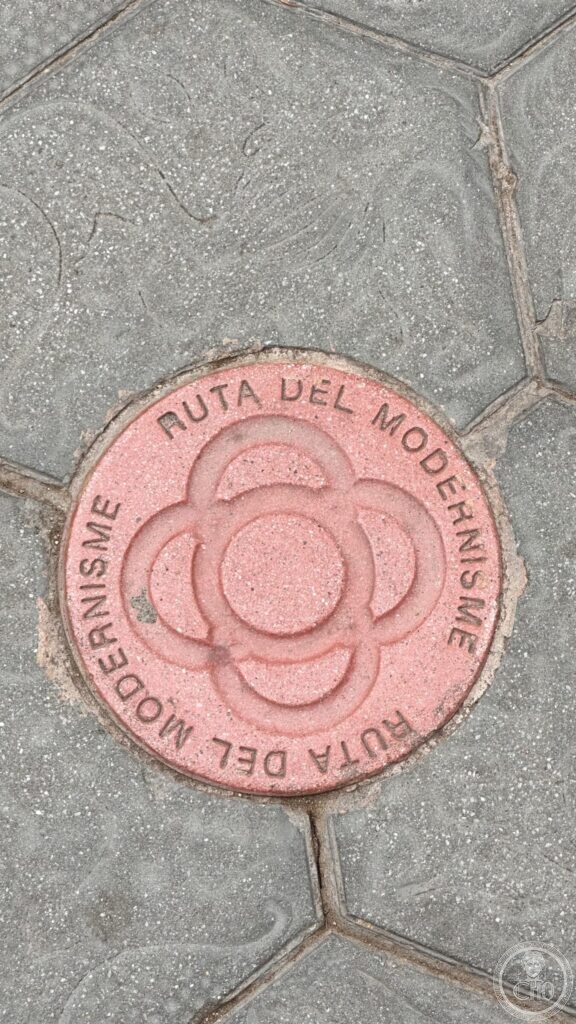
Look down on Passeig de Gràcia and you will find a red disc the size of a saucer let into the grey paving, stamped with a flower and the words RUTA DEL MODERNISME. There are a lot of them. They belong to the route the city runs through its own Art Nouveau, and they are worth following for a reason that has nothing to do with the guidebook you can buy at the end of it.
The route takes in the thirty principal works — Gaudí, Domènech i Montaner, Puig i Cadafalch, the names on every postcard. But its own description gives away the more interesting half: alongside the great houses it lists pharmacies, shops, lamps and benches. Everyday work. And everyday work is what fills the pavement between the famous addresses, unticketed, unqueued, and mostly unphotographed except by people who have looked up.
An architecture of entrances
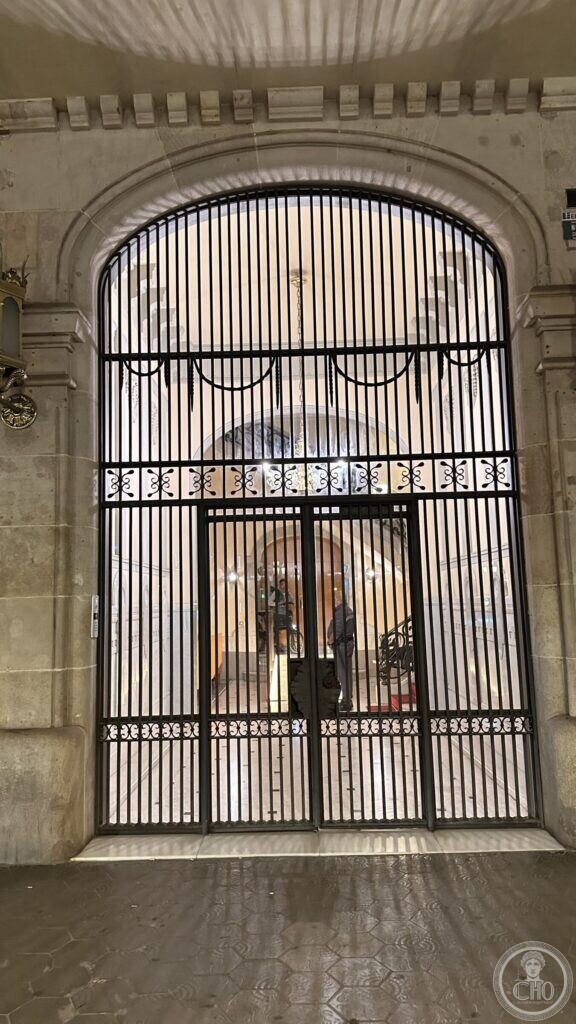
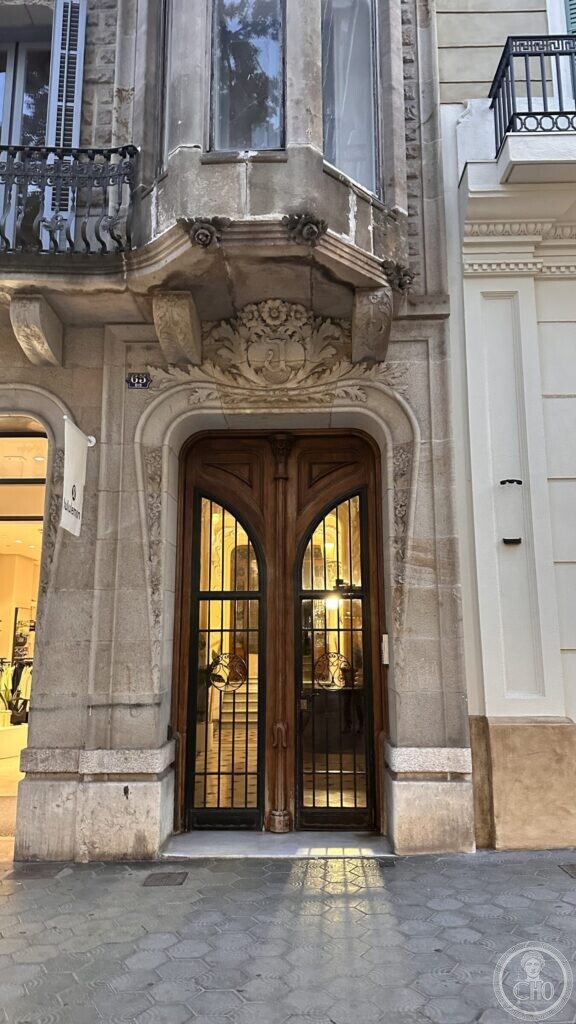
Barcelona’s Modernisme was applied, overwhelmingly, to ordinary apartment blocks for ordinary landlords. That constrains what an architect can do. The plan is fixed by the block, the height by the ordinance, the shopfront by the tenant. What is left is the front door, the balcony rails, the bay window, and the band of ornament under the cornice — and that is exactly where the invention went.
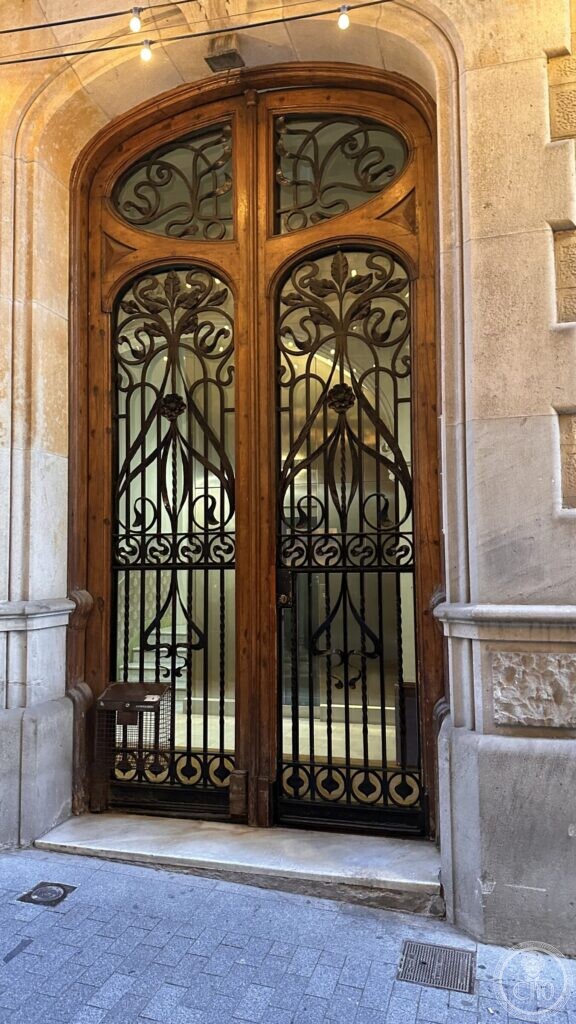
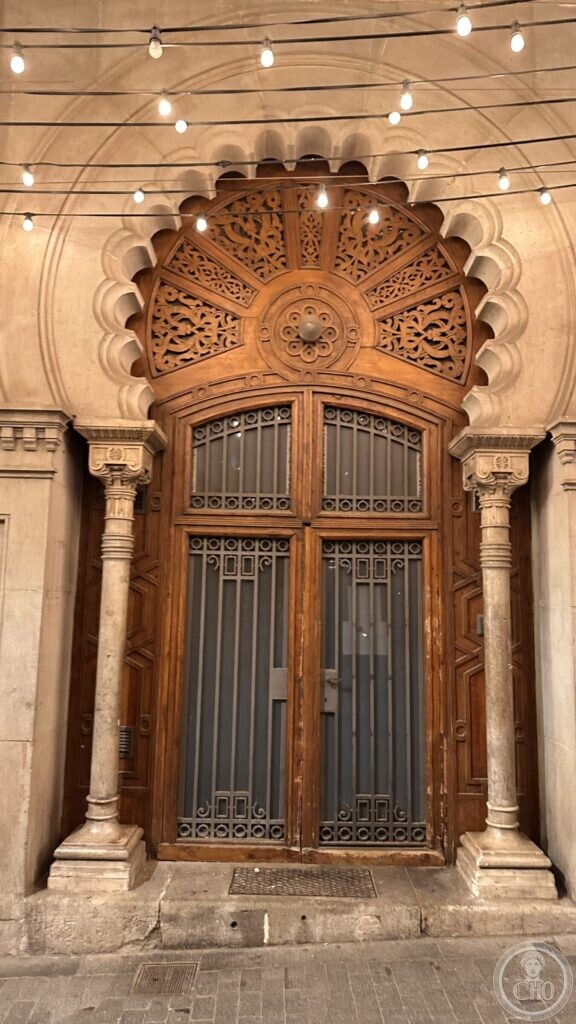
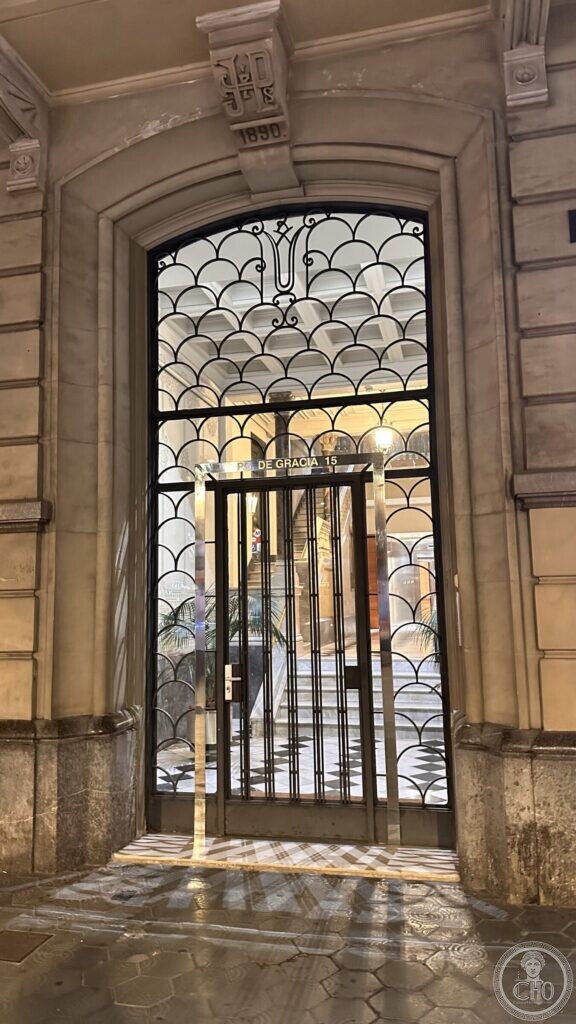
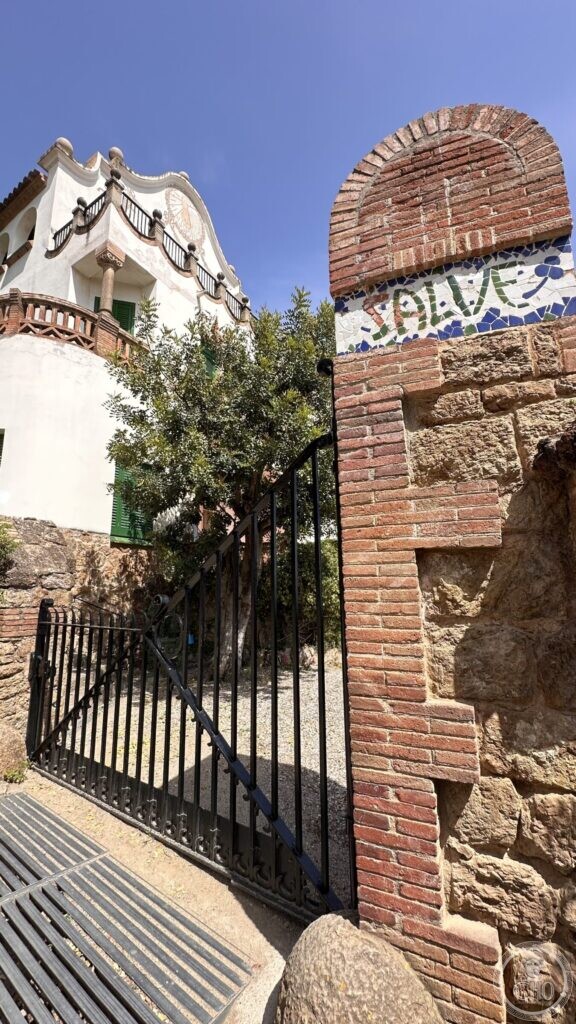
So the street reads as a catalogue of entrances. One door has its grilles drawn as stems with buds at the ends. Forty metres on, a polylobed arch and a carved wooden fanlight take the same building type somewhere else entirely, into the Moorish revival that ran alongside Modernisme and fed it. At number 15 the keystone is dated 1890, a decade early, with the owner’s monogram cut into it: the appetite for a grand entrance was there before the style arrived to satisfy it.
The bay window as the one luxury
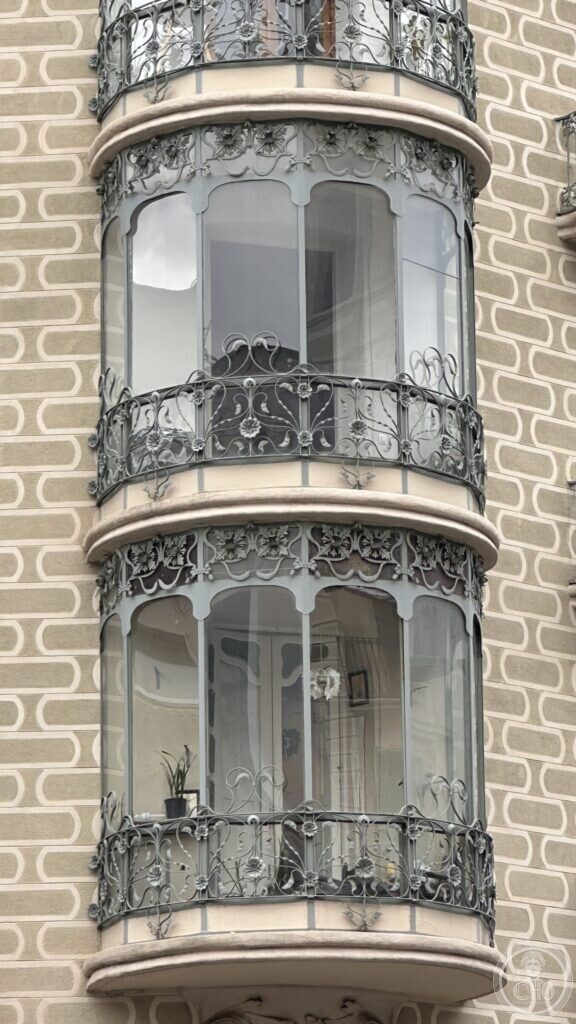
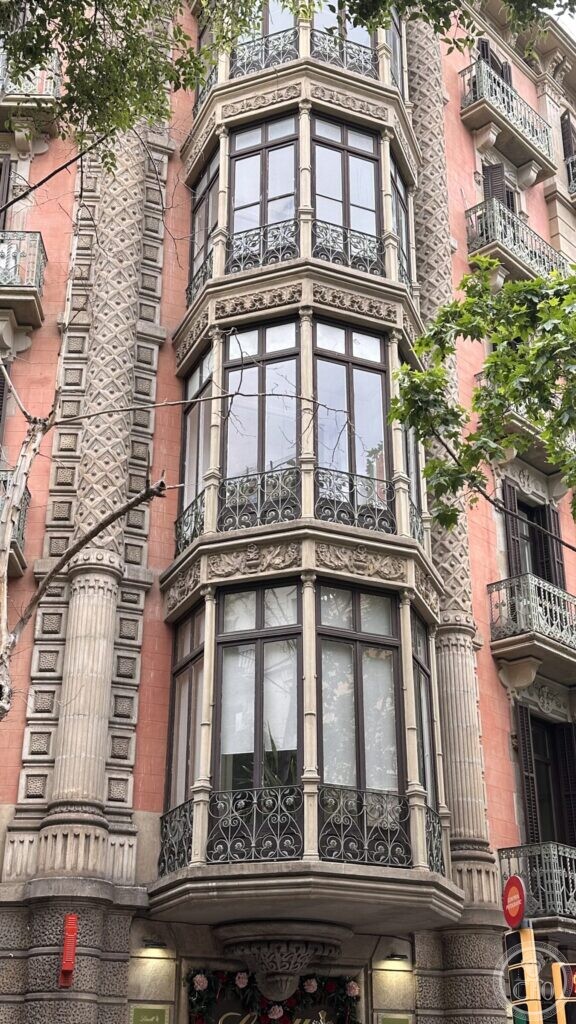
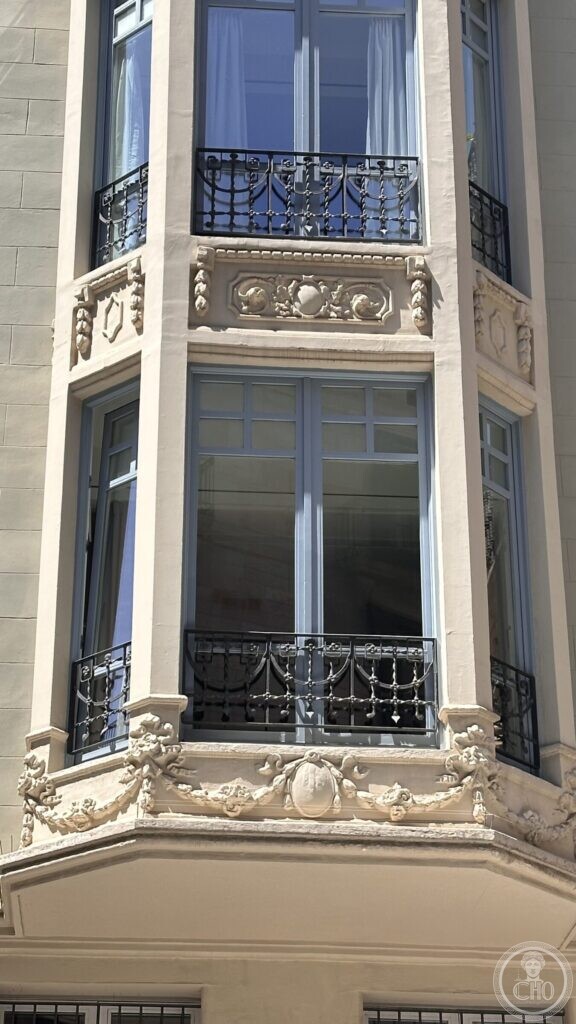
The other place the money went is the tribuna: the glazed bay window that hangs off the front of the flat and gives it a room of light over the street. On Rambla de Catalunya they are rounded and set against walls combed with sgraffito; a block further, one runs three storeys up the corner of a pink façade, its rails worked into flowers. In the old city, at Carrer de Cucurulla 1–3, a front barely wider than the bay carries five floors of it, one above another, like a stack of lanterns.
None of these buildings is on anybody’s list. They are addresses, with post boxes and bicycles in the hall. They are also, collectively, the thing itself — the reason Barcelona looks like Barcelona and not like any other city that built a nineteenth-century extension on a grid.
Two famous doors, and a bench
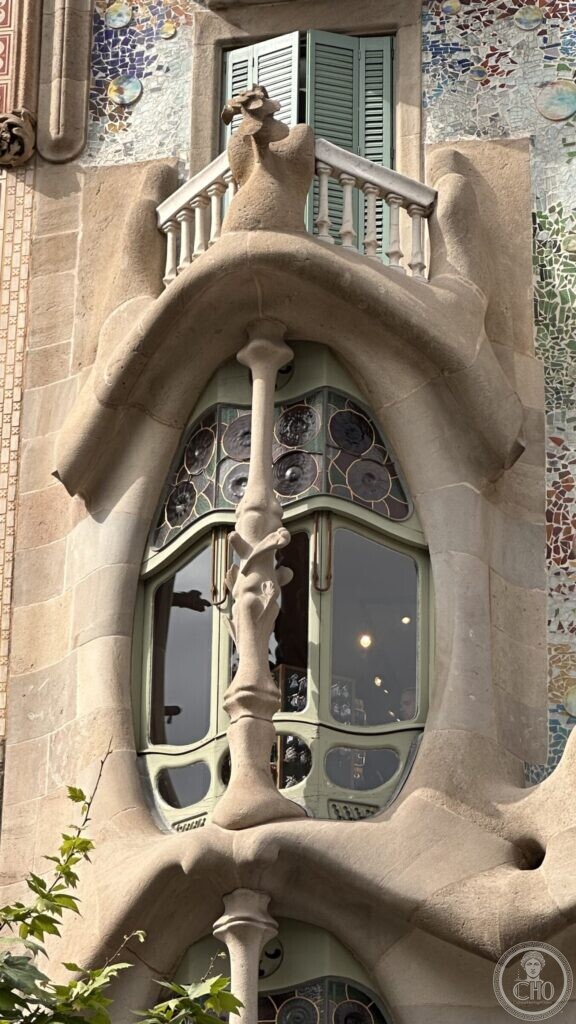
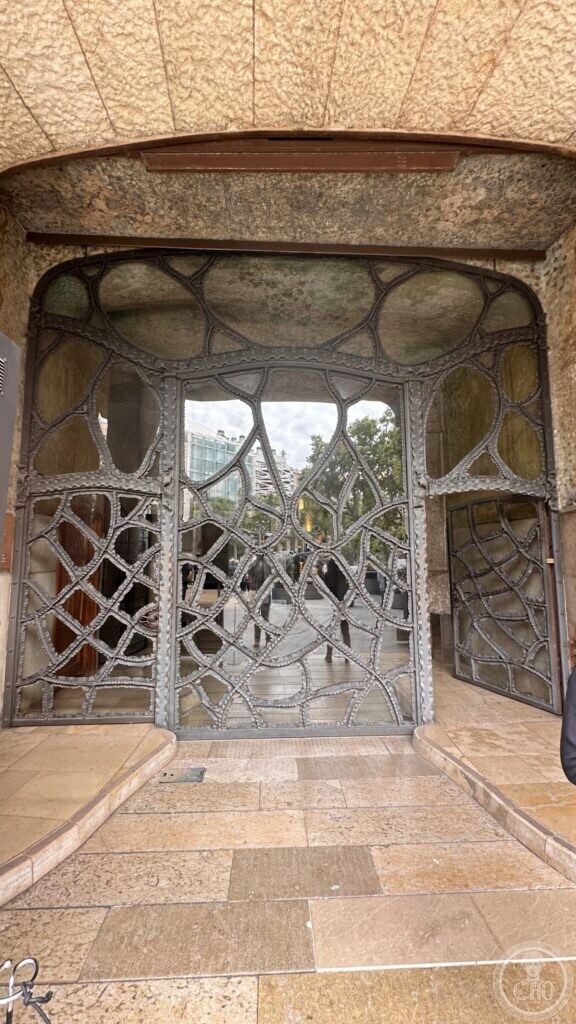
The great houses reward the same habit of looking at the parts. At Casa Batlló the window of the noble floor is framed in stone modelled like bone, with a twisted colonnette down the middle and coloured glass behind, set into a wall of broken tile. At Casa Milà the entrance gate is a web of irregular iron cells under a stone lintel cut in waves. You can stand in front of both from the pavement.
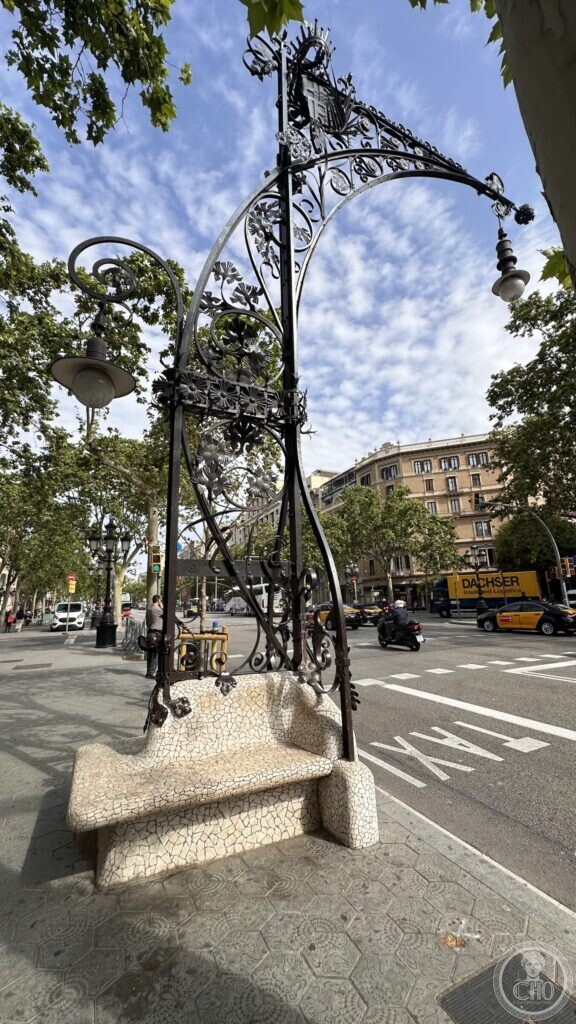
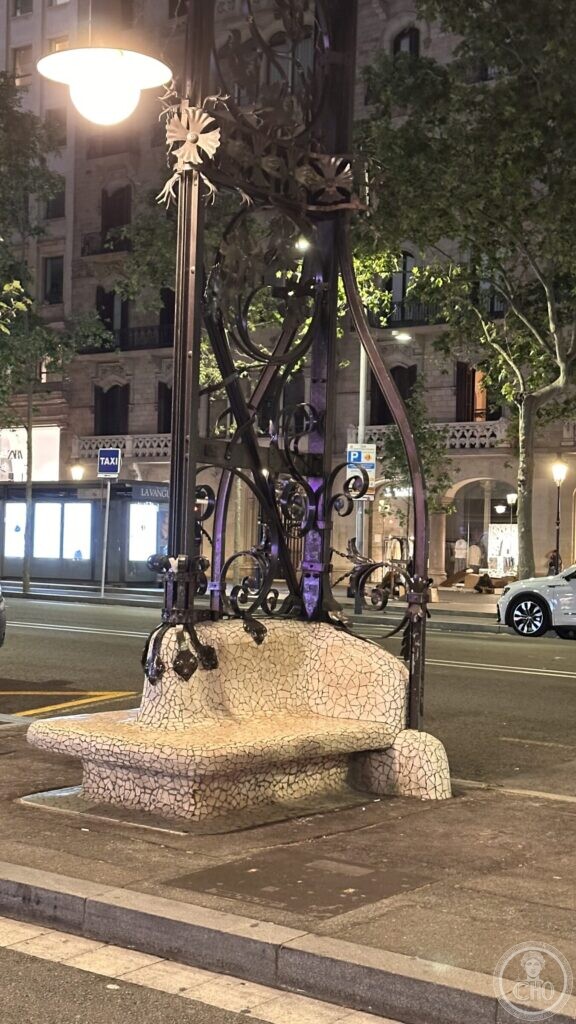
And then there is the object that makes the argument better than any building: the bench-lamp. In 1906 the architect Pere Falqués i Urpí designed a lamp for Passeig de Gràcia that grows out of a bench, or a bench that grows into a lamp — wrought iron curving overhead, the city’s coat of arms at the top, and at the base a seat surfaced in white trencadís, the mosaic of broken tile. The City Council restored them from a bad state in the 1980s. They are street furniture. They are also one of the most photographed pieces of Modernisme in the city, and you are allowed to sit on them.
How to use the medallions
The practical advice is short. Walk Passeig de Gràcia and Rambla de Catalunya in the early morning, when the doors of the halls are open for deliveries and the light comes down the cross streets. Look at the ground for the red discs, then look up. Carry the fact that the tribunes and the doorways cost nothing, and decide from there which two interiors are worth a ticket — two is usually the honest number for a day.
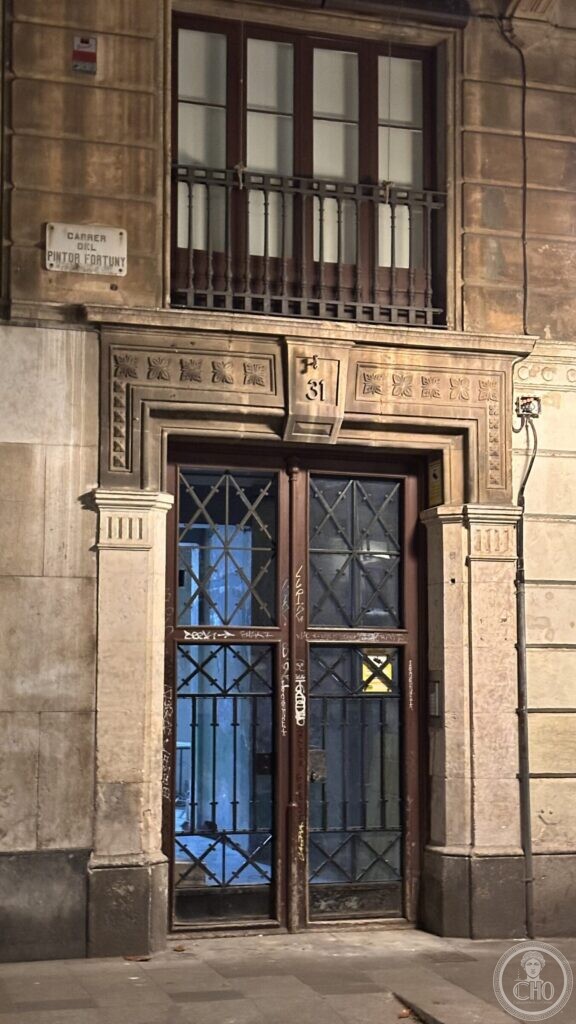
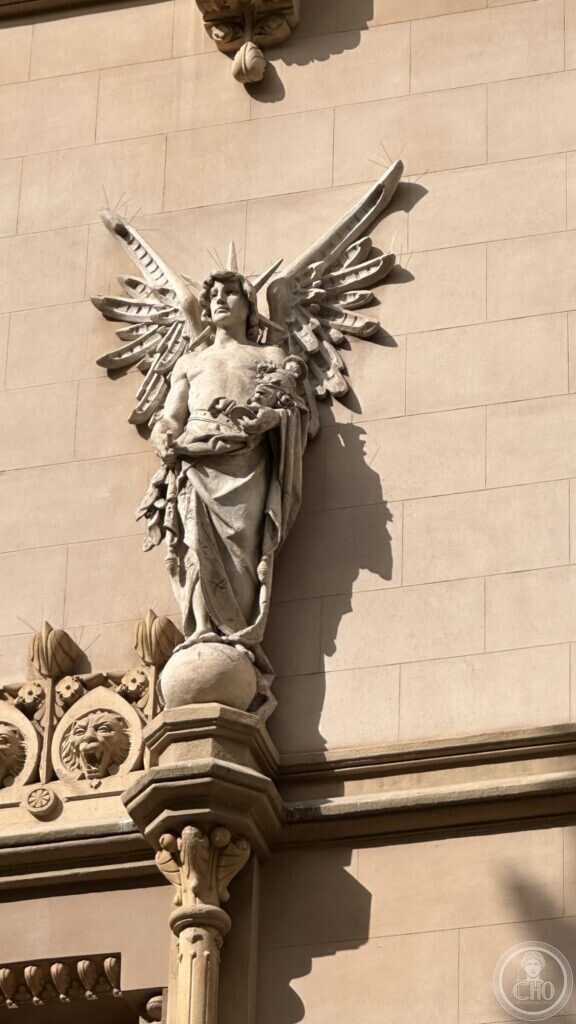
And step off the boulevard. The frieze of carved flowers over a door on Carrer del Pintor Fortuny, in the Raval, is as good as anything on the grand avenue; the winged figure on a corbel above La Rambla goes unseen by the several thousand people who pass under it every hour. The route is marked in the pavement, but it does not end where the medallions do.
Sources
- Ruta del Modernisme de Barcelona (Ajuntament de Barcelona) — the route through the Barcelona of Gaudí, Domènech i Montaner and Puig i Cadafalch, its thirty principal works, and its inclusion of everyday work: pharmacies, shops, lamps and benches
- Ruta del Modernisme de Barcelona — Bancs-Fanals: designed in 1906 by Pere Falqués i Urpí (1850–1916) to light the boulevard, and restored by the City Council in the 1980s
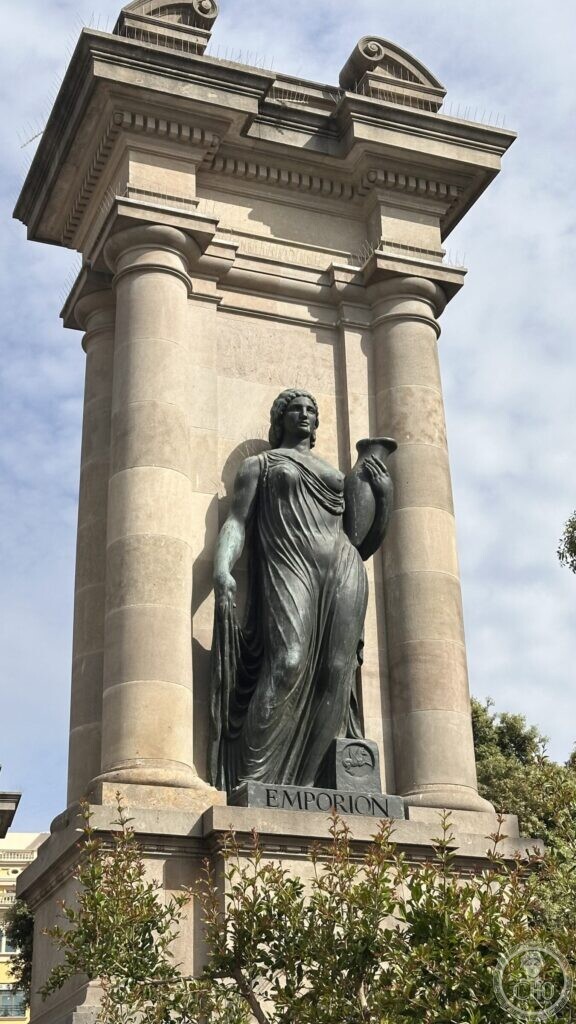
- Dates and inscriptions on Passeig de Gràcia 15, Carrer del Pintor Fortuny 31 and the Plaça de Catalunya pedestal were read from the buildings, photographed in April 2026