
The shoemakers’ guild house on Plaça de Sant Felip Neri was built in 1565 on a street that no longer exists, and rebuilt here in 1950 on ground cleared by a bomb. Most of Barcelona’s Gothic Quarter has a story like it — and knowing them changes how the walk is worth doing.
There is a fact about the Barri Gòtic that guidebooks tend to leave in a footnote, and it is the most useful thing you can know before walking into it. A great deal of the quarter is not where it was built. Façades were taken down, numbered and re-erected on other squares. Houses that had stood against Roman walls for centuries were demolished so the Roman walls could be seen. Palaces were moved to make a medieval quarter look more medieval. The work was done mostly between the 1900s and the 1950s, and it was done well enough that the seams are invisible unless you are told where to look.
This is not a debunking. The stones are old, the craft is real, and a wall rebuilt in 1950 out of 1565 ashlar is still a sixteenth-century wall. But it changes what the walk is. You are not visiting a surviving medieval city. You are visiting one that a modern city decided to keep, edit and display — a rarer thing, and the best argument there is for walking it differently from the crowd.
The gate that had to be uncovered
Start at Plaça Nova, where two round towers flank the entrance to Carrer del Bisbe. They are the gate of Bàrcino, the colony founded here in the first century BC, and the street between them still runs on the line of the Roman decumanus maximus. The lower courses are opus quadratum, big blocks laid square. Medieval Barcelona went on building on top of them in rougher stone.
For most of their life the towers were invisible. Houses stood against them, and the gate was a passage between two ordinary buildings. The houses came down between 1955 and 1958, when the square was cleared to its present width. The arcade of Roman aqueduct attached to one tower is not a survival at all: it was reconstructed in 1958, on foundations found in the subsoil.
So the oldest thing in the quarter is also one of the most recently arranged. That is the pattern, and it repeats down the whole route.
A square rebuilt out of other squares
Five minutes west is Plaça de Sant Felip Neri. The stone of the church is pitted from waist height upward. On the morning of 30 January 1938 the Italian fascist air force bombed Barcelona from nine o’clock until twenty past eleven; the church was in use as a shelter for children from the neighbourhood and for refugees from elsewhere in the Republic. Around twenty children died in the basement. Forty-two people were killed in all and more than a hundred wounded, and the raids went on, which stopped anyone from clearing the site. Only the façade was left standing. Under Franco the official story was that the marks were bullets from the execution of priests — a version that covered the responsibility for the massacre. The city put up signs explaining what happened only in 2018.
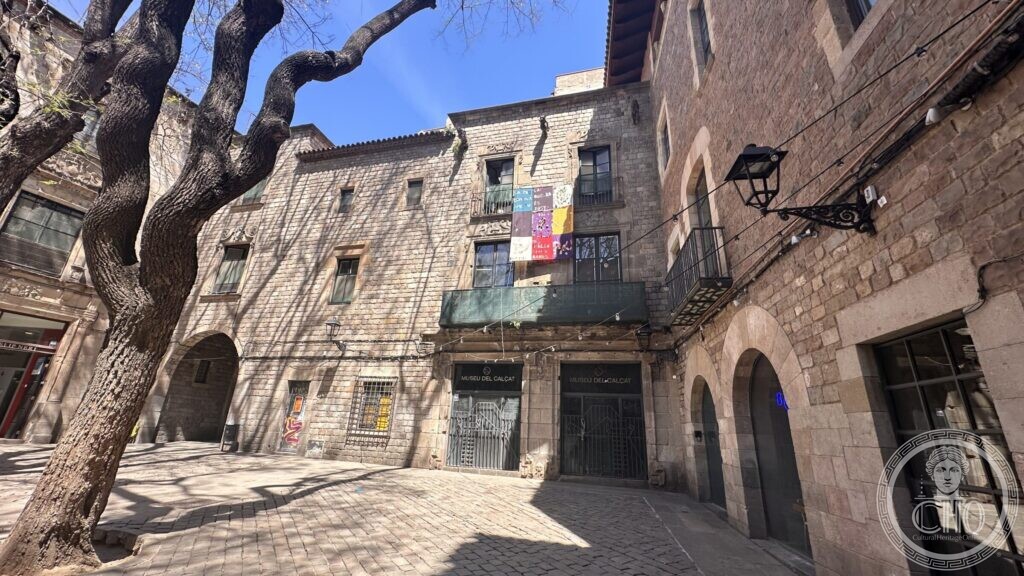
What surrounds that wall is the second half of the story. The square was rebuilt in the 1950s with Renaissance fronts brought from streets the bombing and the new avenues had emptied, among them the old Catedral quarter that is now Plaça Nova. The guild house of the shoemakers in the photograph above came from Carrer de la Corríbia. Its shield carries the lion of Saint Mark, patron of the trade. From 1970 it held the Museu del Calçat, the shoe museum, which left after forty-five years when its rent tripled; the lettering is still over the door, above a locked gate.
A square assembled from the rubble of a bombing, filled with a museum, emptied again by a rent: you could not invent a better short course in what happens to a historic centre.
The palace that was carried here
Walk east to Plaça del Rei, the courtyard of the counts of Barcelona. Three sides are the old royal palace. The fourth is the Casa Padellàs, an early-sixteenth-century palace that stood on Carrer dels Mercaders until the city moved it here, stone by stone, as part of the same plan to compose a Gothic quarter. Digging its new foundations is how the Roman city underneath was found. Since 1943 the complex has been the core of the Barcelona History Museum, and about four thousand square metres of Roman and medieval streets lie under the paving: a dyeing works of the second century, a wine cellar, the quarter of the city’s first Christians.
Two things there are free to walk into, and they are the reason to come early. The ground-floor Àgora and the Clock Courtyard are treated by the museum as an extension of the street. In the courtyard stands a five-tonne iron machine under a glass roof: the rellotge dels flamencs, the clock the Flemish makers Simó Nicolau and Climent Ossen built for the cathedral bell tower, which told Barcelona the time from 1576 until a smaller clock replaced it in 1864.
What the avenue took, and what it left
Downhill on the Baixada de la Llibreteria a wooden shopfront reads SUBIRA, CERERIA, and a brass rail below it CASA FUNDADA EN 1761. The candle shop is the oldest business in Barcelona. It was founded on Carrer dels Corders, and it is here because that street was demolished for the cutting of Via Laietana. The premises it moved into had been fitted out in 1847 — not for candles, but for a luxury draper, which is why a chandler’s has a double Baroque staircase, marble in checks, and two lamp-bearing figures at the foot of the stairs.
A hundred metres further, Via Laietana itself: cut straight through the medieval fabric from 1907, and open along its length by 1913. At number 16 the corner is rounded into a prow, modelled on the Flatiron in New York, built in 1923–25 by Josep Domènech i Mansana for the Caixa Mútua Popular, the Güell family’s bank, with a circular colonnaded temple on the roof. After the Civil War the Falange took it for the vertical syndicate that put employers and workers under one structure; today it is the seat of CCOO de Catalunya. The temple and the union banner, read together, are a hundred years in one glance.
The case for walking it this way
Barcelona is where the argument about mass tourism has been loudest for longest, and the usual reply — go somewhere else, go off the main street — does not survive contact with the Barri Gòtic, where every street is a main street by ten in the morning. The better reply is in the material.
Half of this route costs nothing and is not ticketed: a Roman gate on a public square, a wall with shrapnel in it, a courtyard with a clock, a shop where you can buy a candle. No slot, no queue, and just as good in February. It also asks something a ticketed monument does not — that you notice the stones were moved, and then ask who moved them, and what came down to make room.
That is the difference between seeing a quarter and reading one. The nine stops are collected in our Barcelona Gothic Quarter Virtual Tour, each opening with a 360° panorama — so the walk can be taken from a screen before it is taken on foot, or instead of it, which for a lot of people is the only way it will ever be taken.
Along the way
Sources
- Ajuntament de Barcelona, Programes de Memòria Democràtica — Plaça de Sant Felip Neri: the raid of 30 January 1938, the casualties, the surviving façade, the Francoist account of the marks, the 1950s rebuilding with elements from other bombed sites, and the signs of 2018
- Ajuntament de Barcelona, Museu d’Història de Barcelona — MUHBA Padellàs and MUHBA Plaça del Rei: the palace moved from Carrer dels Mercaders, the museum’s founding core since 1943, the archaeological subsoil, and the free-circulation Àgora and Clock Courtyard
- Ajuntament de Barcelona, barcelona.cat — Cereria Subirà: the 1761 foundation on Carrer dels Corders, the demolition for Via Laietana, and the 1847 fitting-out as a luxury clothing store
- Ministerio de Cultura, Archivo de la Corona de Aragón — Palau del Lloctinent: built 1549–1557 by Antoni Carbonell under the 1547 decree of the Corts of Monsó
- Pobles de Catalunya — Portal del Bisbe, Torres romanes de la plaça Nova, Casa del Gremi de Sabaters, Edifici de Sindicats (Via Laietana 16)
- Ara — «De banc burgès a seu sindical: 100 anys de l’emblemàtic edifici de Via Laietana, 16», for the 1913 opening of the avenue
- Ajuntament de Barcelona, Catàleg del patrimoni arquitectònic protegit — «Conjunt de Via Laietana»: the 1879 Baixeras plan approved in 1889, and the opening of the avenue begun in 1907; and «Cases Tomàs Recolons», Enric Sagnier, 1918
- betevé — on the closure of the Museu del Calçat, and on the rellotge dels flamencs