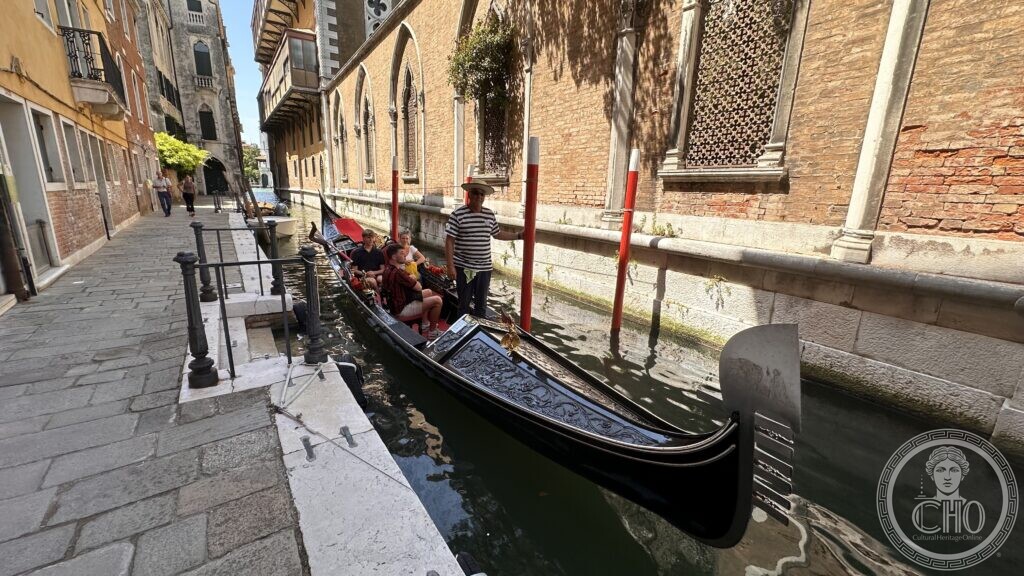
The asymmetry usually quoted is 24 centimetres. The measured survey that Venetian yards work from says 20.36. The iron on the bow is the descendant of a ram, built in secret in the Arsenal for a river war and kept off the canvases of Venetian painters for a hundred years. And the six teeth on it, the wood of the oarlock and the black of the hull are not tradition at all: they are municipal regulation, article by article.
A gondola on the water reads as a single clean line. Take one out, set it on trestles, and it looks like a mistake. One side stands higher than the other. The keel does not run straight; it bends to the right. The boat will not sit level, and it was never meant to.
This is the fact about the gondola that everybody has heard and almost nobody has checked. The hull is asymmetrical because a single rower stands at the stern and works one oar on the right-hand side, and the shape has to lean against a push that would otherwise carry the boat to the left. The figure usually given for how far out of true it runs is 24 centimetres. That number is not on the drawing.
The drawing exists
Gilberto Penzo has been documenting and measuring the boats and ships of Venice since 1979, from a shop in Calle dei Saoneri at San Polo. His survey of the contemporary gondola, drawn with Antonio Rosada and published as a set of eight plates, is not a romantic account of the boat. It is a set of numbers.
Length between the tips of the posts, measured on the diagonal: 10.725 metres. Length overall with the irons: 11.03 metres. Beam inside the planking: 133.5 centimetres, and 143.75 outside. Width of the flat bottom inside the planking: 96.8 centimetres. Building height on the right-hand side 50 centimetres; on the left, 52.4. And the asymmetry, taken between the centreline of the bottom and the line joining the two posts with the hull still on the cantièr: 20.36 centimetres.
Twenty point three six. Not twenty-four. The looser figure has been copied from site to site for years, and it is close enough to sound right, which is exactly why nobody stops to check it. Reference works are no steadier. Treccani gives the boat as 10.75 metres long and 1.75 metres wide, a beam some 30 centimetres greater than the builder’s own survey allows. When the encyclopaedia and the plan disagree, the plan is the one the carpenter is holding.
Eight woods, or nine
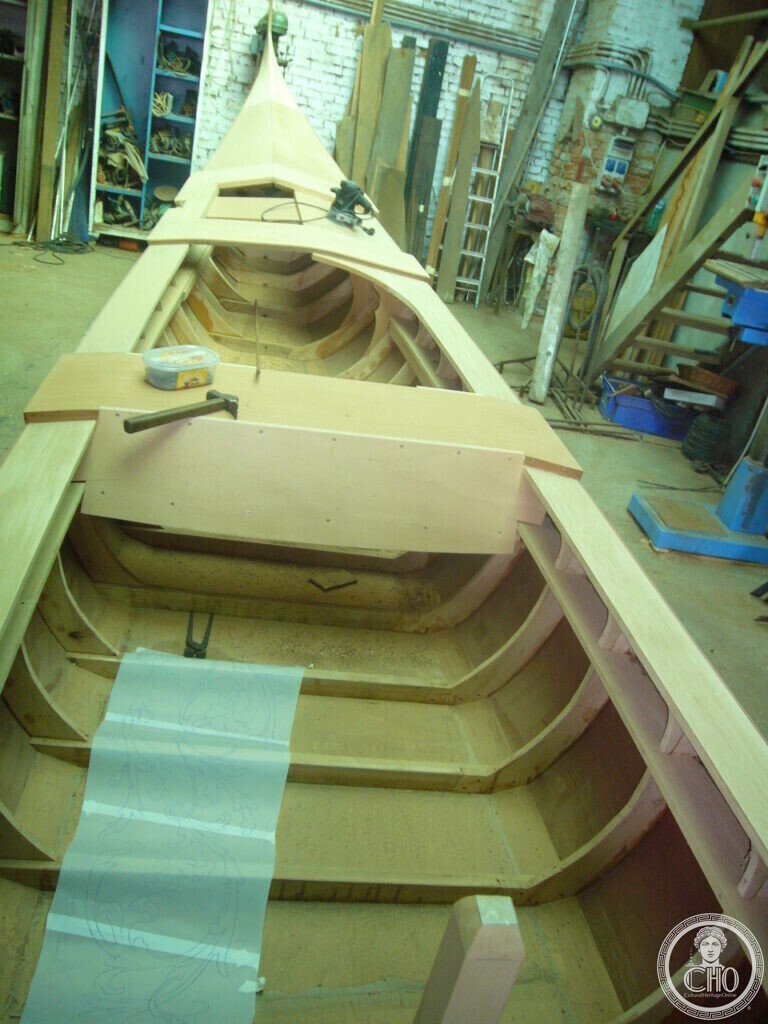
The Squero Tramontin lists the timber it uses: oak, cherry, larch, linden, walnut, mahogany, elm and fir. Eight. The yard also says, without being asked, that marine plywood now goes in where the fir used to, which is the sort of admission that never makes it into a guidebook.
El Fèlze, the association of the trades that between them make the boat, gives the same eight and adds a ninth in small quantity: dogwood. Their account of the squerarióli is a list of parts as much as of species. The aste, the ordinate, the còrbe and the vòlti, the sancòni, the piàne, the sércio. The timber is bent not by steam but by the slow burning of marsh reed. The guild became autonomous in 1610, and split into squerariòli da grosso, who worked tonnage, and da sotil, who worked flat-bottomed boats like this one.
The boat is usually said to hold about 280 separate pieces. The oldest surviving gondola in the world puts a different figure on the woods altogether. It sits in the Mariners’ Museum at Newport News, Virginia: built before 1850, the museum believes at the Casal yard in Venice; 35 feet 8 inches long, which is 10.87 metres and within a few centimetres of a hull built this year; around 1,100 pounds; and made of nine woods that include cedar and beech where a modern hull would carry mahogany. The painter Thomas Moran bought it in Venice in 1890 and kept it on a pond on Long Island; it reached the museum in 1950. It is often described as the gondola of Robert Browning. That story comes from a letter written by Moran’s daughter in 1942, reporting what a hotel manager had told them, and the museum states plainly that it has never been confirmed.
The jig of 1884
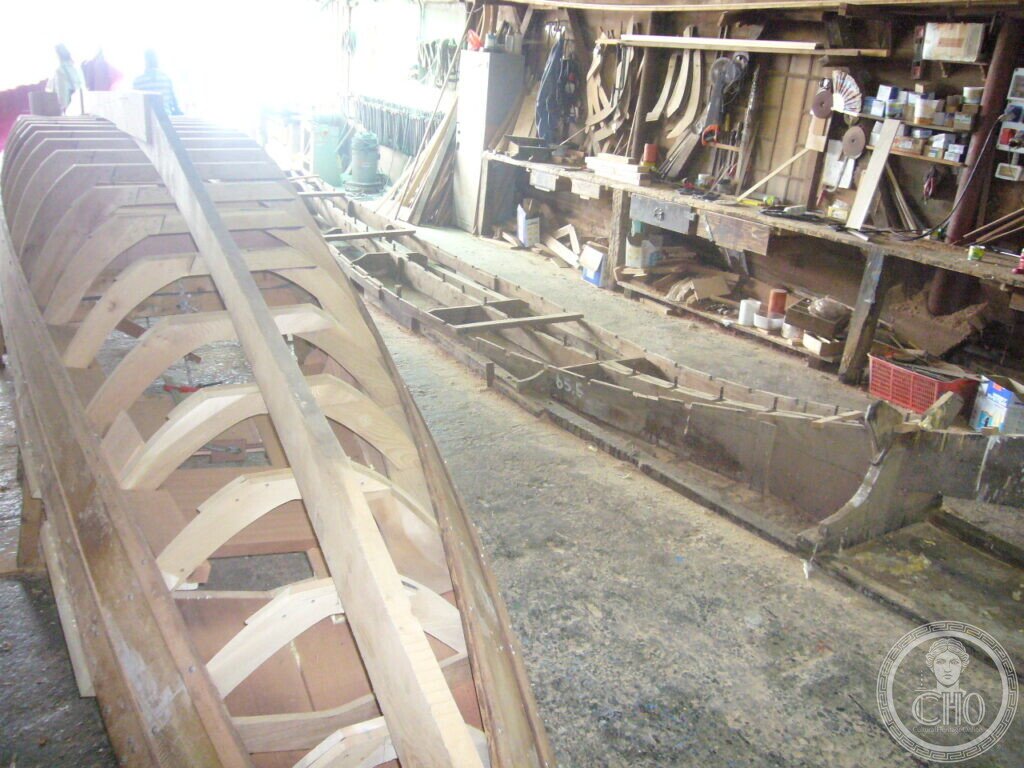
A gondola is not built from a plan pinned to the wall. It is built on a cantièr, a counter-shape, a wooden armature that holds the two posts while the planking and the bottom are fixed to them. Everything the hull will be is decided by that frame, and the frame is the yard’s property in the deepest sense.
The Domenico Tramontin & Figli boatyard was founded on 2 February 1884. Domenico had learned the trade at the Casal ai Servi yard, the same family name the Virginia museum attaches to its 1850 hull, and when he set up on his own in Dorsoduro he altered the form of the boat. The yard’s own account of what happened next is short: the changes were recognised as improvements and were then adopted by every other builder in Venice. The asymmetric gondola that a single rower can drive is his. The assault boat of the 1500s had been symmetrical by design; what Tramontin did, three and a half centuries later, was build the hull crooked so that one man could drive it.
The yard still lays its master frames on the cantiere Domenico built in 1884. A boat launched this year takes its curve from a piece of workshop furniture that is a hundred and forty-two years old. Tramontin supplied gondolas to the House of Savoy, to the police and to the carabinieri, and restored the 1939 royal gondola now kept in the Doge’s Palace. Roberto Tramontin, Domenico’s great-grandson, ran the yard until his daughters Elena and Elisabetta took it over.
Each house signs its work. A Tramontin hull can be told by three small and two larger dovetailed triangles carved into the caenèa at the stern.
The iron is ornament, and the law says six
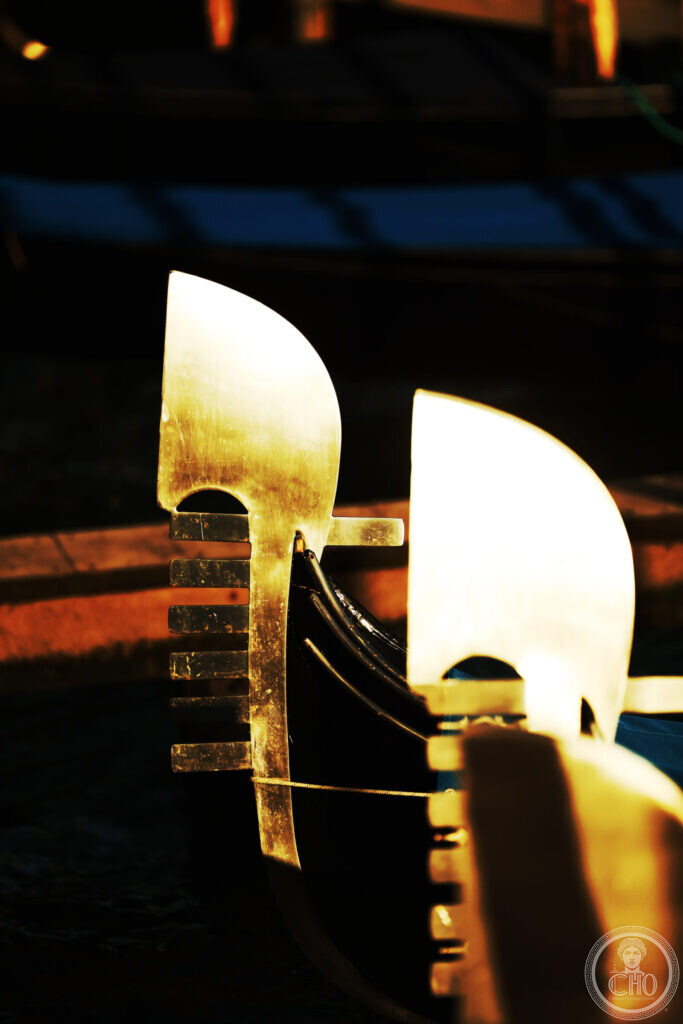
The fèro da próva is the piece every visitor photographs, and the one about which most is invented. El Fèlze, whose members forge it, is blunt: the S-shaped iron with its seven characteristic teeth has generated a myriad of interpretations, and those interpretations have often been fed by gondoliers and boatbuilders themselves. You will be told that six of the teeth are the six sestieri of Venice, that the seventh, turned backwards, is the Giudecca, that the arch beneath the blade is the Rialto bridge and the curve above it the doge’s cap. It is a good story, told by the people who make the object, which is not the same thing as documentation.
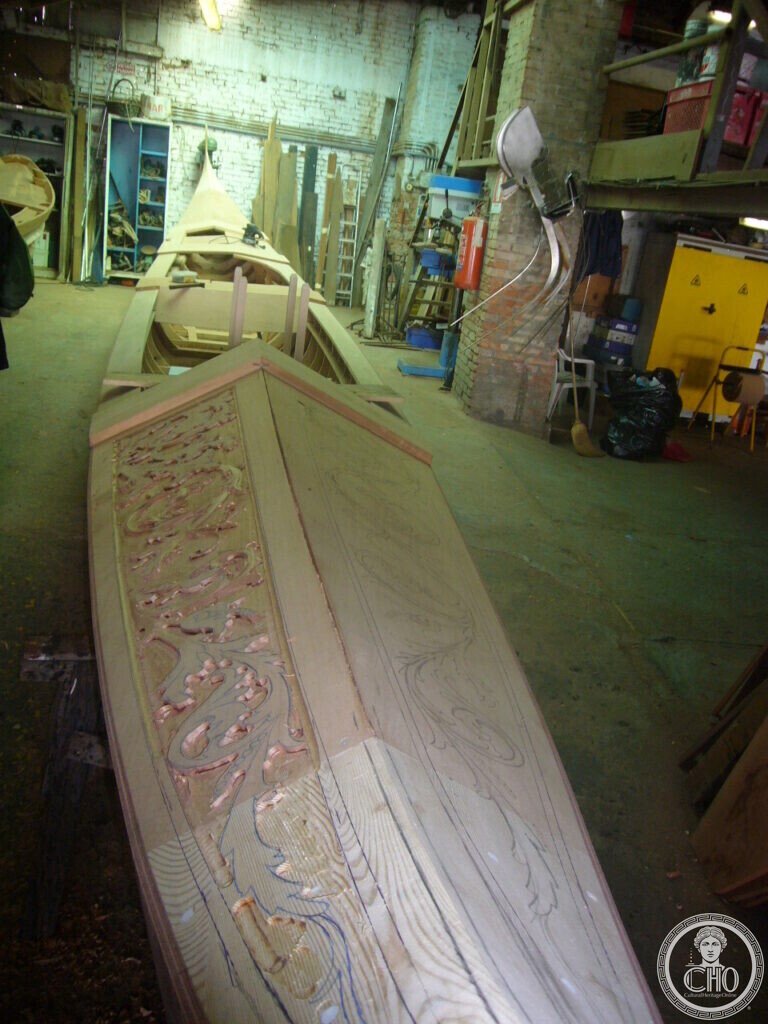
What the same association will also tell you is that the iron has lost the working job it once had and is today pure ornament. It was forged at Premana, in the province of Lecco, and in the Cadore, the mountain country that sent Venice its iron ore, its timber and a good number of its boatbuilders. One iron took more than a week at the anvil. The whole skill of it lies in the taper: the blade must thin from side to side, from roughly eighteen millimetres down to nothing. Many are now laser-cut from stainless steel, and hand-forging is coming back slowly.
And the count is not folklore. It is law. The city’s regulation for the public gondola service specifies the iron under article 22: steel or cast steel, in a single piece; other alloys permitted only if the finish matches; light engraving allowed on the blade; openwork absolutely forbidden. Then the sentence that settles the argument. Il pettine conta sei denti. The comb counts six teeth, with a maximum of three leaves inserted. The seventh tooth of the trade’s own description is the one pointing astern, which is not part of the comb and can be seen standing clear of it in the photograph at the top of this page. Six, then, is not a number handed down from the six districts. It is the number the regulation requires.
The job it lost is the interesting part, and the answer is not in any of the legends.
The hundred years the boat was a state secret
In 2023 Dario Camuffo, of the CNR institute of atmospheric sciences and climate, published in the geographical journal Méditerranée a reconstruction of how the gondola reached its present shape, built from written records and from what painters actually put on canvas. It sets out four phases across a thousand years. The third one is a weapon.
On 10 December 1508 the League of Cambrai was formed against Venice, and the following May the Republic lost the battle of Agnadello. What it needed then were boats that could go up rivers. Marin Sanudo’s diary for 1509 records what the Arsenal did: it built light boats in great secrecy, to row up the Po and the Adige and raid the territory of Ferrara. The boat they rebuilt for the job was the gondola.
The assault version was reinforced, symmetrical and raised at both ends, a profile Camuffo compares to Viking and Norman ships. At bow and at stern it carried heavy pointed irons: a ram low down and an axe above it. They were not decoration and not protection. They were there to run down an enemy boat and break its planking open. The first technical description of the new craft that Camuffo could find is an Arsenal manuscript by Theodoro de Nicolò, of around 1550, giving twenty-eight Venetian feet — 9.73 metres — and five feet in the beam.
Then the boat disappears. For roughly a hundred years the gondola is scarce and stylised in Venetian painting, a silence that Camuffo reads as exactly what it looks like: reason of state. It returns when the wars are over, and the irons come back with it, no longer sharpened, no longer at both ends. What stands on the bow of the boat you photograph today is the descendant of a ram.
The Venetian name has never stopped saying so. The fèro is also called the dolfìn, the dolphin, which is what people saw in those blades; Cesare Vecellio, writing in 1590, remarked how they shone like silver. A weapon that people decided looked like a dolphin, kept on for four centuries after the fighting stopped, and finally written into a by-law.
An oarlock that is not designed
The fórcola is the carved crook the oar rests on, and it is the part of the boat that is fitted to the person who rows it. The remèri, a guild in Venice since 1307, cut it from quarters of trunk chosen before three years of seasoning: walnut, cherry, pear, apple, maple. Their own description of the work is startlingly modest. More than designed, they say, it is the result of a hard piece of labour in which manual skill meets an imagined shape, and the deciding senses are sight and touch. Every bend and every elbow has to allow one of the movements the oar makes in the water.
Here too the regulation has an opinion. Bow and stern forcole must be solid walnut, cherry or pear, in traditional dimensions and forms, and in any case as per the samples deposited with the city. The oars are to be ramin, maple or beech. Their only permitted decoration is a two-colour herringbone band on the upper blade, in red and white or blue and white. The flag on the bow may not exceed 15 by 30 centimetres. The stripes on the gondolier’s jersey must be between one and three centimetres wide in winter, and no more than two and a half in summer.
Black by decree, then and now
The gondola was not always black, and for centuries it was not open either. It carried a felze, a cabin: at first a curved half-barrel roof of branches or cloth, later of wood, tall enough to stand in. A twelfth-century text already records a platus cohopertus cum felce, a boat covered with a felze. The first known picture of one is in a Carpaccio of 1494. Venetian brides used it as a display case, seated on a bench outside it until the sixteenth century and afterwards inside, on a good carpet, with the cabin kept open so they could be seen. Pietro Aretino, watching from his house on the Grand Canal in 1537, declined to describe the brides shining with silk and gold and jewels, and thereby described them.
The magistracy that ended the display had been elected on and off since 1376 and became permanent on 14 February 1515. The Provveditori alle Pompe, the officers of conspicuous consumption, drew up general limits on dress, food and display in 1562 and included gondolas in them; the provisions were tightened from 1609. Which decree first imposed the black is not agreed between sources, and the practical explanation has never needed one, since black pitch was already going on the hull to keep the water out.
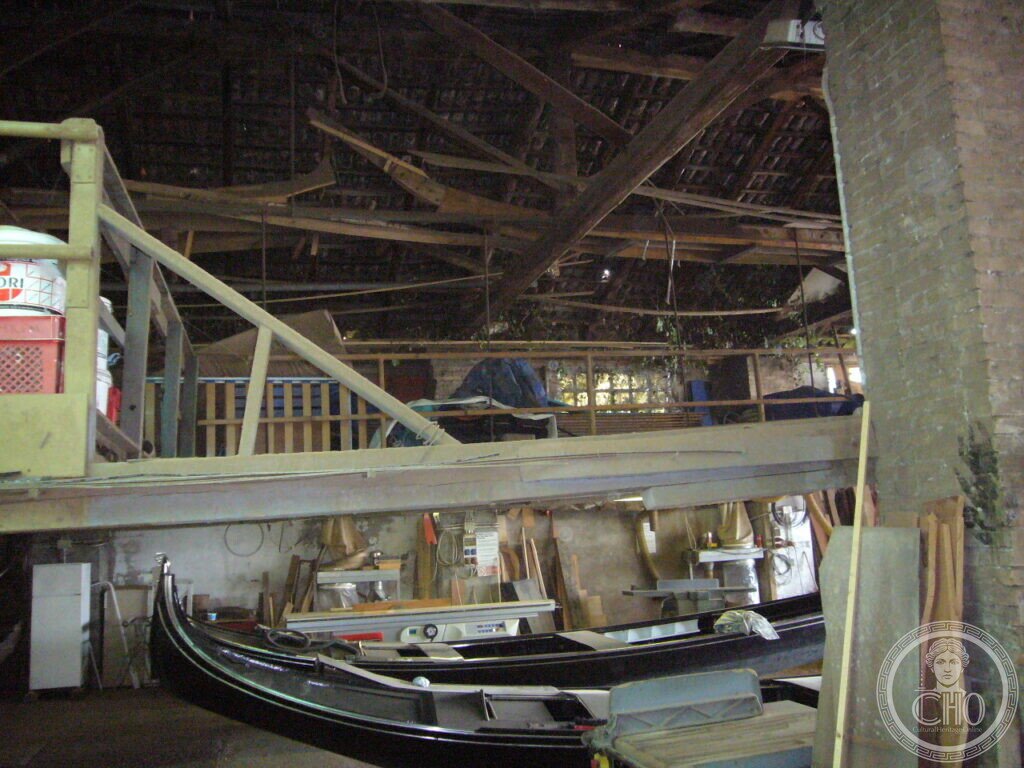
What is agreed is what happens now. Article 22 requires the boat to be gloss black inside and out. White is tolerated only in the bilges and under the bow and stern. Even the antifouling on the bottom must be black. The same article obliges the boat to carry a vertical strip of reflective material at the stern, which is a 21st-century road-safety fitting bolted onto a shape settled in the 19th. A sumptuary law of the Republic and a traffic rule of the Republic of Italy arrive at the same colour for different reasons.
Where they are still made
In the sixteenth century there may have been ten thousand gondolas serving a city of a hundred thousand people. Today the regulation fixes the number of licences at 440, and something like 400 boats are in service. The yards that build them can be counted on one hand. The Venetian boat association Arzanà counts the squero di San Trovaso as one of five still working, and any count depends on where the line is drawn, since some surviving yards only store and repair.
San Trovaso is the one everyone has seen, documented since the seventeenth century and run today by the gondoliers’ cooperative, which both maintains and builds. Its beaten-earth slope still runs down to the rio so that a hull can be walked into the water on wooden rollers. The houses above the sheds look wrong for Venice, and they are: the carpenters came down from the Cadore with the timber rafts on the Piave, and built what they had at home. The church of San Trovaso gives the yard its name, and the Osteria al Squero faces it from the far bank of the rio, twenty metres away.
On the Giudecca, in the brick sheds of the old CNOMV works, the Cantiere Nautico Crea does the whole animal: hull, carved decks, oars and forcole. It was founded by Gianfranco Vianello, called Crea, who won the Regata Storica seven years running. On 20 June 2026 the city launched a new ferry gondola there for the Rialto–San Silvestro crossing, raising the capacity of that traverse from twelve passengers to fourteen and installing, for the first time, a bell at the landing so you can call the boat. A gondola in this city is still municipal transport, and a new one is still news.
Not every squero survived as a squero. On San Giorgio Maggiore, a boat-repair workshop that the land registers place between 1830 and 1879 is now Lo Squero Auditorium, a concert hall with a glass wall onto the lagoon. At Squero Vecio, on the rio dei Mendicanti, the name has outlasted the trade. The question of who builds the next generation is not rhetorical: the squero of San Isepo in Castello, left to the Carpenters and Caulkers Mutual Aid Society by bequest, has been used to run a two-year work-and-school scheme for students of the nautical institute.
What the boat is
On 13 August 2010 Giorgia Boscolo, then twenty-four and the daughter of a gondolier, passed the rowing examination and became the first woman to qualify for the trade. She had done what the regulation requires of everyone: six months standing in as a substitute before the competition for a licence can even be entered. The yard that gave the boat its modern shape is now in the hands of two sisters.
It is tempting to file the gondola under survival, a wooden thing kept alive for the cameras. The paperwork says otherwise. The boat has a measured survey to a hundredth of a centimetre, eight species of timber and a ninth in small quantity, a jig built in 1884 and still in use, a comb of six teeth because an article of municipal law prescribes six, an oarlock legal in three woods, a colour that is compulsory and a reflective strip that is compulsory too. It is not a relic. It is a specification, continuously enforced, of a boat built crooked on purpose around the body of one standing rower.
Twenty point three six centimetres, to be exact.
More views