
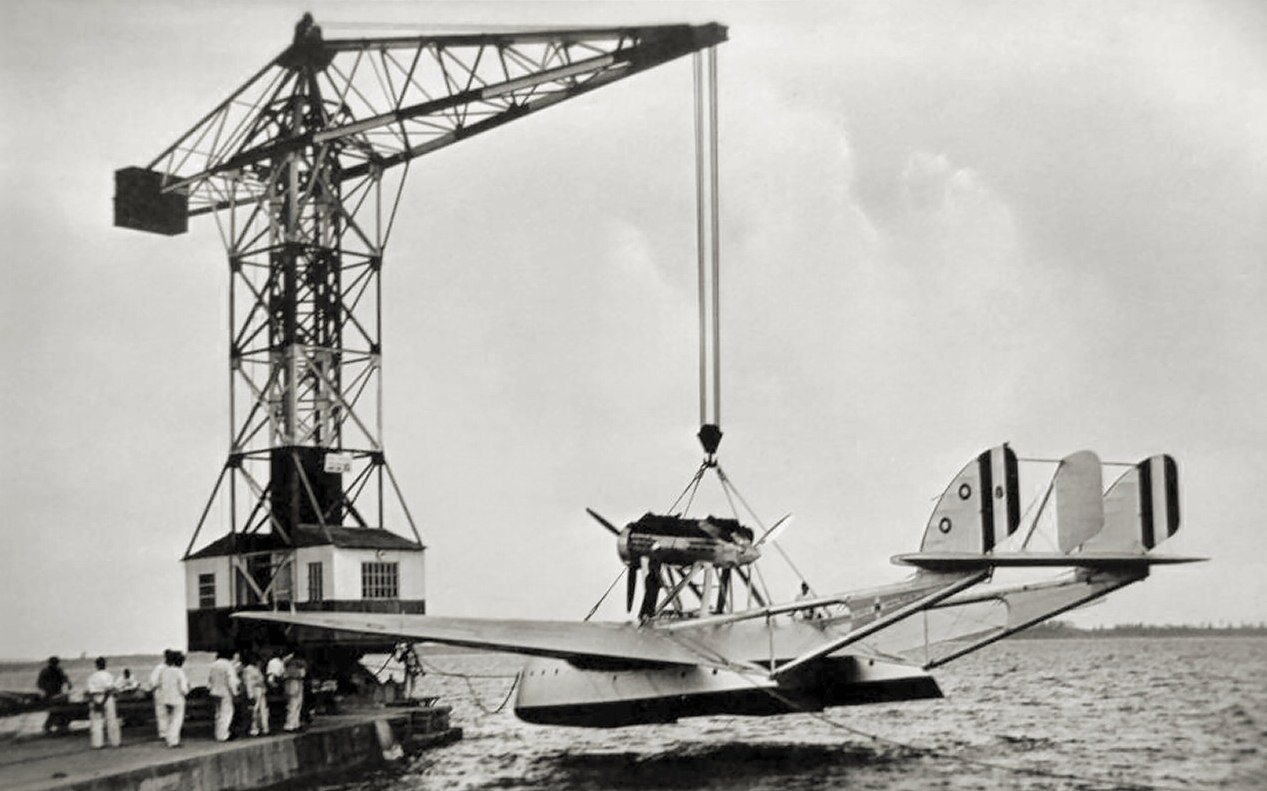
From a lagoon in southern Tuscany, formations of flying boats left for Brazil in 1930 and for Chicago in 1933. The seaplane base is gone — wrecked in 1944 — but the town still keeps its memorial esplanade and the name “Parco delle Crociere”.
At a glance
The Orbetello seaplane base was laid out on the town’s lagoon for the Regia Marina in the early years of Italian naval aviation, with six adjoining hangars, aprons, slipways and jetties. In the interwar years it became the departure point of the mass formation flights — the “crociere” — that made Italo Balbo‘s name: sixty-one aircraft to the western Mediterranean in 1928; fourteen S.55 flying boats to Rio de Janeiro across the South Atlantic in 1930–31; and on 1 July 1933 the Decennial Air Cruise, twenty-five S.55X flying boats bound for the Century of Progress fair in Chicago. In the late 1930s the base received two celebrated prefabricated-concrete hangars by Pier Luigi Nervi; retreating German forces destroyed the installations in 1944, and the site was never rebuilt.
Key facts
- Origins: Regia Marina seaplane station from the earliest years of Italian naval aviation (established 1913), with six adjoining hangars, slipways and jetties
- 1928: western Mediterranean cruise — 61 aircraft in formation, 2,800 km
- 1930–31: fourteen S.55s with 56 crew left for Brazil on 17 December 1930; the formation reached Rio de Janeiro on 15 January 1931
- 1933: the Decennial Air Cruise left Orbetello on 1 July — 25 S.55X to Chicago and back to Rome by 12 August
- Nervi hangars: two 100 × 36 m prefabricated reinforced-concrete hangars, completed by 1940; demolished with the rest of the base by German forces in 1944
- Today: the area is the “Parco delle Crociere”, with the Esedra dei Trasvolatori Atlantici memorial and fragmentary remains
History
The context, stated plainly: the crociere were flown under, and for, the fascist regime — Balbo was its Minister of Aeronautics, and the formations were propaganda instruments as much as feats of airmanship. They were also, technically, exactly that: feats, prepared at Orbetello over months of training in formation flying, navigation and open-sea operations that foreign air forces studied closely. Both facts belong to the record.
The lagoon site made the base: sheltered water in every wind, a ramp-and-hangar line along the shore, and room to marshal dozens of flying boats. From here the South Atlantic cruise departed on 17 December 1930 — fourteen S.55s and fifty-six men, into Rio on 15 January 1931. From here, on 1 July 1933, the Decennial cruise left for Chicago: twenty-five S.55X, via Amsterdam, Londonderry, Reykjavik, Cartwright, Shediac and Montreal, onto Lake Michigan on 15 July before a crowd in the hundreds of thousands. The return, via New York, Newfoundland and the Azores, ended in Rome on 12 August. Two men died on the way — one at Amsterdam on the first leg, one in the Azores on the return — and their names belong to the story as much as the parades do.
The base’s architectural fame came late: at the end of the 1930s Pier Luigi Nervi built two of his revolutionary prefabricated concrete hangars here, 100 by 36 metres under lattice vaults. They stood five years. The Germans demolished the base systematically in their 1944 withdrawal, Nervi’s vaults included; only side annexes and foundations survived. Orbetello kept the memory instead of the buildings — in the Parco delle Crociere and the memorial esplanade to the Atlantic flyers, and in a district north of the lagoon that is still called Neghelli.
What you see
The visit today is an exercise in reading absence. The Parco delle Crociere occupies the western part of the old base, where sports fields and a sailing club stand among the foundations; the Esedra dei Trasvolatori Atlantici gathers the commemoration in one architectural gesture on the lagoon. Period photographs — the crane swinging an S.55 into the water, the hangar line, the massed hulls on the apron — do the rest of the work, and the lagoon itself, flat and sheltered between its two sand bars, still explains at a glance why the base was here.
For the history of engineering, the loss of the Nervi hangars ranks among the sharpest of the Italian war: their surviving siblings elsewhere are studied worldwide, and Orbetello’s were the prototypes’ refinement.
Practical information
- The Parco delle Crociere is public open space on the lagoon edge of Orbetello; access is free.
- Combine the visit with Orbetello’s historic centre and the lagoon nature reserve; the Argentario coast is minutes away.
- The remains are fragmentary — go for the site, the memorial and the setting rather than standing structures.
Getting there
Orbetello sits in the middle of its lagoon on Tuscany’s southern coast, reached from the SS1 Aurelia and by rail (Orbetello–Monte Argentario station). GPS (Parco delle Crociere): 42.44164, 11.21568 · Open in Google Maps.
Related places and reading
- The Balbo Column, Chicago — where the 1933 cruise is still commemorated
- Palazzo d’Italia, Rockefeller Center — the Italian showcase on Fifth Avenue, opened two years after the fleet’s New York welcome
- The Atlantic Squadrons — the full story of the 1930–33 formation flights
- The Route of the Decennial Air Cruise — the three-stop historical route
Sources
- Italian Wikipedia, “Idroscalo di Orbetello” (origins, six hangars, 1928 and 1930–31 cruises, Nervi hangars and their 1944 destruction, Parco delle Crociere and Esedra today).
- English Wikipedia, “Decennial Air Cruise” (1 July–12 August 1933, 25 S.55X, route, accidents at Amsterdam and the Azores, Chicago and New York receptions).
- OpenStreetMap Nominatim (Parco delle Crociere coordinates).
Find it on the map
See this place and what’s around it →Record researched and written by Luigi De Marchi for Cultural Heritage Online, 2026.
Events here — now on & upcoming
- Anniversary: The Decennale Air Cruise — Departure from Orbetello, July 1, 193301 Jul 2027See the event →
- Anniversary: The Decennale Cruise — Return to Ostia, August 12, 193312 Aug 2027See the event →
Historical events at this place (2)
📷 Become a Cultural Heritage Online photographer
Share your photos of places: they stay published under your name as the author. The more they're seen, the more you get noticed — and soon a contest will reward the most appreciated photos.
Log in or sign up free to add a photo