
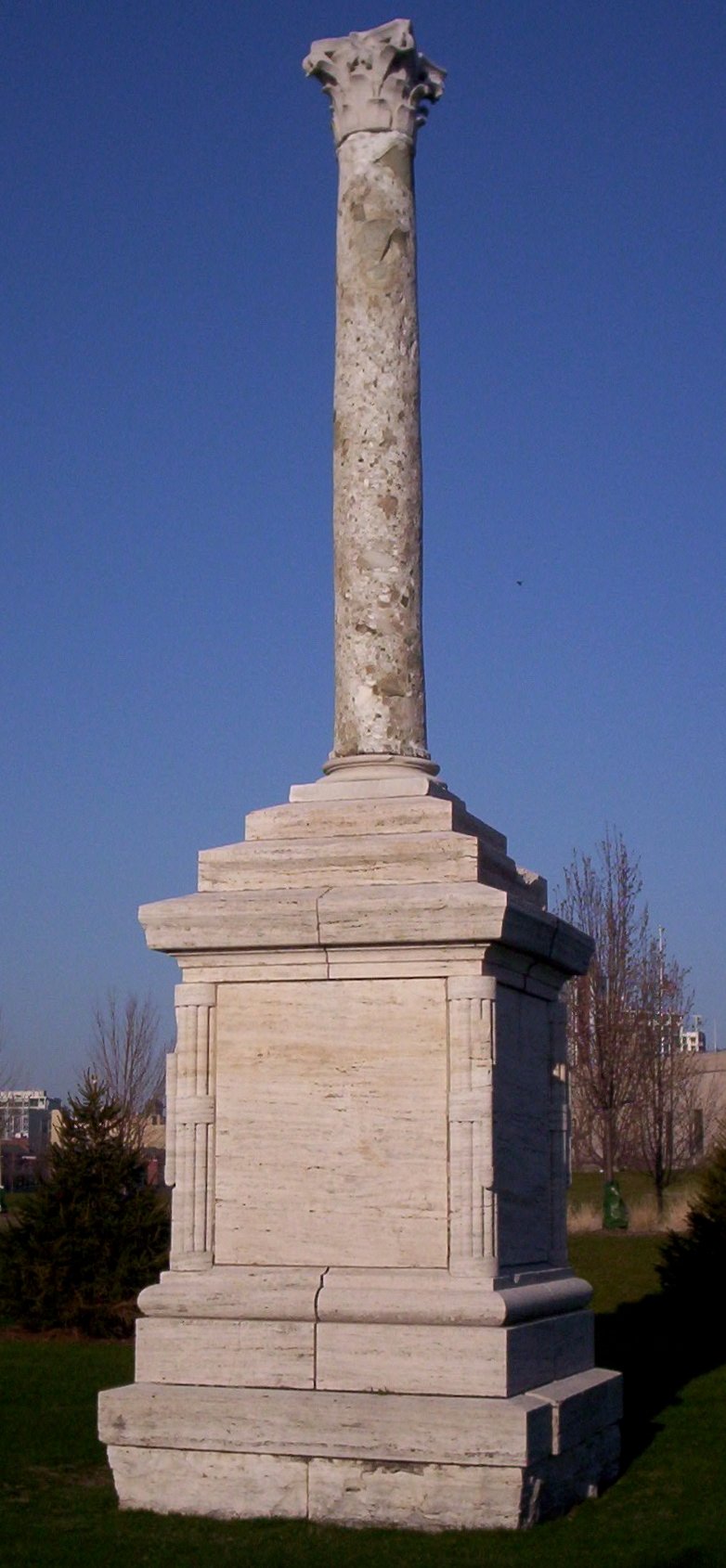
An ancient Roman column from Ostia stands on Chicago’s lakefront, sent by Mussolini’s government in 1934 to commemorate Balbo’s 1933 formation flight. It is the object of an open removal debate — and it is still there.
At a glance
On 15 July 1933 the S.55X flying boats of the Decennial Air Cruise landed on Lake Michigan before a crowd of more than a hundred thousand, the climax of the Century of Progress world’s fair; the city declared “Italo Balbo Day” and renamed Seventh Street as Balbo Avenue. The following year the Italian government shipped over a material thank-you: a roughly 2,000-year-old breccia column from the Roman port of Ostia, mounted on a travertine base designed by the architects Capraro and Komar, with inscriptions in Italian and English commemorating the flight. It stands in Burnham Park near the Lakefront Trail, a few steps from the site of the fair — the one physical trace of the 1933 cruise on American soil, and since 2017 the subject of an unresolved public debate over its removal.
Key facts
- The object: an ancient Roman column in breccia, about four metres (13 ft) tall, from the Prospetto a Mare at Ostia
- The gift: sent by Mussolini’s government to honour the 1933 transatlantic formation flight; arrived by ship and erected in 1934
- The base: travertine, by architects Capraro and Komar, with commemorative inscriptions
- Location: Burnham Park, near Soldier Field and the Lakefront Trail — beside the former Century of Progress fairgrounds
- The debate: removal has been publicly argued since 2017, over Balbo’s role in the fascist regime; Italian-American organisations have opposed it
- Status: still in place (as of December 2024); Balbo Drive’s renaming has been debated in parallel
History
The context, stated plainly: this is a monument given by a dictatorship to celebrate its own achievement, and its donor inscription says so. Balbo was one of the founders of the fascist regime; the flight it commemorates was a propaganda triumph of that regime; and the present debate about the column — remove it, reinterpret it, leave it — is a live argument about how public space should carry difficult history. This card documents the object and the argument, and takes neither side.
The column itself is the oldest thing in the story by two millennia: a shaft of breccia from Ostia, the port of ancient Rome. Shipped across the Atlantic in 1934, it was set on a stepped travertine base at the edge of the fairgrounds where the S.55Xs had been the star attraction the summer before. For decades it stood as an ordinary piece of lakefront furniture, its Latin-rooted stone easier to read as antiquity than as politics.
The 2017 wave of reckoning with contested monuments in the United States changed that. Aldermen and community groups proposed removal; Italian-American organisations defended the column, citing among other things Balbo’s documented opposition to the regime’s alliance with Nazi Germany; the Chicago Park District has so far moved nothing. The column thus does double duty today: a Roman antiquity on Lake Michigan, and a working case study in what cities do with gifts from regimes.
What you see
The monument is modest at close range: a weathered, green-grey shaft of breccia — pebbles of older stone locked in a matrix, polished by two thousand years — carrying a damaged capital, on a clean 1930s travertine pedestal with panelled faces and the commemorative inscriptions. The contrast of materials is the design: ancient stone above, rationalist-classical base below, lake and skyline all around.
Its power is the setting. Stand at the column and the geography of July 1933 assembles itself — the water where the flying boats landed, the fairground footprint, Soldier Field behind — with the Loop’s towers stacked to the north.
Practical information
- The column stands in public parkland on the Lakefront Trail, freely accessible at all times; it is an easy stop on a lakefront walk or ride between Soldier Field and McCormick Place.
- Combine with the Museum Campus (Field Museum, Shedd Aquarium, Adler Planetarium) a short walk north.
Getting there
Burnham Park, Near South Side, Chicago, on the Lakefront Trail south of Soldier Field. GPS: 41.86150, -87.61357 · Open in Google Maps.
Related places and reading
- Idroscalo di Orbetello — the Tuscan lagoon the 1933 fleet left from
- Palazzo d’Italia, Rockefeller Center — Italy’s other contested 1930s presence in a great American downtown
- The Atlantic Squadrons — the full story of the 1930–33 formation flights
- The Route of the Decennial Air Cruise — the three-stop historical route
Sources
- English Wikipedia, “Balbo Monument” (origin of the column, breccia, dimensions, 1934 arrival, Capraro and Komar base, Burnham Park location, removal debate since 2017, in place as of December 2024).
- English Wikipedia, “Decennial Air Cruise” (the 1933 flight, Chicago landing of 15 July, “Italo Balbo Day”, renaming of Seventh Street).
- OpenStreetMap Nominatim (“Italo Balbo Monument”, Lakefront Trail — coordinates).
Find it on the map
See this place and what’s around it →Record researched and written by Luigi De Marchi for Cultural Heritage Online, 2026.
📷 Become a Cultural Heritage Online photographer
Share your photos of places: they stay published under your name as the author. The more they're seen, the more you get noticed — and soon a contest will reward the most appreciated photos.
Log in or sign up free to add a photoIs this page about you?
This page is read by travellers and heritage enthusiasts who find it on Google. Tell us how you are connected to this place and we will take it from there.