
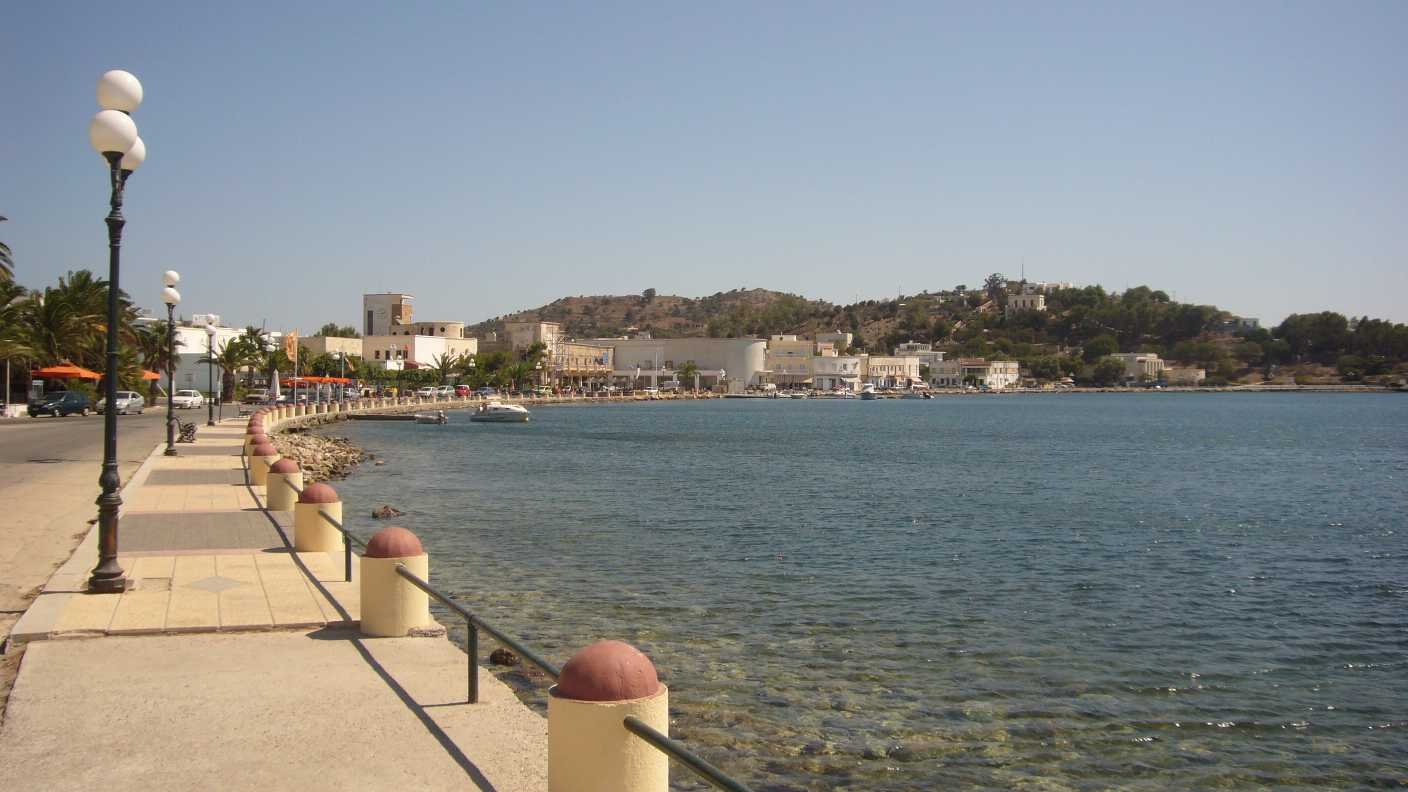
The model town Italian rule built from nothing on the bay of Leros: a complete rationalist city of wide eucalyptus avenues, a cinema, a market, a clock tower — planned by Rodolfo Petracco and Armando Bernabiti, and still lived in today under its Greek name, Lakki.
At a glance
Lakki, founded as Portolago, is the most complete Italian rationalist town outside Italy. Construction began in 1933–1934 under Mario Lago, governor of the Italian Aegean Islands, beside the great natural harbour of Leros where Italy was building its main naval base in the eastern Aegean. The civilian town was designed by Rodolfo Petracco and Armando Bernabiti between 1934 and 1938 on Modern Movement principles: functional zoning, wide tree-lined avenues, and a set of white public buildings — cinema-theatre, market with clock tower, church, school, hotel — whose curved, essential volumes critics have linked to the metaphysical townscapes of De Chirico. After the war the town passed to Greece with the Dodecanese (1947) and took the name Lakki. The ensemble survives largely intact and inhabited.
Key facts
- Founded: 1933–1934 as Portolago, under governor Mario Lago
- Architects: Rodolfo Petracco and Armando Bernabiti (1934–1938)
- Purpose: civilian town for the adjacent Italian naval base of Lepida/Gonià
- Plan: rationalist zoning — commercial, administrative, religious, residential, sports and military districts
- Landmarks: cinema-theatre, circular market with clock tower, church of San Nicola, former Albergo Roma
- Today: Lakki, Greece — the ensemble largely intact and in use
History
Italy occupied the Dodecanese in 1912 and, from the 1920s, made Leros its principal naval stronghold in the eastern Aegean: the deep, sheltered bay of Portolago was ringed with the base of Lepida, an airfield and defensive works. The new town rose beside them to house workers, garrison families and services — first a military foundation, then a civilian one, laid out from scratch on drained ground along the bay.
Petracco and Bernabiti gave the town its character: low white volumes, porticoes, curved corners, a slender clock tower, the round market building, the cinema with its long horizontal front. In 1943 Leros became a battlefield — the Battle of Leros, after the Italian armistice, ended with German occupation — and the bay’s later history included a notorious psychiatric hospital in the former barracks and, in recent years, a refugee camp. The town itself, renamed Lakki, remained: a working Greek port town living inside a rationalist plan.
What you see
The plan reads at street level: two main axes, generous avenues lined with eucalyptus, and the public buildings placed as freestanding white objects rather than street walls. The former cinema-theatre, the market rotunda with its clock tower and the church of San Nicola are the set pieces; between them run two- and three-storey houses with rounded balconies and flat roofs. Weathering is visible — restoration has come in waves — but the ensemble’s coherence is unmatched: this is not one rationalist building in a town, it is a rationalist town entire.
Visiting
Lakki is Leros’s main port: many visitors arrive by ferry directly into the rationalist waterfront. The town can be walked in an hour; the market, the cinema and the seafront avenue are the essential circuit. Leros is reached by ferry from Piraeus and neighbouring islands or by air from Athens. GPS: 37.13318, 26.85321 (Google Maps).
Related places and reading
- Grande Albergo delle Rose, Rhodes (1927) — the flagship hotel of Italian Rhodes
- Sabaudia — the Pontine sister of the same planning season
- Italian Rationalism and the Modern Movement — the language
Sources
- Studies on Portolago/Lakki and the Italian architecture of the Dodecanese (Petracco and Bernabiti, 1934–1938).
- Documentation on the Italian Aegean administration under Mario Lago and on the Leros naval base.
- Historical records of the Battle of Leros (1943) and the post-war history of the bay.
- OpenStreetMap/Nominatim (coordinates).
Find it on the map
See this place and what’s around it →Record researched and written by Luigi De Marchi for Cultural Heritage Online, 2026.
📷 Become a Cultural Heritage Online photographer
Share your photos of places: they stay published under your name as the author. The more they're seen, the more you get noticed — and soon a contest will reward the most appreciated photos.
Log in or sign up free to add a photo