
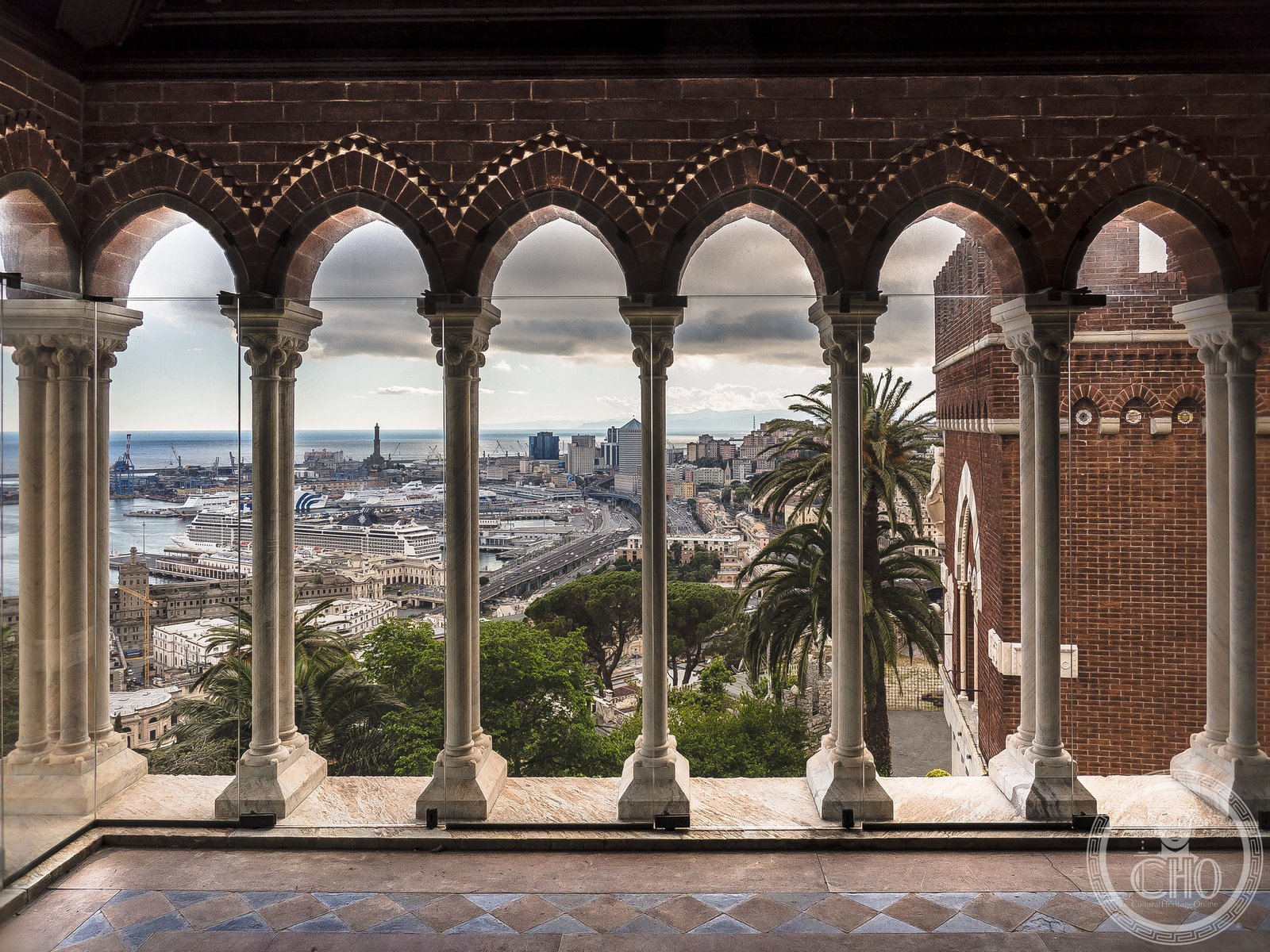
D’Albertis Castle is a picturesque neo-Gothic residence perched on the Montegalletto hill in Genoa, built in the 1890s by sea captain and explorer Enrico Alberto d’Albertis. Donated to the city upon his death in 1932, the castle today houses the Museo delle Culture del Mondo (Museum of World Cultures), inaugurated in 2004, which displays the remarkable ethnographic collections d’Albertis assembled during his voyages to the Americas, the Pacific, and beyond.
At a glance
- Type
- Municipal ethnographic and world cultures museum
- Period
- Castle built 1886–1892; donated to Genoa 1932; museum inaugurated 2004
- Style
- Eclectic neo-Gothic with Moorish and medieval elements
- Location
- Corso Dogali 18, 16136 Genoa, Liguria
- Coordinates
- 44.4184° N, 8.9246° E
Overview
Castello d’Albertis stands on the Montegalletto hill above Genoa’s historic port, commanding panoramic views over the city and the Ligurian Sea. The building was designed and personalised by its owner, the aristocratic sea captain and explorer Enrico Alberto d’Albertis (1846–1932), who filled its rooms with objects, instruments, and artefacts collected during decades of long-distance sailing. After his death the estate was gifted to the municipality and eventually converted into a museum dedicated to the world’s cultures, making the castle itself part of the exhibit — an eccentric Victorian explorer’s home frozen in time.
History
Enrico Alberto d’Albertis acquired the hilltop site and began construction of the castle in 1886, working with architect Alfredo d’Andrade to create a personal folly blending neo-Gothic towers, Moorish interiors, and medieval-style battlements. He sailed repeatedly to the Americas and to Australasia, documenting coastlines and collecting indigenous artefacts, navigational instruments, and natural history specimens. On his death in 1932 he bequeathed the castle and its contents to the city of Genoa. After decades as a naval museum, the complex was completely redesigned and reopened in 2004 as the Museo delle Culture del Mondo, administered by the municipality.
What you see
The museum is spread across the castle’s original rooms, preserving much of d’Albertis’s personal decor — period furniture, astronomical instruments, maritime charts, and personal memorabilia — alongside ethnographic collections from the Americas, the Pacific islands, and Africa. Highlights include pre-Columbian artefacts, indigenous objects from Patagonia and New Guinea, and a remarkable array of navigational tools used during d’Albertis’s own expeditions. The castle also hosts a section devoted to the history of the Columbus family in Genoa, given d’Albertis’s personal research into Columbus’s Ligurian origins. The surrounding terraced garden offers sweeping views of the port below.
Cultural significance
D’Albertis Castle represents a rare survival of a Victorian-era explorer’s private residence converted to public use with its character intact, making it one of the most atmospheric museums in northern Italy. Its ethnographic collections, assembled first-hand during genuine voyages of exploration, give it scientific value beyond its architectural appeal. The museum also contributes to Genoa’s broader identity as a city defined by its long tradition of seafaring, exploration, and maritime trade.
Practical information
- Address
- Corso Dogali 18, 16136 Genoa
- Opening hours
- Check official website for current hours; generally closed Mondays and Tuesdays
- Website
- museidigenova.it
Getting there
The castle is on the Montegalletto hill above the historic centre of Genoa. The most scenic approach is via the Ascensore Montegalletto (public lift) from Piazza del Portello. Alternatively, the city bus line 33 stops at Corso Dogali. From Genoa Principe train station the castle is roughly 15–20 minutes on foot uphill. Limited parking is available in the Corso Dogali area.
Sources & resources
See the place
Find it on the map
See this place and what’s around it →📷 Become a Cultural Heritage Online photographer
Share your photos of places: they stay published under your name as the author. The more they're seen, the more you get noticed — and soon a contest will reward the most appreciated photos.
Log in or sign up free to add a photoIs this page about you?
This page is read by travellers and heritage enthusiasts who find it on Google. Tell us how you are connected to this place and we will take it from there.