

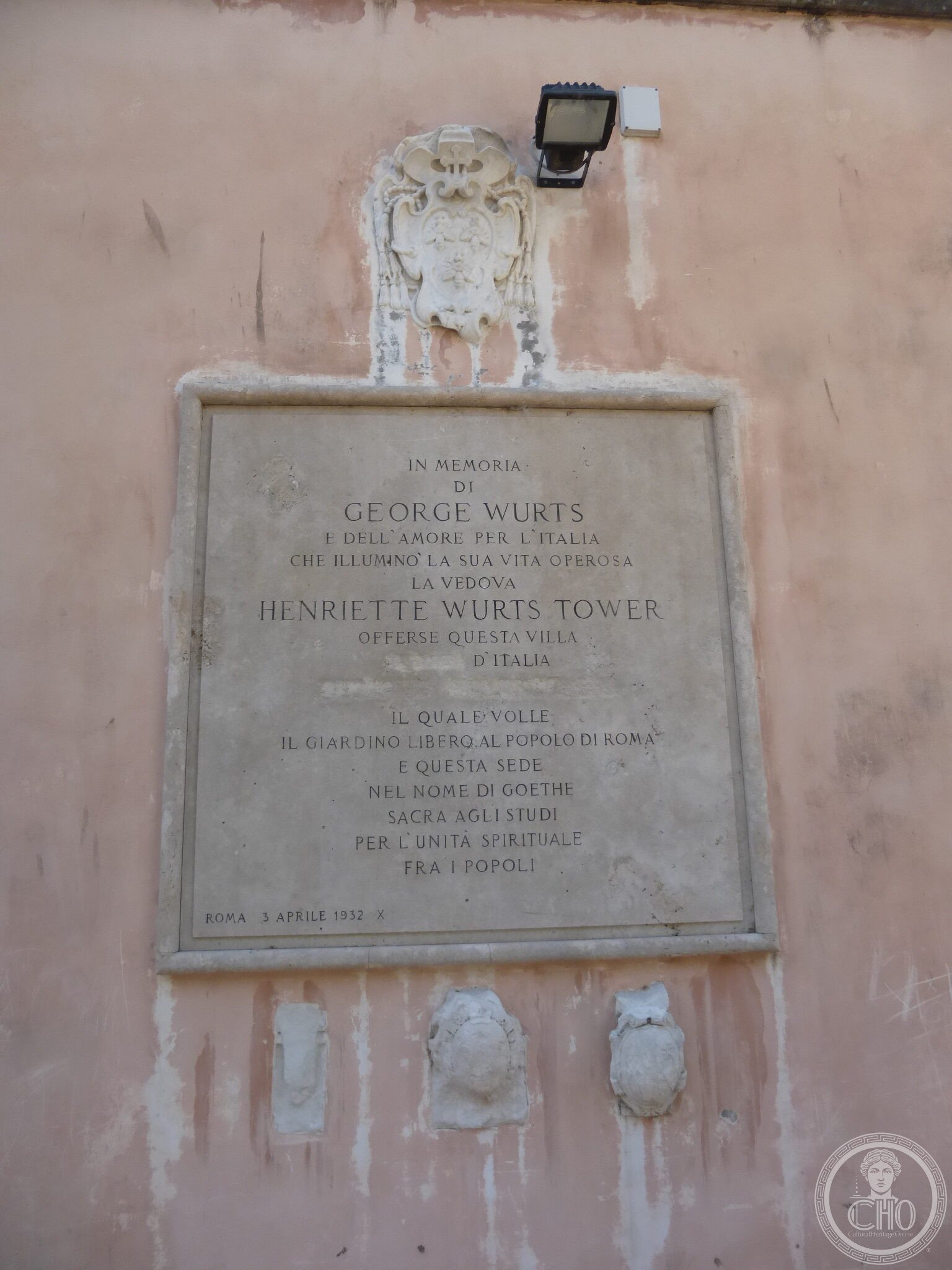
Villa Sciarra is a romantic 19th-century park and historic villa on the Gianicolo hill in the Trastevere district of Rome. Originally a patrician estate whose grounds were laid out as an English landscape garden, the property was purchased in 1902 by the American diplomat Geo. W. Wurts, who enriched it with a remarkable collection of Italian baroque fountains, statues, loggias, and aviaries. Donated to the Italian state in 1930, the villa gardens are now a beloved public park open free of charge.
At a glance
- Type
- Historic villa and public park
- Period
- Estate established by the late 16th century; major transformation in English landscape style in the 19th century; donated to Italy in 1930
- Style
- English landscape garden with baroque sculptural ornament
- Location
- Via Calandrelli 35, Trastevere, Rome — 41.8830° N, 12.4648° E
Overview
The 7-hectare park occupies a privileged position on the northern slope of the Gianicolo, offering tree-lined paths, seasonal flower beds, and quiet corners that attract Roman families and students from the nearby Istituto Italiano di Studi Germanici, which occupies the villa building. The grounds are famous for their extraordinary concentration of baroque garden sculptures — fountains, nymphs, herms, and allegorical figures — transplanted from various Italian estates by the Wurts family. Despite its relative obscurity among tourists, Villa Sciarra is one of the most charming green spaces in central Rome.
History
The estate’s origins date to the 16th century, when it was associated with the Barberini and later the Sciarra-Colonna family, who gave it its name. During the 19th century the grounds were reshaped in the prevailing Romantic English landscape style, replacing formal Italian parterres with winding paths, specimen trees, and a small lake. American diplomat George Wurts and his wife Henrietta Tower Wurts bought the estate in 1902 and spent decades assembling its sculptural programme from baroque gardens throughout Italy. In 1930 the property was donated to the Italian government and subsequently opened as a public park.
What you see
Visitors entering from Via Calandrelli encounter an immediate contrast between the traffic of Trastevere and the hushed allées of ilex, pine, and palm within the walls. The baroque fountain collection is the visual highlight: multi-figured compositions with tritons, dolphins, and mythological figures are scattered across the garden in deliberate theatrical arrangements. A small circular lake with a central fountain island sits near the upper terraces, and several pergolas and rustic loggias frame views toward the city below. The late-19th-century villa building at the park’s centre now houses the German humanities research institute.
Cultural significance
Villa Sciarra is one of the few historic private gardens in Rome that have survived intact as a coherent ensemble of landscape design and sculptural decoration from two distinct periods — the 19th-century Romantic garden and the early-20th-century Wurts collection. The park is listed among the historic green spaces of Rome protected under Italian cultural heritage law. Its relative quietness makes it an important refuge for biodiversity within the city’s urban fabric.
Practical information
The park is open daily from dawn to dusk; entrance is free. The villa building (Istituto Italiano di Studi Germanici) is not open to general visitors. Facilities within the park include benches and a small playground area. Address: Via Calandrelli 35, 00153 Rome.
Getting there
Villa Sciarra is best reached on foot from the Trastevere neighbourhood — approximately 10 minutes from Piazza Santa Maria in Trastevere. Tram line 8 stops at Viale Trastevere, a short walk away. Buses on the Gianicolo route also pass nearby. There is no metro station in the immediate vicinity; Trastevere rail station is about 15 minutes on foot.
Sources & resources
Find it on the map
See this place and what’s around it →📷 Become a Cultural Heritage Online photographer
Share your photos of places: they stay published under your name as the author. The more they're seen, the more you get noticed — and soon a contest will reward the most appreciated photos.
Log in or sign up free to add a photoIs this page about you?
This page is read by travellers and heritage enthusiasts who find it on Google. Tell us how you are connected to this place and we will take it from there.