
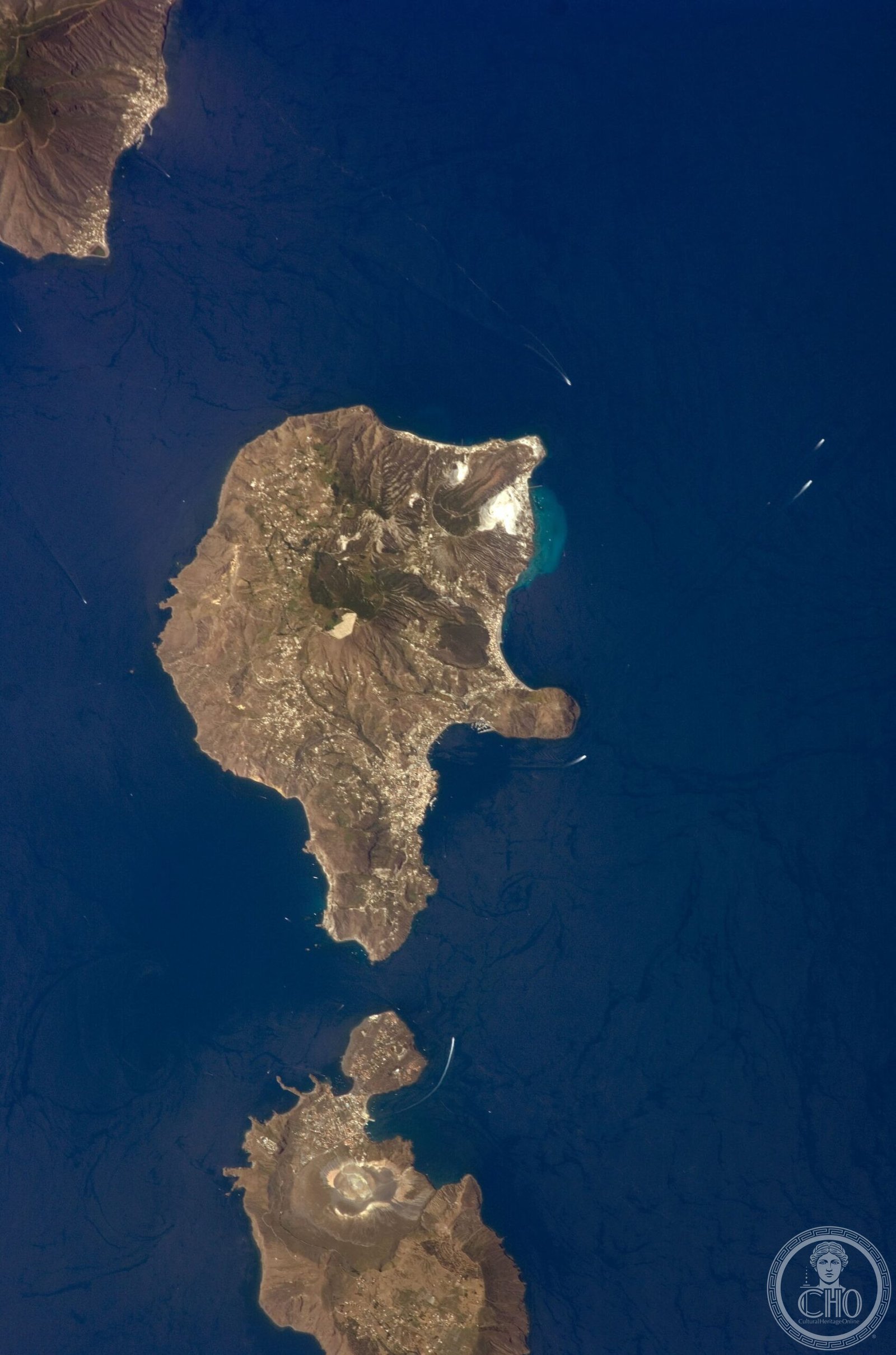
Aeolian Islands
The Aeolian Islands are a volcanic archipelago in the Tyrrhenian Sea north of Sicily, comprising seven main islands — Lipari, Vulcano, Stromboli, Salina, Filicudi, Alicudi and Panarea. Inhabited since the Neolithic period and inscribed as a UNESCO World Heritage Site in 2000, the islands are celebrated for their active volcanism, exceptional prehistoric heritage, and crystal waters that draw up to 600,000 visitors every summer.
At a glance
- Type
- Volcanic archipelago · UNESCO World Heritage Site
- Period
- Inhabited from c. 4000 BCE (Neolithic); UNESCO inscription 2000
- Style
- Natural and cultural landscape; active volcanic geology
- Location
- Tyrrhenian Sea, north of Sicily, Province of Messina, Italy
- Coordinates
- 38.4824° N, 14.9376° E
- Islands
- Lipari (largest), Vulcano, Stromboli, Salina, Filicudi, Alicudi, Panarea
Overview
The Aeolian Islands, also called the Lipari Islands after their largest island, take their name from Aeolus, the mythical ruler of the winds in Greek tradition. The archipelago lies about 25 kilometres north of the Sicilian coast and covers a combined land area of roughly 115 square kilometres. With a resident population of around 15,000, the islands balance a living community with one of Italy’s most visited natural and cultural heritage destinations.
The islands were inscribed on the UNESCO World Heritage List in 2000 for their outstanding geological value, as they illustrate ongoing volcanic processes and have provided scientists with a classic reference for understanding different eruption types — the Vulcanian and Strombolian styles are both named after islands here. The archipelago also contains exceptional Neolithic and Bronze Age archaeological evidence documenting prehistoric trade routes across the central Mediterranean.
History
Human settlement on the Aeolian Islands dates to approximately 4000 BCE, when Neolithic communities arrived drawn by the volcanic obsidian that could be knapped into sharp tools and traded widely. By the Bronze Age the islands had become a significant maritime hub, controlling trade routes between the western and eastern Mediterranean. Greek colonists from Cnidus and Rhodes founded the city of Lipara on Lipari around 580 BCE, building temples and fortifications whose remains are still visible today. The islands passed through Carthaginian, Roman and Byzantine rule before becoming part of the Norman Kingdom of Sicily in the twelfth century.
During the medieval period Lipari served as an episcopal seat and a place of exile, including for a number of early Christian saints. Repeated raids by Barbary pirates in the sixteenth century — most devastatingly in 1544 under Khair ad-Din Barbarossa — depopulated several islands for decades. Gradual resettlement followed under Spanish Bourbon rule, and the economy diversified from obsidian into pumice, capers, Malvasia wine and, eventually, tourism.
What you see
Each island in the archipelago has a distinct character. Lipari hosts the Museo Archeologico Eoliano, one of Italy’s richest prehistoric museums, housed within a Norman-era citadel above the main port. Stromboli is dominated by its permanently active volcano, whose nightly lava flows into the sea are visible from the shore and attract guided night hikes. Vulcano offers the Gran Cratere hiking trail and therapeutic sulfurous mud pools. Salina, the greenest and highest island, is covered with vineyards producing the celebrated Malvasia delle Lipari DOC wine and capered fields that supply restaurants across Italy.
The coastlines of all seven islands are characterised by dramatic basalt cliffs, sea stacks and pumice beaches. Underwater, the waters are among the clearest in the Mediterranean and support rich marine life within a protected marine reserve.
Cultural significance
The Aeolian Islands occupy a foundational place in the archaeology of the prehistoric Mediterranean, having yielded one of the most complete sequences of Bronze Age material culture in the central Mediterranean basin. Their ongoing volcanic activity continues to make them a living laboratory for volcanology, geology and ecology. UNESCO recognition in 2000 confirmed their outstanding universal value for both natural science and cultural heritage.
Practical information
- Main hub
- Lipari — central ferry and hydrofoil connections to all other islands
- Museum
- Museo Archeologico Regionale Eoliano “Luigi Bernabò Brea”, Lipari — check official website for hours and admission
- Best season
- May–June and September–October for mild weather and fewer crowds; July–August peak season
- Notes
- Stromboli summit access restricted; guided tours required above 290 m
Getting there
Hydrofoil and ferry services operate year-round from Milazzo (Sicily), with journey times of around 55 minutes to Lipari by hydrofoil. Seasonal services also run from Naples, Palermo, Messina and Reggio Calabria. Milazzo is reachable by train from Messina (approximately 45 minutes) and by road from Palermo (around 3 hours). No private vehicles may be brought to most of the smaller islands; scooter and bicycle hire is available on Lipari, Salina and Vulcano.
Sources & resources
Find it on the map
See this place and what’s around it →📷 Diventa un fotografo di Cultural Heritage Online
Condividi le tue foto dei luoghi: restano pubblicate con la tua firma come autore. Più vengono viste, più ti fai conoscere — e presto un concorso premierà le foto più apprezzate.
Accedi o registrati gratis per aggiungere una foto