
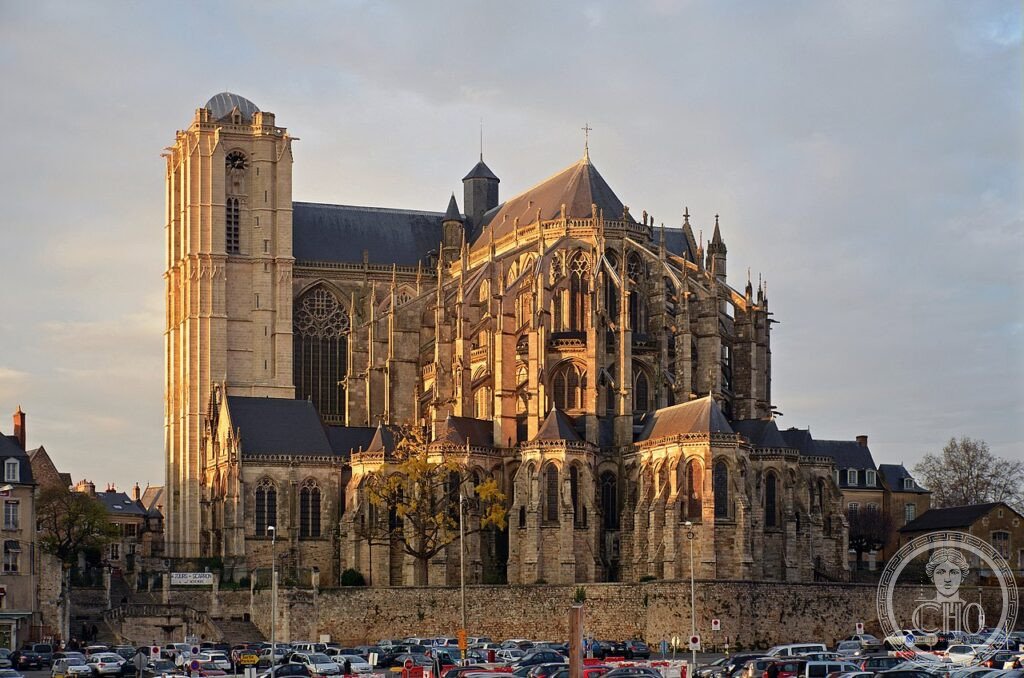
134 metres long, the cathedral of Le Mans juxtaposes two different buildings with no mediation between them: a Romanesque nave, with extremely domed Angevin vaults, and a Gothic choir built a century later. In the nave, the Ascension window, of around 1120, is the oldest still in place in France.
At a glance
Le Mans Cathedral (Cathédrale Saint-Julien) presents an architecturally complex building in which a Romanesque nave and a Gothic choir stand directly juxtaposed, two genuinely distinct structures rather than a single stylistically unified whole. The nave was begun by Bishop Hoël at the end of the 11th century and completed by his successor Hildebert de Lavardin (died 1126), before Guillaume de Passavant (bishop 1145-1182) carried out structural reinforcement work that gave the nave its present appearance, including its distinctive alternating supports and extremely bulging Angevin-style vaults. The Gothic choir, begun around 1221, was largely complete by its 1254 consecration, with the final vaults not raised until the second half of the 13th century and the whole project finished by 1273. At 134 metres long and covering 5,000 square metres, the cathedral is among the largest in France, and its stained-glass collection — spanning the 12th, 13th, and 15th centuries, including the Ascension window of around 1120, the oldest stained glass still in its original location in France — ranks alongside Chartres as one of the finest surviving medieval glass ensembles in the country.
Key facts
- Romanesque nave: begun late 11th century under Bishop Hoël, completed by Hildebert de Lavardin (died 1126); reinforced and given its present form under Guillaume de Passavant (1145-1182), with alternating supports and extremely bulging Angevin vaults.
- Gothic choir: begun c. 1221, largely complete at its 1254 consecration; vaults raised in the second half of the 13th century; whole project finished 1273.
- Scale: 134 metres long, 5,000 square metres — among the largest cathedrals in France.
- Ascension window: c. 1120, in the nave — the oldest stained glass still in its original location anywhere in France.
- 13th-century glazing campaign: 1230-1270, new windows funded by the city’s trade and craft guilds — a notable instance of civic/commercial rather than purely ecclesiastical or royal patronage of cathedral glass.
History
Le Mans’s position as the historic capital of the Plantagenet dynasty’s ancestral county of Maine — the family that would go on to rule England as well as vast French territories — gave the city’s cathedral project unusual resources and ambition across its long medieval construction history, reflected in both the scale of the eventual building and the quality of its surviving decorative programme. The specific decision to build an entirely new Gothic choir from 1221 while retaining the earlier Romanesque nave rather than replacing the whole structure produced the cathedral’s most distinctive characteristic: rather than a single coherent stylistic vision, visitors encounter two genuinely different medieval buildings standing end to end, the nave’s rounded Romanesque arches and heavily bulging Angevin vaults giving way abruptly to the choir’s more vertically emphatic, structurally lighter Gothic forms.
The cathedral’s stained glass reflects a similarly layered history of patronage across several centuries: the Ascension window of around 1120, surviving as the oldest stained glass still in its original cathedral setting anywhere in France, predates the Gothic choir by a full century, having been created for and installed in the earlier Romanesque nave; the substantial glazing campaign of 1230-1270, meanwhile, was specifically funded by Le Mans’s trade and craft guilds rather than exclusively by ecclesiastical or royal patrons, a pattern of civic commercial investment in cathedral decoration documented at several major French Gothic cathedrals of the period and reflecting the growing economic and civic self-confidence of medieval French towns during the 13th century.
What you see
The direct architectural contrast between the Romanesque nave and Gothic choir is the cathedral’s essential visual experience, best appreciated by walking the building’s full 134-metre length and observing the transition from the nave’s rounded arches and bulging Angevin vaults to the choir’s taller, more structurally refined Gothic forms. The Ascension window, in the nave, rewards close attention as the oldest surviving in-situ stained glass in France, while the broader 13th-century glazing campaign — funded by the city’s guilds — fills much of the choir with narrative and decorative glass from the same broad period as the architecture surrounding it. The cathedral’s choir stalls and the “Petite Mise au Tombeau” (small entombment sculpture group) add further significant decorative elements to a building whose overall scale places it among France’s largest cathedrals.
Practical information
- Opening hours: Monday-Friday 9:00-18:00, Saturday 9:00-19:00, Sunday 9:00-18:00.
- Admission: free.
- Address: 2 Place Saint-Michel, 72000 Le Mans.
Getting there
Le Mans has direct TGV rail connections from Paris Gare Montparnasse, taking approximately 1 hour, making it a practical day trip from the French capital. By car, Le Mans sits at the junction of the A11 and A28 motorways. The cathedral stands in the Cité Plantagenêt, Le Mans’s well-preserved medieval quarter, walkable from Le Mans station in approximately 15-20 minutes. GPS: 48.0093° N, 0.1988° E.
Nearby
- Cité Plantagenêt — the historic quarter directly surrounding the cathedral; well-preserved medieval and Renaissance streets and half-timbered houses.
- Gallo-Roman city walls of Le Mans — encircling part of the Cité Plantagenêt; among the best-preserved late Roman defensive walls in France.
- Circuit des 24 Heures du Mans — on the edge of the city; the world-famous endurance motor racing circuit, unrelated to the historic centre but a major regional association.
Sources
- Cathédrale Saint-Julien Le Mans — official parish visitor portal (cathedraledumans.fr).
- Ville du Mans — “La cathédrale Saint-Julien” (lemans.fr).
- Le Mans Tourisme — official visitor information (lemans-tourisme.com).
- Wikipedia — “Cathédrale Saint-Julien du Mans” (fr.wikipedia.org).
Find it on the map
See this place and what’s around it →📷 Become a Cultural Heritage Online photographer
Share your photos of places: they stay published under your name as the author. The more they're seen, the more you get noticed — and soon a contest will reward the most appreciated photos.
Log in or sign up free to add a photoIs this page about you?
This page is read by travellers and heritage enthusiasts who find it on Google. Tell us how you are connected to this place and we will take it from there.