
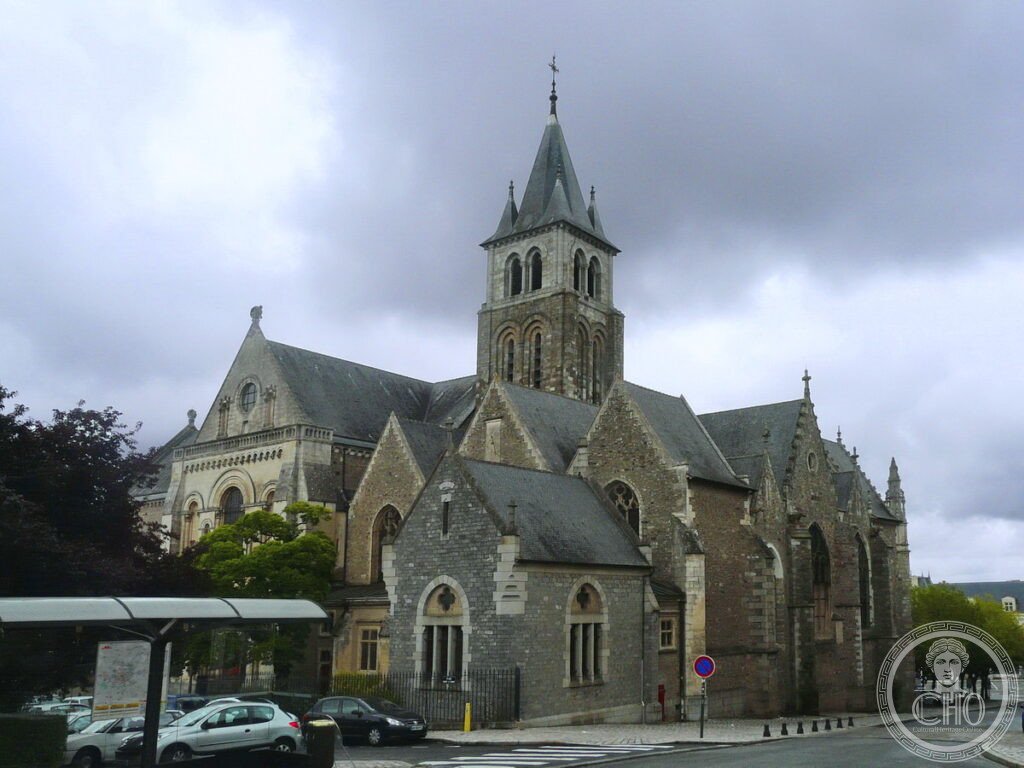
Born as a simple monks’ chapel in 1070, then a parish church from 1160, the Trinité of Laval accumulated Angevin Gothic naves, Renaissance chapels and finally a Neo-Romanesque portal before gaining, only in 1855, with the creation of the diocese, the title of cathedral.
At a glance
Laval Cathedral (Cathédrale de la Sainte-Trinité) began its life around 1070 as a monastic chapel built by monks from La Couture du Mans on the outskirts of Laval castle. It initially functioned only as a dependency of the Pritz priory rather than as an independent church. It gained status as Laval’s parish church in 1160, subsequently receiving a nave covered with distinctive bulging (“domed”) ribbed vaults in the Angevin or Plantagenet Gothic style associated with the wider Anjou region. A major expansion between 1485 and 1595 added a left side aisle documenting the transition from Flamboyant Gothic to Renaissance style, including two chapels built 1517-1541 in a full Renaissance architectural break from the rest of the building. Despite this long accumulation of building phases, the church did not become a cathedral until 1855, when the Diocese of Laval was created. This designation prompted further regularising additions, including a Neo-Romanesque west portal and an elevated crossing tower modelled on Saint-Germain-des-Prés in Paris.
Key facts
- Origins: c. 1070, built by monks from La Couture du Mans as a dependency of the Pritz priory; gained status as Laval’s parish church in 1160.
- Angevin Gothic nave: covered with bulging ribbed vaults in the Plantagenet/Angevin Gothic style, added following the church’s elevation to parish status.
- 1485-1595 expansion: a left side aisle documenting the transition from Flamboyant Gothic to Renaissance style; two chapels built 1517-1541 in full Renaissance style, including an oval dome, marking a complete architectural break from the rest of the building.
- Cathedral status: only achieved in 1855, with the creation of the Diocese of Laval — over 780 years after the building’s origins as a monastic chapel.
- 1855 regularisation: addition of a Neo-Romanesque west portal, a new metal roof framework, and an elevated crossing tower modelled on the church of Saint-Germain-des-Prés in Paris.
History
Laval Cathedral’s building history is defined less by any single coherent architectural vision than by nearly eight centuries of incremental accumulation. Each phase reflects the priorities and resources of its own period rather than any master plan for the eventual whole. What began as a modest monastic dependency chapel in 1070 grew, through its 1160 promotion to parish church, its Angevin Gothic nave vaulting, its late-15th to 16th-century Flamboyant-to-Renaissance expansion, and its eventual 1855 cathedral-status regularisation, into a building whose different sections visibly belong to entirely different centuries and stylistic traditions. Architectural historians describe this composite character as lacking real stylistic coherence, but it also makes the building an unusually legible record of successive building phases across nearly a millennium.
The gap between the church’s medieval and early modern building phases and its eventual 1855 elevation to cathedral status reflects the specific administrative history of French Catholic dioceses. Many of these were created, suppressed, or reorganised at various points to reflect shifting political geography. The Diocese of Laval’s creation in 1855 gave the city, which had functioned for centuries without its own bishopric despite the antiquity and continuous religious use of the Trinity church, formal ecclesiastical status matching its established regional significance. The additions made specifically to mark this new status — the Neo-Romanesque portal and the crossing tower modelled on the prestigious Parisian abbey church of Saint-Germain-des-Prés — represent a deliberate 19th-century attempt to give the building a more monumental, cathedral-appropriate presence, layered onto centuries of earlier, more organically accumulated construction.
What you see
The building’s composite character rewards a visit specifically aimed at tracing its successive construction phases: the Angevin Gothic nave with its distinctive bulging vault profile, the Renaissance chapels of 1517-1541 with their oval dome and elaborate portal detail, standing in deliberate stylistic contrast to the surrounding medieval fabric, and the 19th-century Neo-Romanesque portal and Saint-Germain-des-Prés-inspired crossing tower added at the moment of the building’s 1855 promotion to cathedral status. The interior furnishings — altarpieces, statues, triptychs, funerary monuments, tapestries, and the cathedral organ — add a further, richly varied layer reflecting the accumulated patronage of a building in continuous religious use for nearly a millennium.
Practical information
- Opening hours: 1 April-30 September, 9:30-19:00 (10:00-19:00 in July-August); 1 October-31 March, 9:30-18:00.
- Admission: free; a reception team is on hand for a few hours daily.
- Address: Rue Renaise, 53000 Laval.
Getting there
Laval has direct TGV rail connections from Paris (approximately 1.5 hours) and Rennes (approximately 45 minutes). By car, Laval sits on the A81 motorway (Paris-Rennes). The cathedral stands in the historic centre on the right bank of the Mayenne river. GPS: 48.0681° N, -0.7736° E.
Nearby
- Château de Laval — a short walk from the cathedral; a medieval fortress combining a Romanesque keep with Renaissance additions, overlooking the Mayenne river.
- Vieux Laval (old town) — surrounding the cathedral; half-timbered medieval streets along the Mayenne.
- Mont-Saint-Michel — approximately 1.5 hours by car; the UNESCO-listed tidal island abbey.
Sources
- Patrimoine de la ville de Laval — “Cathédrale de la Sainte-Trinité, 11ème-20ème siècles” (patrimoine.laval.fr).
- Office de Tourisme Laval Agglomération — visitor information (laval-tourisme.com).
- Wikipedia — “Cathédrale de la Sainte-Trinité de Laval” (fr.wikipedia.org).
- Les églises de la Mayenne — historical documentation (leseglisesdelamayenne.fr).
Find it on the map
See this place and what’s around it →📷 Become a Cultural Heritage Online photographer
Share your photos of places: they stay published under your name as the author. The more they're seen, the more you get noticed — and soon a contest will reward the most appreciated photos.
Log in or sign up free to add a photoIs this page about you?
This page is read by travellers and heritage enthusiasts who find it on Google. Tell us how you are connected to this place and we will take it from there.