

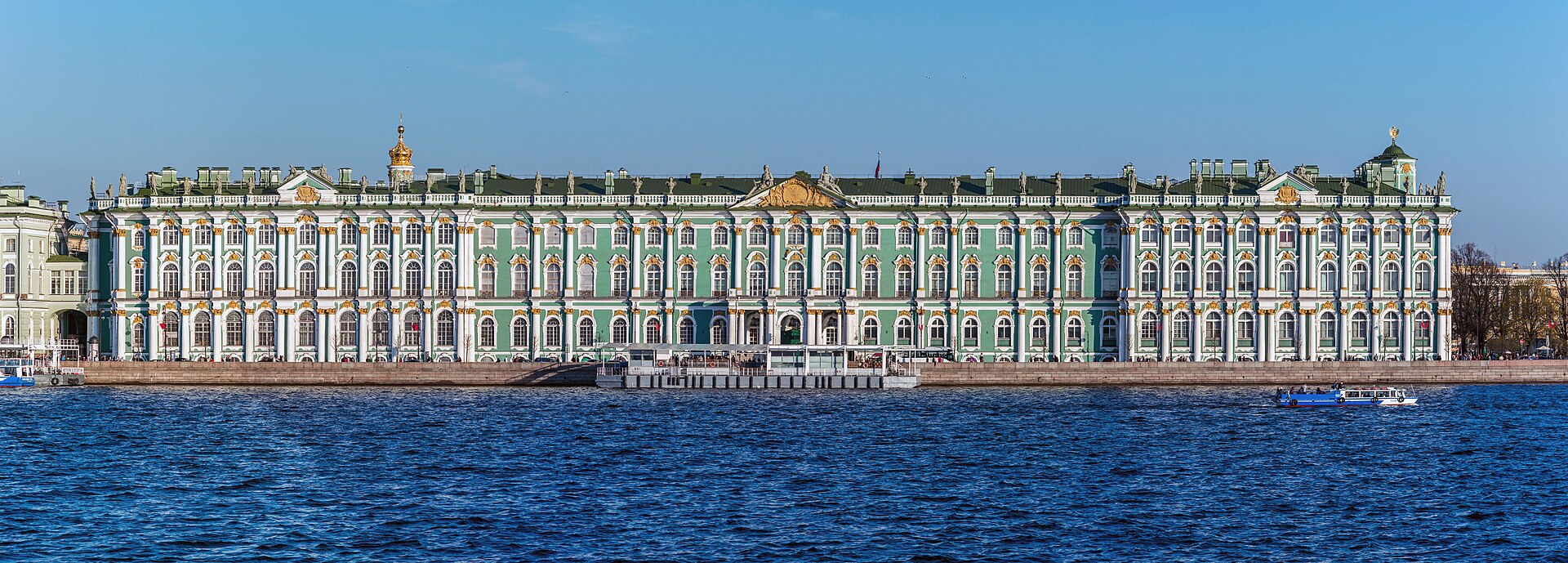
The State Hermitage Museum is one of the largest and most celebrated art and culture museums in the world, located along the Neva River embankment in Saint Petersburg, Russia. Founded in 1764 when Empress Catherine the Great acquired a collection of paintings from Berlin merchant Johann Ernst Gotzkowsky, it has grown into a complex of six historic buildings — centred on the Winter Palace — housing a permanent collection of over three million works spanning art, archaeology, and applied decorative arts from antiquity to the 20th century.
At a glance
- Type
- State art and cultural history museum
- Period
- Founded 1764; open to the public since 1852
- Style
- Baroque and neoclassical palace complex (Winter Palace: Bartolomeo Rastrelli, 1754–1762)
- Location
- Palace Embankment 34, Saint Petersburg, Russia
- Coordinates
- 59.9400° N, 30.3142° E
Overview
The State Hermitage Museum holds the largest collection of paintings in the world and ranks among the top ten most visited art museums globally, attracting nearly three million visitors in 2022. Its six interconnected buildings on Palace Square include the Winter Palace — the former official residence of Russian tsars — the Small Hermitage, the Old Hermitage, the New Hermitage, the Hermitage Theatre, and the General Staff Building. The collection encompasses ancient Egyptian and Greek artefacts, Renaissance and Baroque masterworks, Impressionist and Post-Impressionist paintings, and vast holdings of applied arts and decorative objects.
History
Catherine the Great’s 1764 purchase of 225 Dutch and Flemish paintings is traditionally considered the museum’s founding moment. Over the following decades, Catherine and her successors assembled one of the world’s greatest private art collections, acquiring entire collections from European dealers and rulers. The museum opened to the public in 1852 under Nicholas I. In the early Soviet period, the Hermitage’s holdings were dramatically altered — many masterworks were sold abroad to raise foreign currency — but the collection was rebuilt through nationalisation of private collections and state acquisitions throughout the 20th century.
What you see
Visitors enter through the Jordan Staircase of the Winter Palace, an overwhelming Baroque set-piece of gilded stucco, frescoed ceilings, and coloured marble. The museum’s 350 galleries span three million square feet and display works ranging from Rembrandt and Rubens to Matisse and Picasso. Highlights include the Knight’s Hall of medieval armour, the gold rooms of Scythian antiquities, the Raphael Loggias (a faithful copy of the Vatican originals commissioned by Catherine), and the world-class collection of French Impressionist and Post-Impressionist paintings in the General Staff Building.
Cultural significance
The Hermitage is a global symbol of the encyclopedic museum tradition and a monument to the cosmopolitan ambitions of the Russian imperial court. Its holdings document the movement of art and cultural objects across continents and centuries, making it an irreplaceable resource for the study of world art history. It holds UNESCO recognition and is listed among the world’s most significant cultural institutions.
Practical information
- Address
- Palace Embankment 34, Saint Petersburg 190000, Russia
- Opening hours
- Tuesday–Sunday 10:30–18:00; Wednesday 10:30–21:00; closed Monday. Check the official website for current hours and admission prices.
- Admission
- Charged; free for Russian citizens under 18 and on specific public days
- Website
- hermitagemuseum.org
Getting there
The Hermitage is a 10-minute walk from Nevsky Prospekt, Saint Petersburg’s main boulevard. The nearest metro stations are Admiralteyskaya (Line 5, Purple) and Nevsky Prospekt (Lines 2 and 3, Blue and Green). Numerous bus and trolleybus routes serve Palace Square. Water taxis on the Neva River also stop nearby in summer.
Sources & resources
- State Hermitage Museum — Wikipedia
- State Hermitage Museum (official website)
- Cultural Heritage Online
See the place
Find it on the map
See this place and what’s around it →Events here — now on & upcoming
- Anniversary: The Storming of the Winter Palace — November 7, 191707 Nov 2027See the event →
📷 Become a Cultural Heritage Online photographer
Share your photos of places: they stay published under your name as the author. The more they're seen, the more you get noticed — and soon a contest will reward the most appreciated photos.
Log in or sign up free to add a photo