
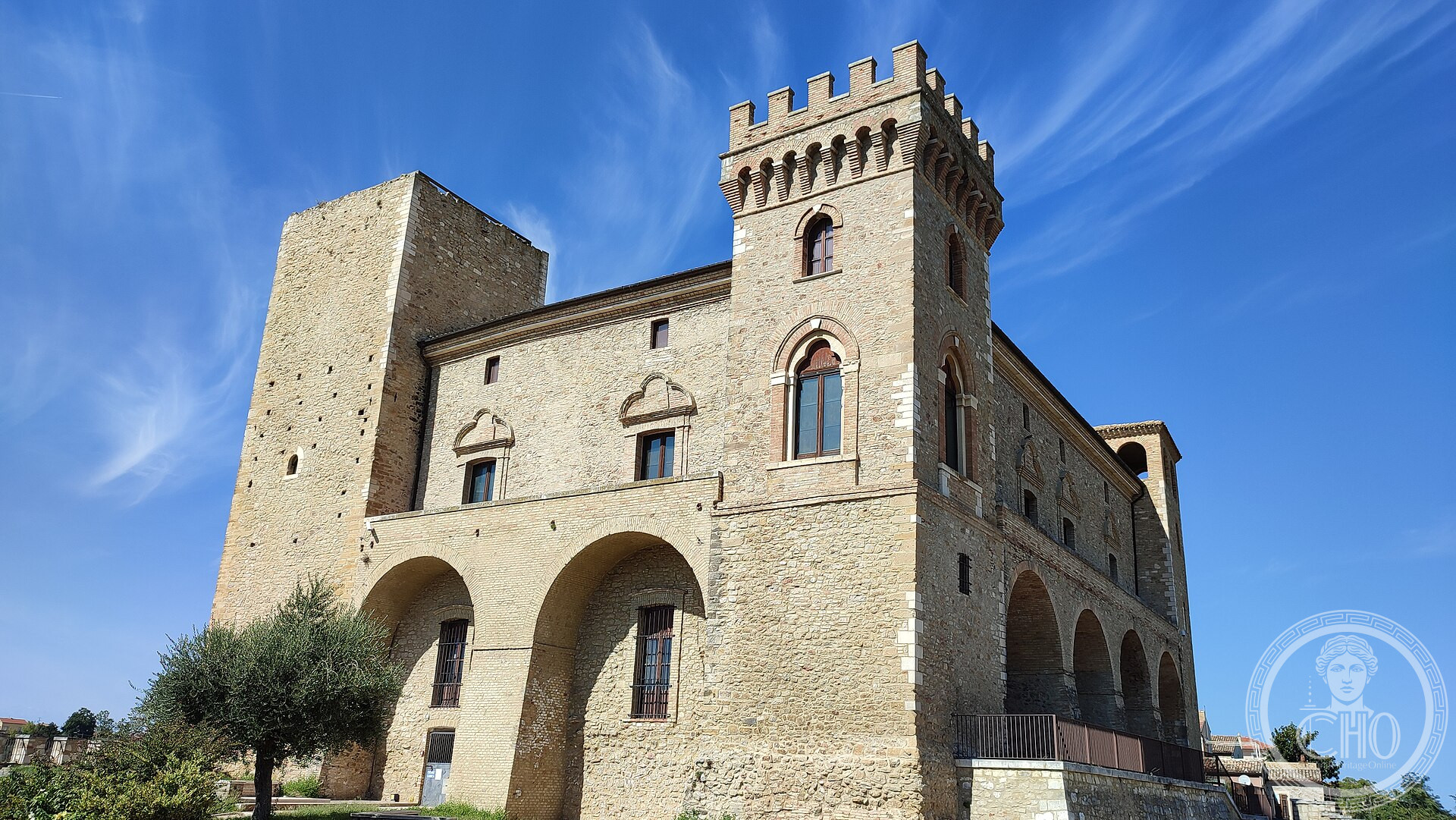
The Ducal Castle of Crecchio is a medieval fortress dominating the hilltop village of Crecchio in the Province of Chieti, Abruzzo, dating to the 12th century. Converted into a noble residence by 1789 and adopted as the ancestral seat of the de Riseis family, it became a site of unexpected 20th-century history when King Victor Emmanuel III of Italy sheltered within its walls on 10 September 1943, the night after Italy’s armistice with the Allies, before departing from the nearby port of Ortona. Today it houses an Etruscan and Byzantine museum and anchors one of Italy’s most beautiful villages.
At a glance
- Type
- Medieval castle; noble residence; museum
- Period
- 12th century; converted to residential use 1789
- Style
- Medieval military fortification; later adapted for aristocratic residence
- Location
- Crecchio, Province of Chieti, Abruzzo, Italy
- Coordinates
- 42.2966° N, 14.3267° E
Overview
The Ducal Castle of Crecchio stands as the most prominent landmark of the medieval village of Crecchio, recognised as one of the borghi più belli d’Italia (Italy’s most beautiful villages). Rising over the surrounding countryside of the Chieti hinterland, the castle has served successively as a military stronghold, a noble family seat, and a cultural institution housing important archaeological collections. Its walls witnessed one of the most dramatic moments in Italian 20th-century history.
History
The castle dates to the 12th century, constructed to assert feudal control over the surrounding territory and provide a defensible stronghold in a strategically elevated position. Over the following centuries it passed through various noble hands before being converted from a purely military function to a residential palazzo in 1789, becoming the ancestral seat of the de Riseis family. In 1926, Prince Umberto of Savoy and his bride briefly stayed at the castle during their honeymoon travels through Abruzzo. The castle’s most historically resonant moment came on 10 September 1943, when King Victor Emmanuel III, fleeing Rome in the chaotic hours following Italy’s armistice with the Allied powers, spent a night here before departing for exile from the port of Ortona.
What you see
The castle dominates the hilltop of Crecchio with a solid medieval mass that speaks to its origins as a defensive structure. Its walls and towers are integrated into the fabric of the village, which retains a remarkably intact medieval character with narrow stone lanes and traditional Abruzzese architecture. Inside, the rooms that once served as a noble residence now house the Etruscan and Byzantine museum, displaying artefacts recovered from the surrounding area that span millennia of continuous human settlement. The views from the castle over the rolling Abruzzese landscape and towards the Adriatic coast are exceptional.
Cultural significance
Beyond its architectural and historical value, the Ducal Castle of Crecchio holds a unique place in modern Italian history as a refuge for the monarchy at its most vulnerable moment. The castle today serves as a focal point for Abruzzo’s heritage tourism, combining medieval atmosphere with archaeological collections that illuminate the deep human history of a region often overlooked in favour of more famous Italian destinations.
Practical information
- Address
- Via Castello, Crecchio, 66010 Chieti CH
- Museum
- Etruscan and Byzantine Museum (Museo Etrusco-Bizantino) housed within the castle
- Opening hours
- Check official website or contact the municipality of Crecchio for current opening times
Getting there
Crecchio lies approximately 20 km south-east of Chieti and 25 km west of Lanciano. The nearest railway station is Lanciano, served by regional trains from Pescara (approx. 30 min). From Lanciano, Crecchio is reachable by local bus or taxi. Travelling by car from the A14 Adriatica motorway, take the Lanciano exit and follow signs for Crecchio via the SS84 road.
Sources & resources
Find it on the map
See this place and what’s around it →📷 Become a Cultural Heritage Online photographer
Share your photos of places: they stay published under your name as the author. The more they're seen, the more you get noticed — and soon a contest will reward the most appreciated photos.
Log in or sign up free to add a photo