

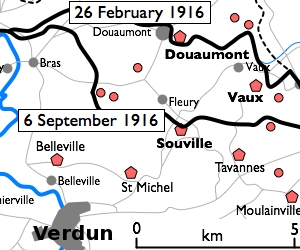
The largest fortress in Verdun’s defensive ring, Fort Douaumont became a symbol of military vulnerability during World War I when German forces captured it in a single day, triggering a nine-month battle that reshaped modern warfare.
At a glance
Fort Douaumont was the highest and most substantial of 19 large defensive works protecting Verdun since the 1890s. By 1915, advances in weaponry had rendered it strategically obsolete, a fact the fort’s fate would brutally confirm.
History
Built as part of Verdun’s ring fortifications in the 1890s, Fort Douaumont represented the cutting edge of defensive architecture. Yet technological progress outpaced fortification design. German 420 mm Gamma guns—super-heavy howitzers introduced in 1914—had already reduced Belgian forts to rubble, convincing the French General Staff that Verdun’s fortresses could not survive modern artillery bombardment.
By 1915, the French made a fateful decision: Fort Douaumont and other Verdun forts were partly disarmed and left virtually undefended. On 25 February 1916, just three days into the Battle of Verdun, a small German raiding party of only 19 officers and 79 men entered the fort through an open window overlooking the moat and occupied it without firing a shot. The fort’s fall shocked the French Army and initiated a nine-month battle of immense human suffering.
French forces finally recaptured Douaumont on 24 October 1916, when three infantry divisions of the Second Army retook it during the First Offensive Battle of Verdun, bringing the 1916 phase of the battle toward closure.
What you see
The fort’s physical design reflects late-19th-century military thinking: a substantial hilltop stronghold with defensive works arranged in a ring formation around Verdun. Its position as the highest fort in the defensive system underscored its intended strategic importance, though this prominence also made it a prime target once the battle commenced.
Cultural significance
Fort Douaumont stands as a stark testament to the obsolescence of fixed fortifications in the age of mechanised warfare. Its bloodless capture and subsequent recapture encapsulate the Battle of Verdun—one of World War I’s deadliest engagements—and the grinding attrition that defined the Western Front. The fort remains emblematic of military strategy’s vulnerability to technological change.
Key facts
- Country: France
- City: Verdun
- Period: Built 1890s; pivotal engagement February–October 1916
- Coordinates: 49.2169, 5.4383
- UNESCO World Heritage Site: Yes (as part of Verdun battlefield)
Practical information & getting there
Fort Douaumont is located on the heights north of Verdun in northeastern France. The site is accessible to visitors year-round and forms part of the larger Verdun battlefield memorial landscape, which includes museums, cemeteries, and interpretive centres throughout the region. Information on opening hours, guided tours, and visitor facilities is available through local Verdun tourism services.
Sources & resources
Find it on the map
See this place and what’s around it →📷 Become a Cultural Heritage Online photographer
Share your photos of places: they stay published under your name as the author. The more they're seen, the more you get noticed — and soon a contest will reward the most appreciated photos.
Log in or sign up free to add a photoIs this page about you?
This page is read by travellers and heritage enthusiasts who find it on Google. Tell us how you are connected to this place and we will take it from there.