
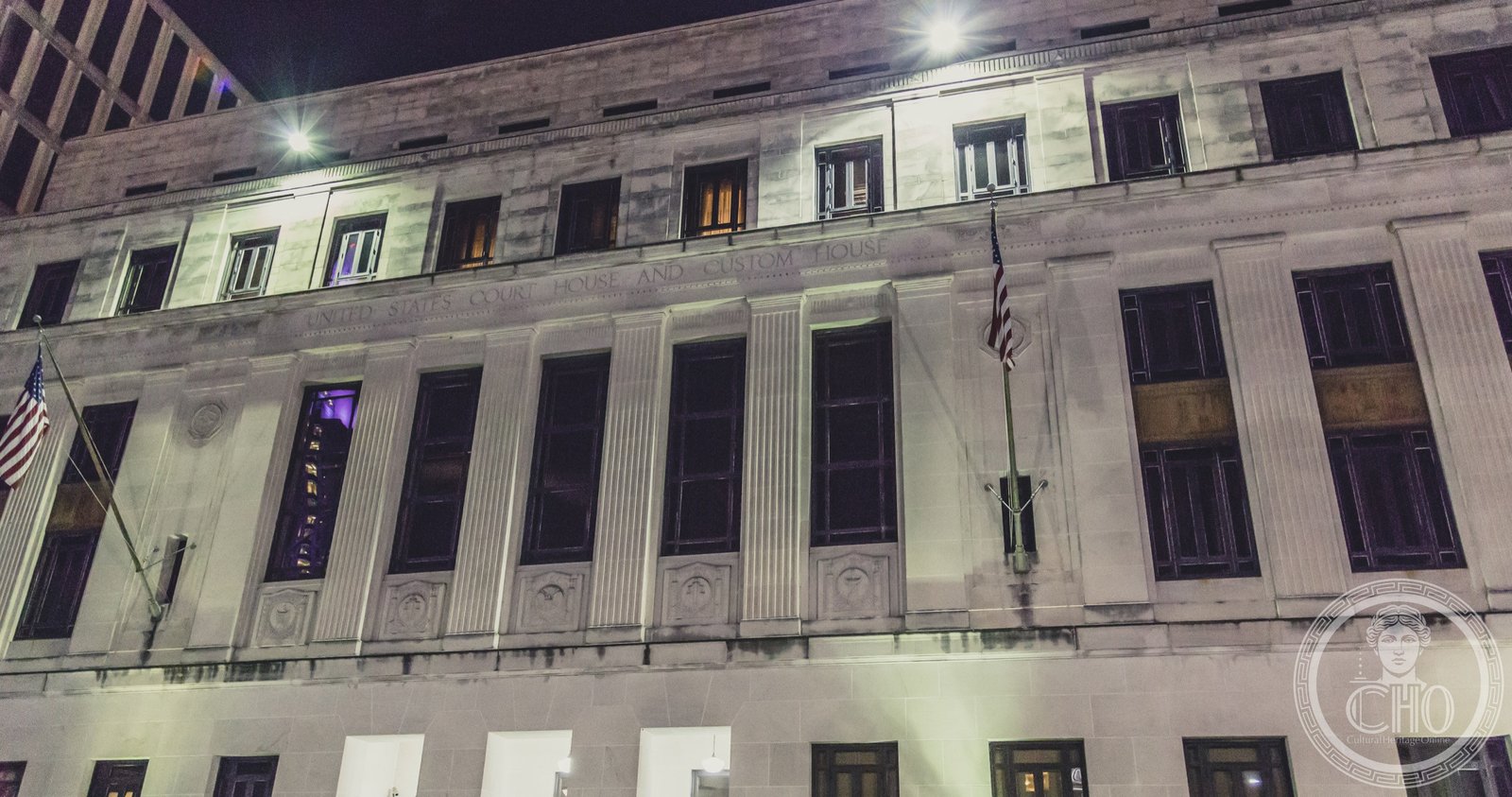
John Archibald Campbell U.S. Courthouse
A restrained federal landmark where Art Deco ornament meets Renaissance Revival gravity: white Indiana limestone, bronze spandrel panels with vine motifs, and corbeled travertine walls that have witnessed federal justice in Mobile for nearly a century.
At a glance
The John Archibald Campbell U.S. Courthouse at 113 Saint Joseph Street is one of Mobile’s most distinguished federal buildings. Constructed between 1934 and 1935 under the supervision of Louis A. Simon, Supervising Architect of the Treasury, it served the Southern District of Alabama for over eighty years before a comprehensive $18 million renovation in 2020 transformed it into the U.S. Bankruptcy Court. The building draws together two vocabularies—Renaissance Revival massing and Art Deco surface decoration—in a synthesis typical of federal architecture during the New Deal era. Named for John Archibald Campbell, the only Supreme Court Justice from Alabama, it was added to the National Register of Historic Places in 2008.
Key facts
- Built: 1934–35 (west addition 1939–40)
- Architects: Carey and Dowling; Office of the Supervising Architect (Louis A. Simon)
- Style: Renaissance Revival with Art Deco ornament
- Materials: White Indiana limestone, granite base, bronze panels
- NRHP listed: October 8, 2008 (ref. 08000964)
- Address: 113 Saint Joseph St., Mobile, AL 36602
- GPS: 30.69396°N, 88.04317°W
History
Construction began in 1934 during the New Deal building program that erected federal courthouses and post offices across the South. The project was designed by the local firm of Carey and Dowling working in coordination with the Office of the Supervising Architect of the U.S. Treasury, then led by Louis A. Simon. The main structure was completed in 1935; a west addition followed in 1939–40, extending the building’s footprint while maintaining formal continuity with the original facade. The courthouse was named for John Archibald Campbell (1811–1889), an Alabama-born Associate Justice of the Supreme Court who resigned from the bench in 1861 and later served as Assistant Secretary of War for the Confederacy before returning to a distinguished private legal practice in New Orleans.
For decades the building housed the federal district court for the Southern District of Alabama. By 2018 the court had relocated to a newer facility, and the Campbell Courthouse entered a transition period. A $18 million renovation launched in 2020 preserved its historic interiors—corbeled travertine walls, terrazzo floors, and walnut woodwork—while adapting the spaces to serve as the U.S. Bankruptcy Court for the Southern District of Alabama. Its 2008 National Register listing recognized both its architectural significance and its role in the civic fabric of Mobile.
What you see
The east facade presents thirteen bays of white Indiana limestone rising from a granite base, the overall mass firmly in the Renaissance Revival tradition of symmetry and rustication. Yet it is the surface ornament that declares the building’s era: stylized Ionic pilasters on the second and third floors flatten classical forms into geometric abstraction, and the bronze spandrel panels between floors carry vine-and-scroll motifs that belong unmistakably to the Art Deco vocabulary. The chamfered corners and restrained horizontal emphases reinforce the sense of a classical idiom under modernist pressure.
Inside, the public spaces retain their original materials. Corbeled travertine cladding lines the walls of the main corridor; terrazzo floors in geometric patterns recall the building’s 1930s origins. Walnut woodwork in the courtrooms adds warmth to the otherwise monumental interiors. The 1939–40 west addition was designed to blend seamlessly with the original, and from Saint Joseph Street the building reads as a unified, commanding presence in Mobile’s civic core.
Practical information
- Public access: The building functions as a federal courthouse; access to public areas during court hours (typically Monday–Friday, 8 AM–5 PM)
- Security: Federal building security screening required at entry
- Exterior viewing: The Saint Joseph Street facade is fully visible from the sidewalk at all times
- Photography: Exterior photography unrestricted; interior photography subject to federal courthouse rules
Getting there
The courthouse stands at 113 Saint Joseph Street in Mobile’s downtown civic district, within easy walking distance of Cathedral Square and the Government Street historic corridor. The nearest commercial airport is Mobile Regional Airport (MOB), approximately 12 miles west of downtown. From the airport, take I-65 North and exit toward the downtown waterfront; Saint Joseph Street is two blocks from the convention center area. Street parking and public garages are available nearby.
Nearby
- Cathedral Basilica of the Immaculate Conception — two blocks north on Dauphin Street; Greek Revival landmark completed 1850
- Mobile Museum of Art — 15-minute drive south at Langan Park; extensive decorative arts collection
- USS Alabama Battleship Memorial Park — 5 miles east across the bay; WWII-era warship open to visitors
Sources
- National Register of Historic Places nomination: John Archibald Campbell U.S. Courthouse, ref. 08000964 (October 8, 2008)
- Wikipedia: “John Archibald Campbell United States Courthouse” — https://en.wikipedia.org/wiki/John_Archibald_Campbell_United_States_Courthouse
- General Services Administration historic buildings inventory — Mobile, Alabama federal properties
Find it on the map
See this place and what’s around it →📷 Diventa un fotografo di Cultural Heritage Online
Condividi le tue foto dei luoghi: restano pubblicate con la tua firma come autore. Più vengono viste, più ti fai conoscere — e presto un concorso premierà le foto più apprezzate.
Accedi o registrati gratis per aggiungere una foto