
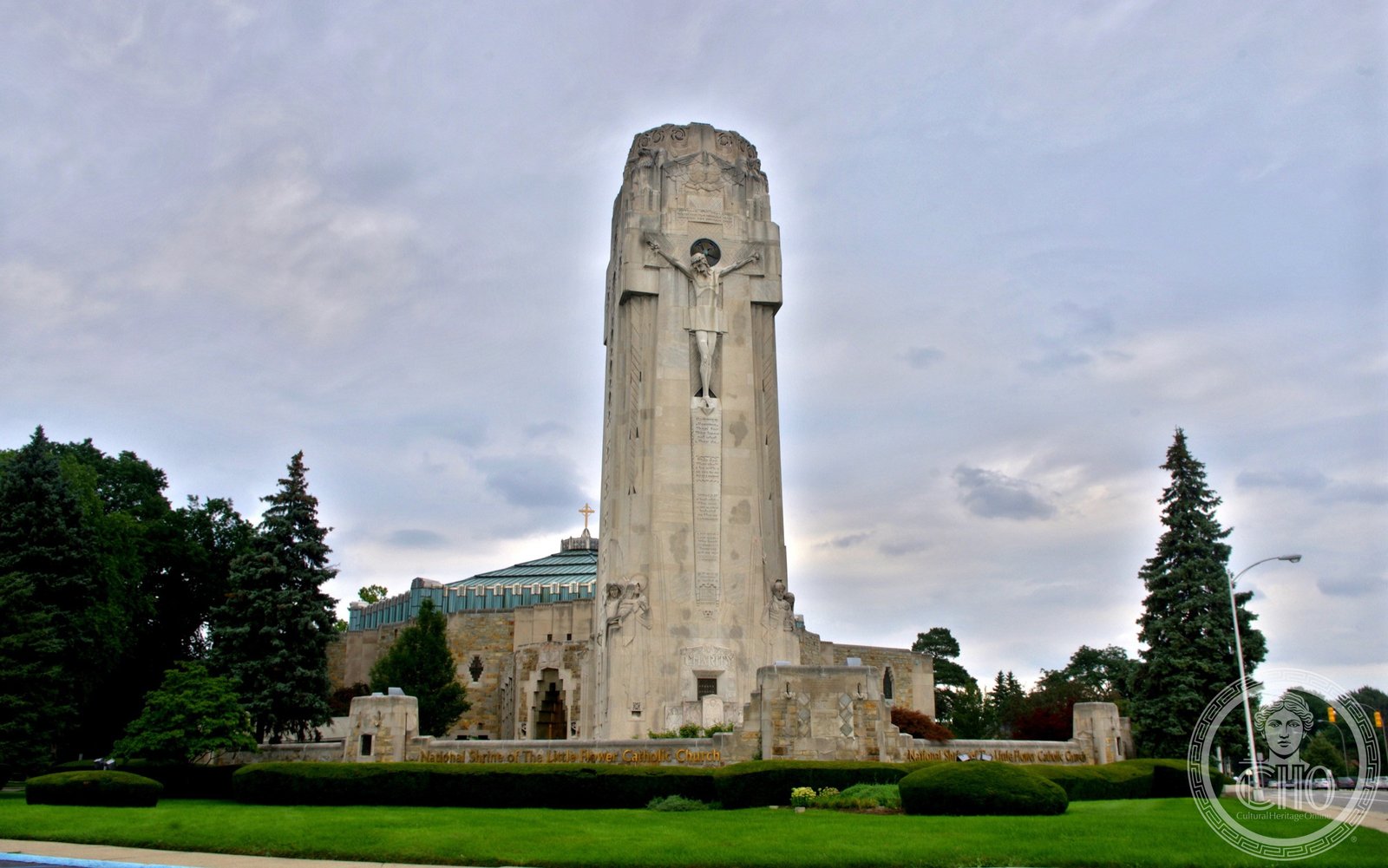
A basilica in the Detroit suburb of Royal Oak, the National Shrine of the Little Flower was built between 1931 and 1936 and is notable for its Art Deco stone tower, from which Father Charles Coughlin broadcast to a national radio audience of tens of millions during the 1930s.
At a glance
The National Shrine of the Little Flower stands at 2100 West Twelve Mile Road in Royal Oak, a suburb north of Detroit, Michigan. The church complex was built between 1931 and 1936 under the direction of Father Charles Coughlin — the “Radio Priest” — who made it the broadcasting base for his influential weekly radio program heard by an estimated thirty million Americans at its peak. The Art Deco stone tower that rises at the center of the complex, carries a crucifix at its apex and is decorated with geometric stone carving in the Art Deco manner. The shrine was dedicated to Saint Thérèse of Lisieux (“the Little Flower”) and was elevated to the rank of basilica. It is one of the most architecturally distinctive Catholic institutions in the Midwest.
Key facts
- Address: 2100 West Twelve Mile Road, Royal Oak, MI 48073
- Built: 1931–1936
- Style: Art Deco stone tower; Romanesque church
- Status: Minor Basilica, National Shrine
- Dedication: Saint Thérèse of Lisieux
- Associated figure: Father Charles Coughlin, “the Radio Priest”
History
The shrine grew out of the parish founded by Father Charles Coughlin in Royal Oak in 1926. Coughlin began broadcasting on Detroit radio station WJR in 1926 and quickly attracted a national audience that followed his mix of religious commentary and social criticism through the Depression years. By the early 1930s the weekly radio program was broadcast nationally and heard by an estimated thirty million listeners, making Coughlin one of the most powerful voices in American public life before television. The construction of the Shrine complex, designed by New York architect Henry J. McGill of Hamlin and McGill, was made possible by donations from his national audience — coins and small bills sent by working-class Catholic families who identified with Coughlin’s populist message.
The stone tower, designed by McGill in an Art Deco style that distinguished it from conventional Gothic church towers, became the visual symbol of the Shrine’s identity and of Coughlin’s broadcast operation. The geometric stone carving of the tower placed the building in the mainstream of American institutional Art Deco architecture while giving it a religious character that differentiated it from purely commercial buildings of the same period. The tower’s height and distinctive profile made it a landmark in suburban Detroit from the time of its construction.
Father Coughlin’s influence grew increasingly controversial through the 1930s, and his broadcasts were suppressed by Church authorities in 1942. The Shrine continued as a parish and national pilgrimage destination after his radio career ended. It was designated a Minor Basilica by the Vatican, recognizing its status as a major pilgrimage site, and listed on the National Register of Historic Places for its architectural significance and its historical role in American Catholic media history.
What you see
The Shrine complex combines the Romanesque-influenced main church with the Art Deco stone tower that rises above it. The stone tower is the building’s defining architectural element: a stepped shaft of limestone adorned with geometric stone carving and panels, culminating in a large crucifix at the apex. McGill’s Art Deco ornament — flat geometric forms, stylized motifs, and angular bands — is executed in stone rather than terra-cotta, giving the tower a weight and permanence unusual in the atmospheric style. The contrast between the tower’s Art Deco angularity and the rounded arches of the church below creates the building’s distinctive silhouette.
The interior of the church is decorated in a manner appropriate to a national shrine and basilica, with mosaic work, stained glass, and devotional elements accumulated over decades of pilgrimage use. The broadcast facilities used by Father Coughlin have been preserved as part of the building’s historical record. The overall complex reads as a monument to a specific moment in American Catholic popular culture — ambitious, technically sophisticated, and deeply embedded in the circumstances of its decade.
Practical information
- Address: 2100 West Twelve Mile Road, Royal Oak, MI 48073
- Open: Daily for prayer and visitation; call ahead for tour availability
- By car: Royal Oak is accessible via I-696 (east-west) and Woodward Avenue (M-1) from Detroit
- Transit: SMART bus routes serve Twelve Mile Road
Getting there
The Shrine is located in Royal Oak, a northern suburb of Detroit in Oakland County, accessible via Interstate 696 from the east or west and via Woodward Avenue (M-1) from downtown Detroit, approximately 12 miles south. Detroit Metro Airport (DTW) is approximately 30 miles to the southwest. Royal Oak is served by SMART bus route 415 (Twelve Mile Road).
Nearby
- Detroit Zoo (Royal Oak, one mile east)
- Downtown Royal Oak (walkable commercial district)
- Cranbrook Educational Community (Bloomfield Hills, 10 miles northwest)
Sources
- Wikipedia, “National Shrine of the Little Flower” — history, Father Coughlin, basilica status, architectural description
- National Register of Historic Places — National Shrine of the Little Flower, Royal Oak, Michigan
- Archdiocese of Detroit — Shrine history and pilgrimage information
Find it on the map
See this place and what’s around it →📷 Become a Cultural Heritage Online photographer
Share your photos of places: they stay published under your name as the author. The more they're seen, the more you get noticed — and soon a contest will reward the most appreciated photos.
Log in or sign up free to add a photoDo you manage this place?
This page is read by travellers and heritage enthusiasts who find it on Google. Keep it accurate — and make it work for you. Free for non-profit heritage institutions.