
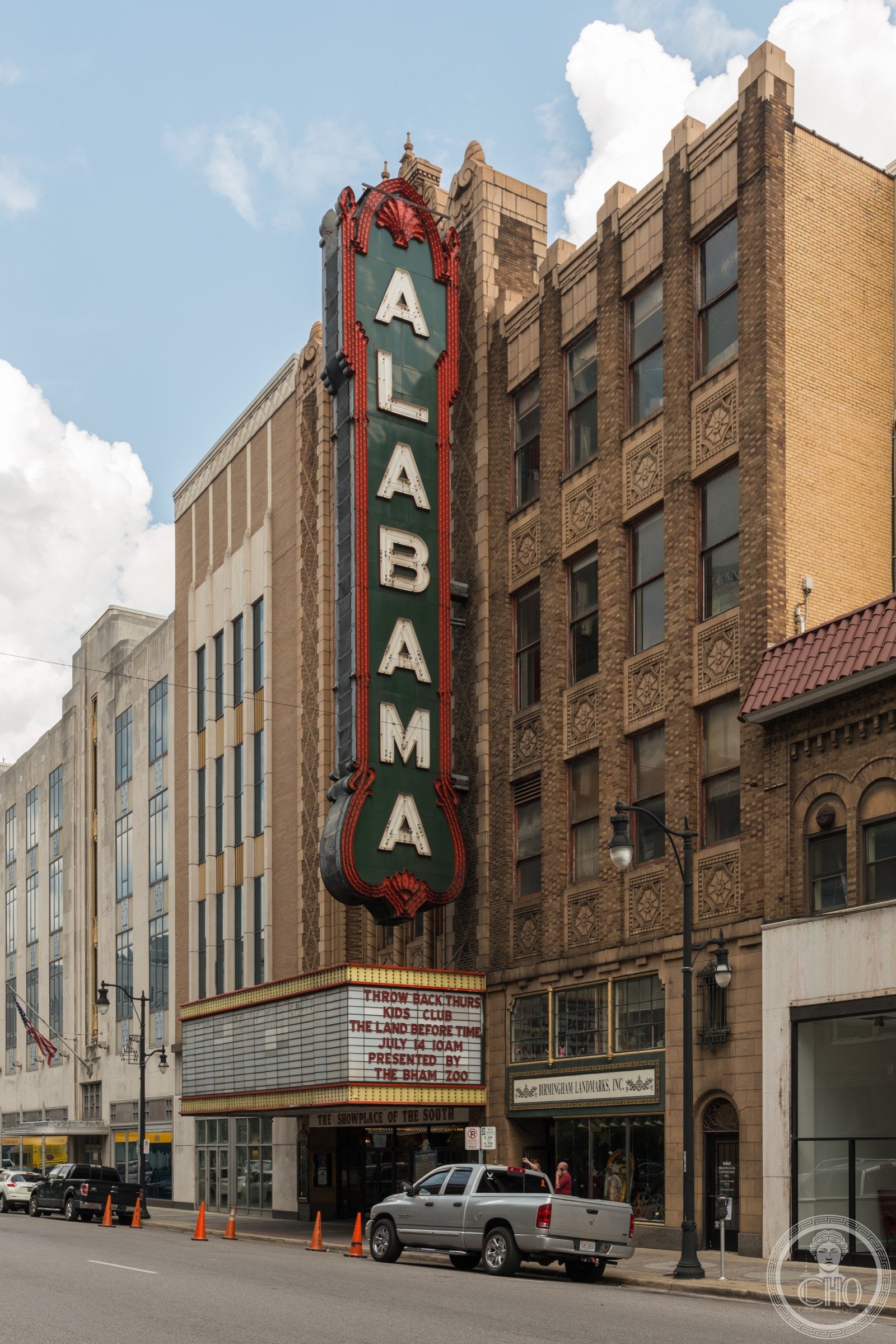
One of the South’s great atmospheric movie palaces, the Alabama Theatre opened in 1927 with a Moorish-inflected Art Deco interior that transported Birmingham audiences to a world of fantasy — and has been painstakingly preserved as one of the finest surviving examples of 1920s American entertainment architecture.
At a glance
The Alabama Theatre at 1817 Third Avenue North in downtown Birmingham was completed in 1927 for Loew’s Inc., the major theater chain, to designs by the Chicago architectural firm Graven & Mayger. An “atmospheric” theater — a type that simulates an outdoor setting inside the auditorium, with a painted sky ceiling, simulated stars, and architectural scenery — the Alabama seats approximately 1,800 and was conceived to make every performance an immersive event. It is a National Historic Landmark, operated since 1987 by the nonprofit Birmingham Landmarks, Inc.
Key facts
- Address: 1817 Third Avenue North, Birmingham, AL 35203
- Opened: 1927
- Architects: Graven & Mayger (Chicago)
- Style: Atmospheric / Moorish Art Deco
- Capacity: approx. 1,800 seats
- National Historic Landmark: Yes
- Current use: Birmingham Landmarks, Inc. — events, film screenings, concerts
- Organ: Preserved Wurlitzer theatre organ, still in use
History
The atmospheric theater was an American innovation of the 1920s — a variant of the movie palace concept in which the interior of the auditorium was designed to simulate an outdoor environment. Rather than the Renaissance or Baroque grandeur of earlier movie palaces, the atmospheric theater offered open skies (or their simulation), planted gardens, and architecturally eclectic scenery. John Eberson, who invented the atmospheric type, designed theaters across the country in this mode. The Alabama Theatre’s designers Graven & Mayger brought their own approach to the form, creating a Moorish fantasy that drew on Islamic ornamental traditions — arches, geometric tilework, painted stucco, and the repeated arabesque — to produce an interior of unusual richness.
The Alabama opened in 1927 as Loew’s Alabama Theatre, part of the major national circuit’s Southern expansion. Birmingham in the 1920s was a growing industrial city, its steel industry producing the capital that supported investments in cultural infrastructure like the Alabama. The theater served as the city’s premier movie venue for decades, hosting first-run films and live performances before the decline of downtown movie exhibition in the second half of the 20th century.
In 1987 the theater was purchased by Birmingham Landmarks, Inc., a nonprofit organization committed to its preservation and operation as a performing arts venue. The group has undertaken extensive restoration work on the auditorium, the stage, and the Wurlitzer theatre organ — one of the finest surviving examples of the instruments that accompanied silent films in the 1920s. The National Historic Landmark designation recognizes the Alabama Theatre as a building of exceptional national significance.
What you see
The Alabama Theatre’s Third Avenue facade presents a formal, largely Art Deco exterior — the Moorish elaboration is concentrated inside. The entrance lobby leads into a foyer with ornamental detail that announces the interior’s character, and then into the auditorium itself: a space designed to produce a specific effect of transport and wonder. The ceiling is painted to simulate sky and hung with small lights that simulate stars; the walls present Moorish arches and stucco relief work; the proscenium is flanked by architectural scenery that evokes a Mediterranean or Middle Eastern courtyard.
The effect is deliberately theatrical in the most literal sense — the auditorium is itself a stage set, a designed environment that frames the entertainment without competing with it. Sitting in the Alabama Theatre before a film or performance begins, with the “sky” overhead and the Moorish ornament surrounding the audience, one understands why the atmospheric concept resonated so deeply with audiences who came to be transported out of ordinary life. The Wurlitzer pipe organ, still played before many screenings, completes the experience.
Practical information
- Events: Regular programming including classic film screenings, concerts, private events; check Birmingham Landmarks’ official calendar
- Tours: Public tours available on select dates; check the organization’s website for current schedule
- Organ concerts: The Wurlitzer organ is played live before many film screenings
- Exterior: The facade is viewable at all times from Third Avenue North
Getting there
The Alabama Theatre is in downtown Birmingham at 1817 Third Avenue North, one block from 20th Street — the city’s main commercial spine. Birmingham-Shuttlesworth International Airport (BHM) is about 5 miles northeast. The Birmingham Rapid Transit bus network serves downtown. The theater is within walking distance of Railroad Park, the Birmingham Museum of Art, and the Civil Rights District.
Nearby
- Birmingham Museum of Art (1959) — significant regional collection including American and European art, five blocks northwest
- Lyric Theatre (1914) — another restored downtown Birmingham theater, three blocks west on 3rd Avenue
- 16th Street Baptist Church (1911) — National Historic Landmark, site of the 1963 bombing, four blocks west
Sources
- Wikipedia, “Alabama Theatre (Birmingham)” — architect, date, capacity, NHL designation, Wurlitzer organ
- National Historic Landmark nomination — architectural and historical significance
- Birmingham Landmarks, Inc. — operational history and restoration documentation
- Theatre Historical Society — atmospheric theater survey records
Find it on the map
See this place and what’s around it →Record researched and written by Luigi De Marchi for Cultural Heritage Online, 2026.
📷 Become a Cultural Heritage Online photographer
Share your photos of places: they stay published under your name as the author. The more they're seen, the more you get noticed — and soon a contest will reward the most appreciated photos.
Log in or sign up free to add a photoIs this page about you?
This page is read by travellers and heritage enthusiasts who find it on Google. Tell us how you are connected to this place and we will take it from there.