
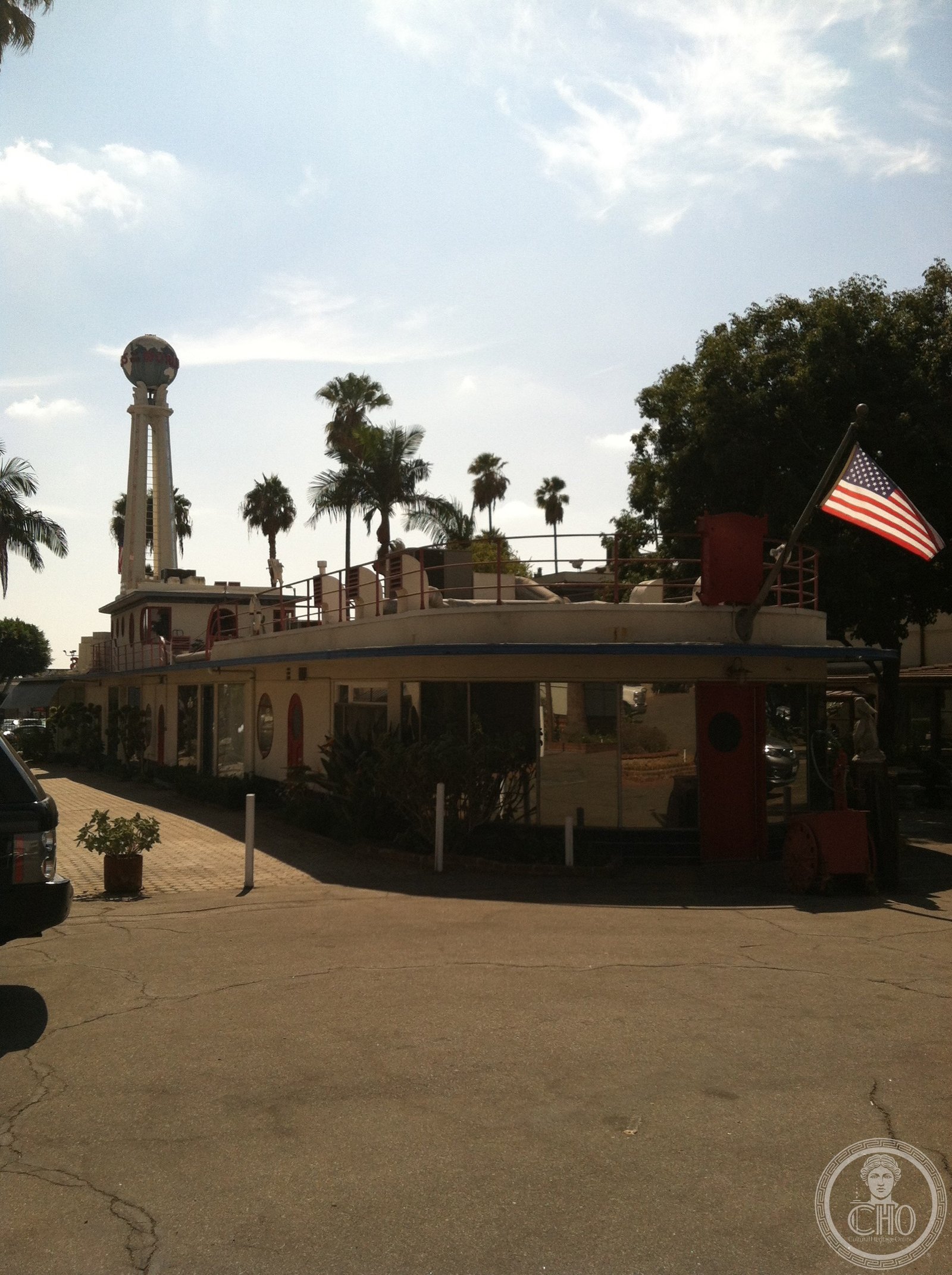
Crossroads of the World is the first outdoor shopping complex ever built in the United States and one of Hollywood’s most delirious pieces of architecture: a ship-shaped building in Streamline Moderne dressed in nautical portholes and topped by a spinning globe, surrounded by small cottage-scale shops that interpret every architectural tradition simultaneously.
At a glance
Designed by Robert V. Derrah and completed in 1936, Crossroads of the World occupies a lot on Sunset Boulevard in Hollywood that was developed as a retail complex combining a central anchor building with a collection of smaller shop cottages arranged around an open courtyard. The concept — pedestrian-scaled retail around a landscaped central space — was commercially ahead of its time and became the template for the post-war shopping center. Derrah’s central building takes the form of a streamlined ocean liner, its prow pointed toward Sunset Boulevard, a revolving globe perched at the tower above the ship’s bridge. The surrounding cottages adopt Tudor, Spanish, Norman, and Moorish architectural vocabularies without apology. The ensemble is a complete expression of the Hollywood fantasy environment applied to retail: everything familiar is transformed into a set piece, and shopping becomes a spectacle.
Key facts
- Completed: 1936
- Architect: Robert V. Derrah
- Address: 6671 Sunset Boulevard, Hollywood, Los Angeles, CA 90028
- Style: Streamline Moderne / Art Deco with eclectic cottage units
- Significance: First outdoor shopping complex in the United States
- Status: Los Angeles Historic-Cultural Monument; current use as office complex
- GPS: 34.0981°N, 118.3288°W
History
Ella Crawford, a Los Angeles entrepreneur, commissioned Robert Derrah to design a retail complex unlike anything that had been attempted in American commercial real estate. The concept of grouping shops around an open courtyard — accessed by pedestrians from the street rather than from an enclosed interior — drew on the mission-era California tradition of the courtyard commercial building but pushed it into the mid-1930s automotive age, where the frontage on Sunset Boulevard and the Crossroads’ visibility from passing cars was as important as the retail interior.
Derrah, who had already designed the Coca-Cola Bottling Plant on South Central Avenue in the form of a streamlined ship, brought the same nautical obsession to Crossroads of the World. The central building’s ship prow, porthole windows, and bridge superstructure were not whimsical additions but the core of the design concept: in the language of Streamline Moderne, the ship was the supreme metaphor for controlled speed, efficiency, and technological optimism, and the spinning globe at the top amplified this message with a suggestion of global reach. The surrounding cottage shops — each designed in a different historical idiom — provided the eclectic variety that Hollywood’s international population and its entertainment industry mythology demanded.
The complex operated as retail through the mid-twentieth century. As Hollywood’s commercial center shifted west toward the Cahuenga corridor, Crossroads transitioned to office use. It was designated a Los Angeles Historic-Cultural Monument in 1974 and has been maintained as an office complex, its exteriors preserved. The building demonstrates the direct lineage between the pre-war outdoor shopping complex and the post-war suburban shopping center, and its commercial concept — if not its architecture — became the dominant retail format of late twentieth-century America.
What you see
The Sunset Boulevard streetfront presents the ship building’s prow: white stucco walls, rounded horizontal moldings that emphasize the streamlined profile, porthole windows at regular intervals, and the tower above — a mast-like superstructure with the characteristic globe, which does actually rotate, visible from the street. The building reads as a piece of Hollywood scenography as much as architecture: it is designed to be experienced from a moving car, with enough recognizable imagery (the ship, the globe, the tower) to register in the second it takes to pass at cruising speed.
Inside the courtyard, accessed from Sunset or the side streets, the scale shifts completely: the cottage shops are one and two stories, with steeply pitched roofs in varying styles — a Tudor cottage next to a Spanish adobe next to a Normandy farmhouse — arranged informally around a landscaped central space. The effect is of a village in miniature, an architectural language deliberately pitched at human scale rather than automotive visibility. The contrast between the Streamline Moderne central building and the pre-modern cottage idioms around it is one of the ensemble’s defining characteristics: Hollywood’s simultaneous appetite for the future and for romantic historical fantasy, held in the same lot.
Practical information
- Exterior: The Sunset Boulevard facade and the courtyard are accessible; the complex is currently used as offices
- Photography: The ship prow is best photographed from Sunset Boulevard; the courtyard interior is accessible during business hours
- Access: The courtyard is generally open during business hours; the office buildings require tenant access
- Time needed: 20–30 minutes for a full exterior circuit including courtyard
Getting there
Crossroads of the World is at 6671 Sunset Boulevard in Hollywood, between Las Palmas Avenue and McCadden Place. The nearest Metro station is Hollywood/Vine on the B Line (1 mile east). Street parking is available on the surrounding blocks; the Metro B Line provides frequent service from downtown Los Angeles (Hollywood/Highland station is 0.7 miles west). The Hollywood Walk of Fame runs along Hollywood Boulevard, one block south.
Nearby
- Paramount Studios (0.5 miles southeast — the oldest active Hollywood studio, with its own Art Deco gates)
- Hollywood Walk of Fame (1 block south on Hollywood Boulevard)
- Hollywood Forever Cemetery (0.8 miles east)
- Amoeba Music (0.4 miles west — in a converted bowling alley on Sunset)
Sources
- Los Angeles Historic-Cultural Monument designation, Crossroads of the World, No. 134
- Los Angeles Conservancy, “Crossroads of the World” landmark documentation
- Esther McCoy, “Five California Architects,” research notes on Robert Derrah
Find it on the map
See this place and what’s around it →📷 Become a Cultural Heritage Online photographer
Share your photos of places: they stay published under your name as the author. The more they're seen, the more you get noticed — and soon a contest will reward the most appreciated photos.
Log in or sign up free to add a photoDo you manage this place?
This page is read by travellers and heritage enthusiasts who find it on Google. Keep it accurate — and make it work for you. Free for non-profit heritage institutions.