
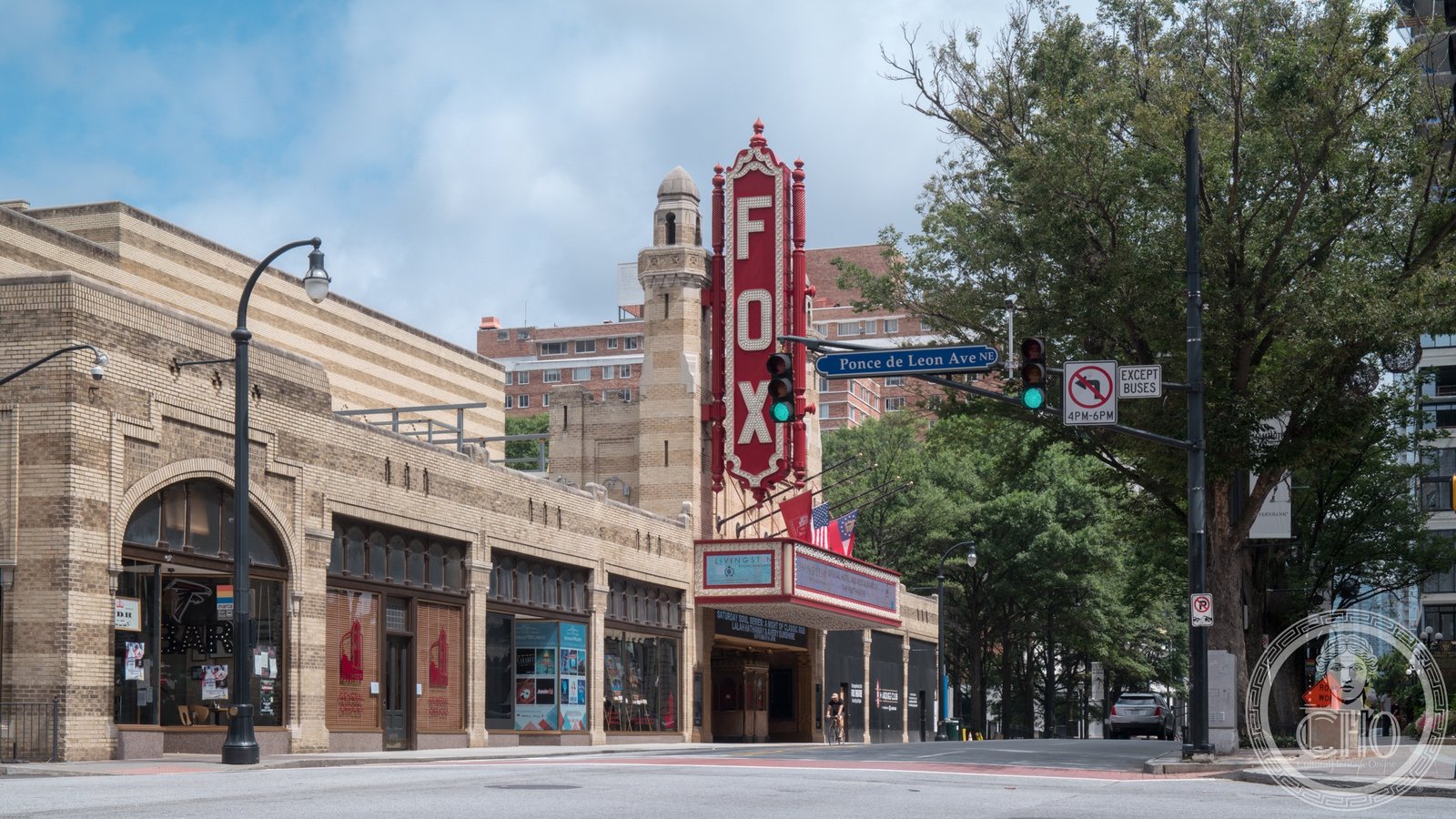
Atlanta’s Fox Theatre is the kind of building that makes you question whether you have stepped into a building at all. Its auditorium ceiling is a night sky — stars twinkling, clouds drifting — stretched over nearly 4,700 seats in a fantasy of Moorish domes and Egyptian columns that has no equal in the American South.
At a glance
The Fox Theatre opened on December 25, 1929, as a showcase for the Shriners (who built it as a fraternal temple before selling it to William Fox for his theatre chain) and for the sound films of the early talkie era. Marye, Alger & Vinour designed the exterior in an eclectic Moorish style, the elaborate street facade commanding the Peachtree Street corridor with domes, minarets, and horseshoe arches. Inside, a full atmospheric ceiling — among the most elaborate in the country — creates the illusion of an open-air courtyard beneath a starlit Egyptian sky. The Fox narrowly survived demolition in the 1970s; a public campaign saved it, and today it operates as a major live performance venue hosting Broadway touring productions, concerts, and special events.
Key facts
- Opened: December 25, 1929
- Architects: Marye, Alger & Vinour
- Address: 660 Peachtree Street NE, Atlanta, GA 30308
- Capacity: approximately 4,678 seats
- Style: Moorish Revival / Egyptian Art Deco / Atmospheric
- Status: National Historic Landmark (designated 1974)
- GPS: 33.7727°N, 84.3857°W
History
The Fox Theatre’s story begins not with the movies but with the Shriners. The Yaarab Temple of the Ancient Arabic Order of the Nobles of the Mystic Shrine acquired the Peachtree Street site in the late 1920s with the ambition of building Atlanta’s most spectacular fraternal meeting hall. Their design brief called for a facility that would serve as a temple, hotel, and assembly space for their organization, with the exotic Islamic and Egyptian imagery that Shriner iconography traditionally favored.
When William Fox — the Hollywood mogul — offered to co-develop the property as a movie palace, the partnership produced a building more extraordinary than either party could have managed alone. The Shriners’ fraternal program required large assembly rooms and ceremonial spaces; Fox’s theatre program required an auditorium of the atmospheric type that his chain was pioneering — in which the entire experience was designed as a fantasy environment rather than a conventional picture house. The result, under Marye, Alger & Vinour’s direction, was both: a Moorish exterior sheltering a freestanding auditorium inside whose domed ceiling was engineered to simulate a night sky.
The Depression that arrived within months of the Fox’s opening was catastrophic for both partners. The Fox film empire collapsed in 1932; the Shriners lost the building to foreclosure. A succession of operators kept the Fox open through the mid-century, but by the early 1970s its scale — too large and expensive for the new multiplex era — brought it to the edge of demolition for a high-rise office tower. A community campaign, coordinated under the banner “Save the Fox,” raised the funds to purchase and restore the building. The restoration, completed in 1975, returned the Fox to full operation and established it as Atlanta’s signature cultural venue.
What you see
The Peachtree Street facade is the Fox’s first act of bravado: a broad composition of horseshoe arches, glazed terracotta panels in geometric Islamic patterns, and two flanking minarets that announce the building from a block away. The marquee at street level interrupts the historical fantasy with the practical language of commercial entertainment — its neon signage has been a Peachtree corridor landmark since the building opened. At night, with the marquee illuminated, the facade does something that very few pieces of commercial architecture manage: it earns the word spectacular without self-parody.
Inside, the auditorium is the Fox’s masterpiece. The atmospheric ceiling — a stretched canvas system engineered to give the impression of an outdoor sky — shifts from deep blue twilight to starfield during the course of a performance, with controllable cloud effects. The walls are structured as a Moorish courtyard with Islamic-patterned tile and carved plaster latticework; Egyptian friezes and lotus-column capitals appear in the lobbies and foyers. The cumulative effect, experienced from one of the nearly 4,700 seats, is of sitting outdoors on a warm night — an illusion that the building’s architects and engineers maintained with remarkable conviction across the full circuit of decoration.
Practical information
- Tickets: The Fox operates as an active performance venue; tickets are required for most events. The box office is at the main Peachtree Street entrance
- Tours: The Fox offers public architectural tours that include the auditorium and backstage spaces; book via the venue website
- Exterior: The Peachtree Street facade is always freely viewable; best photographed in the evening when the marquee is lit
- Time needed: 1.5–2 hours for a guided tour; plan more time if attending a performance
- Accessibility: Fully accessible; the venue has been upgraded to modern accessibility standards during restoration work
Getting there
The Fox Theatre is on Peachtree Street NE in Midtown Atlanta, at the intersection with Ponce de Leon Avenue. MARTA’s North Avenue station (Red and Gold lines) is approximately 0.4 miles south; the Midtown station is 0.5 miles north. Street and garage parking are available in the immediate blocks. The Fox is 2.5 miles north of downtown Atlanta’s Five Points MARTA hub.
Nearby
- Ponce City Market (0.5 miles east — adaptive reuse of the 1926 Sears Roebuck building)
- High Museum of Art (0.7 miles north on Peachtree Street)
- Piedmont Park (0.8 miles northeast)
- The William-Oliver Building (1930 Art Deco, 2.5 miles south in downtown Atlanta)
Sources
- National Historic Landmark nomination, The Fox Theatre, 1974
- Fox Theatre Inc., official history and architectural documentation
- Georgia Historic Preservation Division, Atlanta landmark documentation
Find it on the map
See this place and what’s around it →📷 Become a Cultural Heritage Online photographer
Share your photos of places: they stay published under your name as the author. The more they're seen, the more you get noticed — and soon a contest will reward the most appreciated photos.
Log in or sign up free to add a photoIs this page about you?
This page is read by travellers and heritage enthusiasts who find it on Google. Tell us how you are connected to this place and we will take it from there.