
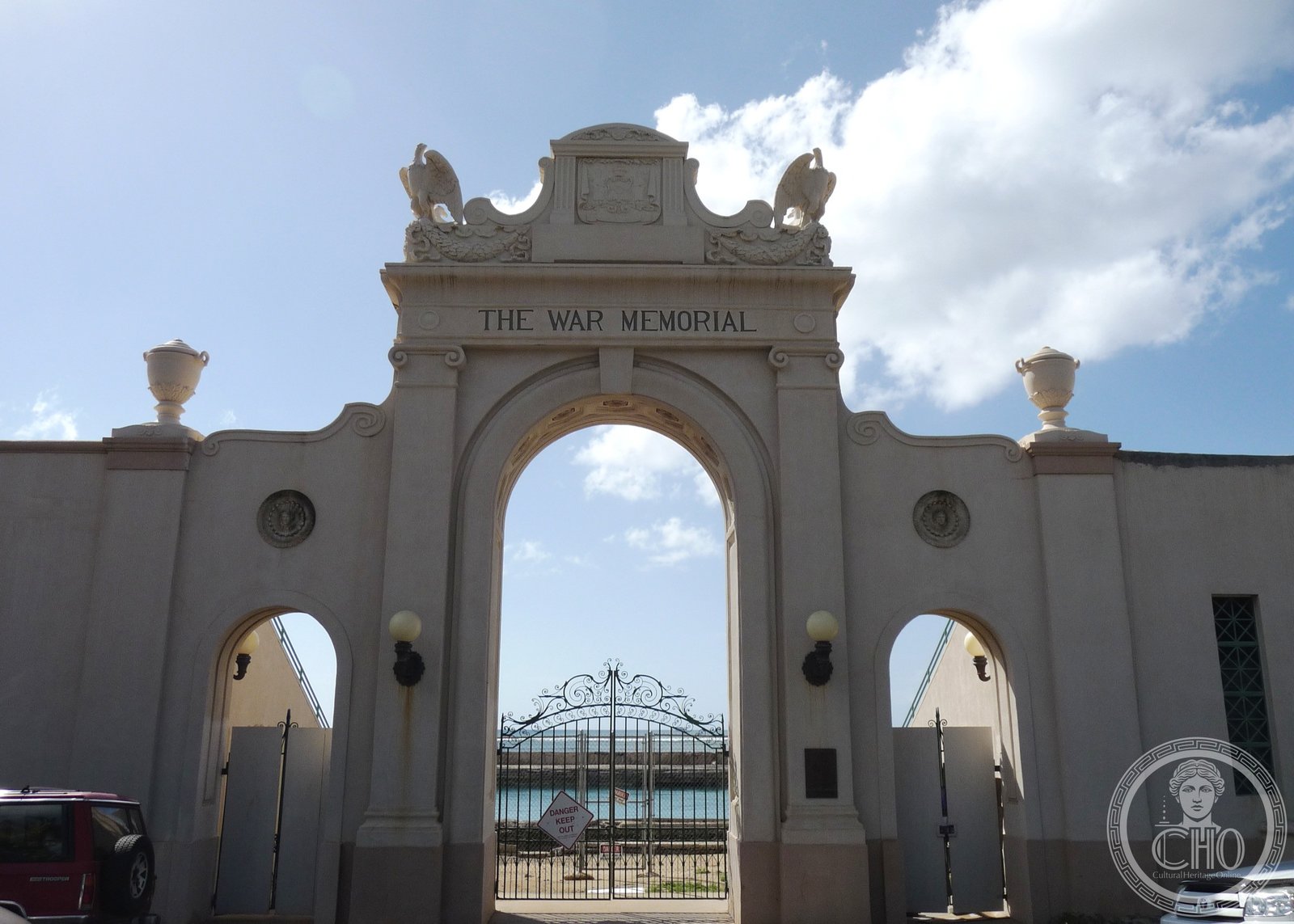
A saltwater swimming stadium built in 1927 as Hawaii’s tribute to its World War I dead — a Beaux-Arts landmark on Kalakaua Avenue, now caught between decay and the competing visions of those who would save it.
At a glance
The Waikiki Natatorium War Memorial stands on Kalakaua Avenue at the eastern edge of Waikiki, between the resort hotel district and the quieter sands near Diamond Head. Built in 1927, it is a saltwater swimming complex enclosed by a symmetrical Beaux-Arts structure: a central entrance arch flanked by colonnaded wings, all in white concrete, with the pool water drawn from the adjacent Pacific through a filtration system. The building honors Hawaii’s soldiers who died in the First World War. Today the pool is empty, the structure deteriorates, and the building exists in a contested state — simultaneously a National Register landmark and a subject of decades-long debate about whether restoration or removal is the more honest act of commemoration.
Key facts
- Address: 2777 Kalakaua Avenue, Waikiki, Honolulu, Hawaiʻi
- Opened: 1927
- Style: Beaux-Arts
- Function: War memorial and saltwater swimming stadium
- Pool: Competition-length saltwater pool, originally fed by filtered ocean water from the adjacent reef
- Historic designation: National Register of Historic Places (listed 1972)
- Status: Closed; pool empty; under preservation review
History
When the Territory of Hawaii commemorated the end of the First World War, it chose an unusual form of memorial: a natatorium — a covered or semi-enclosed swimming stadium — that would honor the dead through a living athletic facility. The choice reflected both Hawaii’s relationship with the ocean and the prominence of competitive swimming in Hawaiian culture at the time. Duke Kahanamoku, the Honolulu-born Olympic swimming champion whose gold medals in 1912 and 1920 had made him one of the most celebrated athletes in the world, was deeply associated with the natatorium and swam here during the building’s active years. The Natatorium was, in part, a monument to the aquatic tradition he represented internationally.
The facility served as a competitive swimming venue for decades, hosting local, national, and international meets. But by the mid-twentieth century, maintenance costs and the changing priorities of Waikiki’s rapid development as a resort district had placed the Natatorium under increasing pressure. The pool closed in the late 1970s, and since then the structure has been the subject of repeated preservation plans, engineering assessments, and public controversies. A succession of proposed restorations have stalled over cost, jurisdiction, and competing visions of what the memorial should mean to contemporary Hawaii.
The building was listed on the National Register of Historic Places in 1972, a designation that recognized its significance as both an architectural and a cultural landmark. As of the 2020s, the Natatorium remains a vivid argument about how communities treat the spaces where memory, architecture, and civic inertia intersect.
What you see
The Natatorium’s most photographed element is its entrance arcade: a central arch flanked by lower colonnaded wings, all in white rendered concrete, symmetrically composed in the Beaux-Arts tradition. The gateway reads as a triumphal arch translated into a tropical setting — formal, classical, and oddly serene given the building’s condition. The arch opens directly toward Kalakaua Avenue, with the Pacific visible in the background on the ocean side of the structure. The scale is monumental but not oppressive, calibrated to a civic gesture rather than a military grandeur.
Behind the entrance, the pool structure stretches toward the ocean, with grandstand seating along both long sides — concrete bleachers that once held spectators for championship events. The oceanic context is embedded in the building’s engineering: the pool was filled with filtered seawater drawn from the reef just offshore. The overall composition — classical entrance arch, saltwater pool, bleachers, ocean backdrop — is unlike any other war memorial in the United States.
Practical information
- Status: Closed to the public; exterior visible from Kalakaua Avenue and the adjacent beach path
- Access: The entrance facade is directly on Kalakaua Avenue; the ocean side is approached via Sans Souci Beach (Kaimana Beach)
- Photography: Excellent from the beach path and from the street
- Admission: No admission (exterior viewing only)
Getting there
The Natatorium is at 2777 Kalakaua Avenue at the eastern edge of Waikiki, near the boundary between Waikiki and the Diamond Head district. By bus, TheBus routes along Kalakaua Avenue serve the area; the Natatorium is near the Diamond Head end, about two miles from central Waikiki. On foot or by bicycle, the Waikiki beachfront path leads directly to the structure from the main hotel district in about twenty minutes. Parking is limited along Kalakaua; the Kapiolani Park area provides the most convenient access for the area.
Nearby
- Kapiolani Park — Honolulu’s oldest public park, stretching from the Natatorium toward Diamond Head, with lawns, courts, and the Waikiki Shell amphitheater
- Diamond Head State Monument — the volcanic crater east of Waikiki, with a hiking trail to the summit, the most recognizable skyline feature in Hawaii
- Kaimana Beach (Sans Souci Beach) — the quieter Waikiki beach adjacent to the Natatorium, popular with local residents
- Honolulu Zoo — at the Diamond Head end of Kapiolani Park, on Kapahulu Avenue
Sources
- Wikipedia: Waikiki Natatorium War Memorial
- National Register of Historic Places nomination documentation (1972)
- City and County of Honolulu, Department of Design and Construction
- Hawaii State Archives historical records
Find it on the map
See this place and what’s around it →Record researched and written by Luigi De Marchi for Cultural Heritage Online, 2026.
📷 Become a Cultural Heritage Online photographer
Share your photos of places: they stay published under your name as the author. The more they're seen, the more you get noticed — and soon a contest will reward the most appreciated photos.
Log in or sign up free to add a photoIs this page about you?
This page is read by travellers and heritage enthusiasts who find it on Google. Tell us how you are connected to this place and we will take it from there.