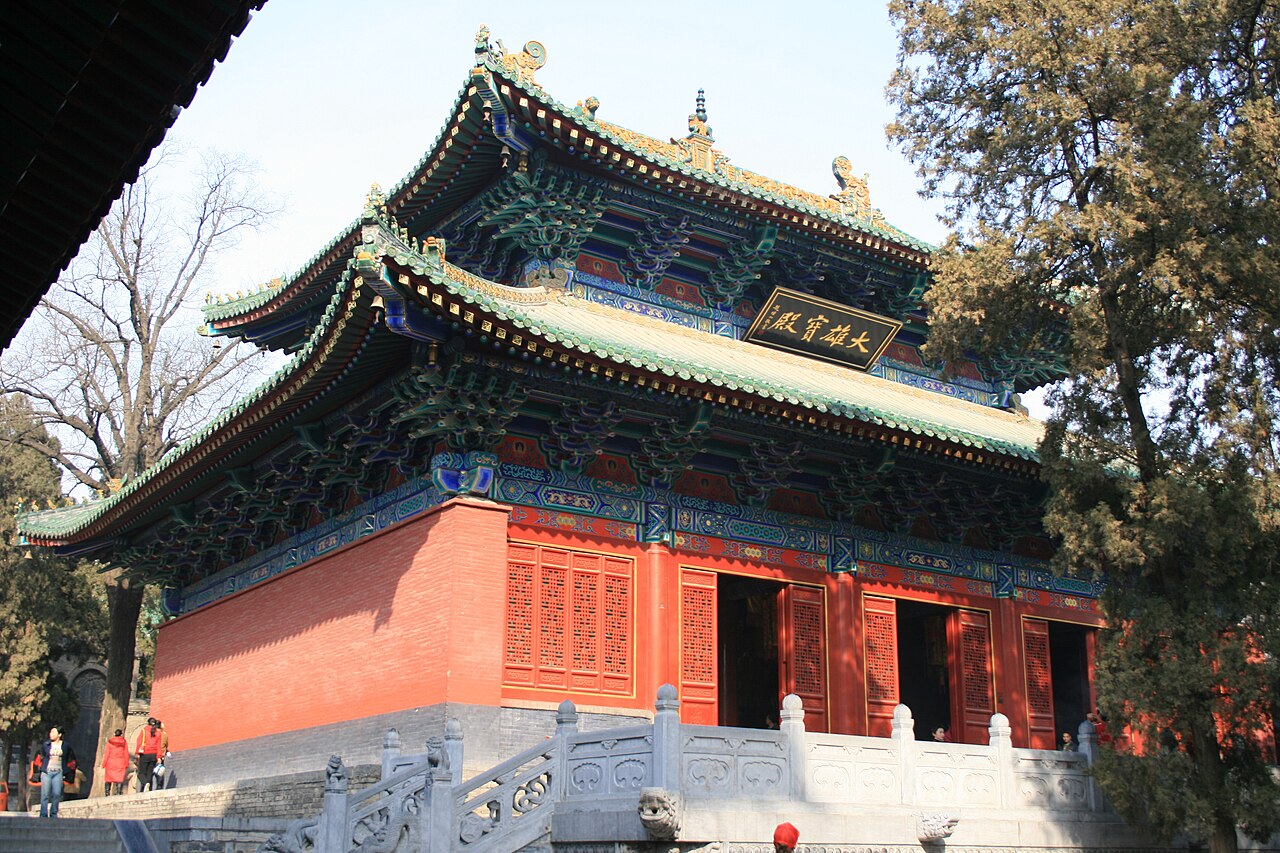
The Historic Monuments of Dengfeng in “The Centre of Heaven and Earth,” inscribed by UNESCO in 2010, comprise eight monument groups (eleven individual structures) on and around Mount Song (Songshan, 嵩山) in Dengfeng County, Henan Province — including the Shaolin Temple (少林寺, the Zen Buddhist monastery founded 495 CE and associated with the origin of Chinese martial arts), the Zhongyue Temple complex (Middle Sacred Mountain Temple, founded 2nd century BCE, the oldest continuously operating Daoist temple in China), the Dengfeng Observatory (周公測景台, the 8th-century BCE Zhou dynasty gnomon tower for solar observation, and the Yuan-dynasty Dengfeng Observatory, 1276 CE, one of the oldest surviving astronomical observatories in China), the Songyang Academy (嵩陽書院, one of China’s Four Great Academies, Neo-Confucian educational institution active from the 11th century), and three historic pagodas spanning the Northern Wei (c. 520 CE, the Songyue Pagoda, the oldest surviving brick pagoda in China) through Qing periods. The inscription’s Outstanding Universal Value rests on the exceptional concentration within one mountain landscape of structures representing China’s three philosophical and religious traditions — Buddhism, Daoism, and Confucianism — alongside the archaeological record of astronomical observation that documents the Zhou dynasty’s cosmological geography: the belief that Mount Song was the centre of heaven and earth (tian di zhi zhong), making it simultaneously the axis of the Chinese cosmos and the optimal location for solar measurement.
The Henan Cultural Corridor: Yellow River civilisation from Shang to Tang Longmen Grottoes Luoyang · Yin Xu Anyang · Temple of Heaven Beijing — 60 to 500 km
Sixty Kilometres west of Dengfeng by road (approximately 1 hour on the G55 Expressway from Dengfeng to Luoyang City, or approximately 40 minutes by bus from Dengfeng to Luoyang) and then approximately 15 kilometres south to the Longmen Grottoes (Luoyang South, accessible by taxi or bus from Luoyang Station), the Longmen Grottoes (inscribed 2000) are the nearest and most directly related UNESCO companion to the Dengfeng inscription. The historical connection between Dengfeng and Luoyang is the Northern Wei and Tang imperial axis: Luoyang was the Eastern Han capital (25–220 CE), the Northern Wei capital after the move from Datong (494–534 CE), and the secondary Tang capital (618–907 CE, as the “Eastern Capital” to Chang’an’s “Western Capital”). The Dengfeng inscription’s Shaolin Temple was founded by Northern Wei Emperor Xiaowen (the same emperor who moved the capital from Datong to Luoyang and completed the Yungang Grottoes programme); the Longmen Grottoes were begun under the same Northern Wei emperor immediately upon the capital’s establishment at Luoyang. The Dengfeng Observatory (Gaocheng Observation Platform, built 723 CE by the Tang monk astronomer Yi Xing and official Nangong Yue, for measuring the shadow lengths of the 8-metre gnomon on the winter and summer solstices) and the Yuan-dynasty Dengfeng Observatory (built 1276–1279 CE by the astronomer Guo Shoujing) demonstrate the continuity of astronomical observation at Mount Song from the Zhou period through the Yuan dynasty — a 2,000-year record of solar observation at the same location that makes the Dengfeng site unique in the history of astronomical science. From Dengfeng, Luoyang is reached by bus (approximately 1 hour) or by the Luoyang-Dengfeng tourist railway (Longhai Line branch, approximately 1.5 hours).
One Hundred and Thirty Kilometres east of Dengfeng by road and HSR (approximately 45 minutes from Dengfeng by bus to Zhengzhou East Station, then approximately 45 minutes from Zhengzhou East to Anyang East on the Beijing-Guangzhou HSR), Yin Xu at Anyang (inscribed 2006) is the Shang-period archaeological terminus of the central Henan cultural corridor. The Dengfeng inscription’s Songyue Pagoda (520 CE, Northern Wei period, the oldest surviving brick pagoda in China) is separated from Yin Xu’s Shang bronze-casting workshops by approximately 1,500 years of cultural history, but both are located within 150 kilometres on the same northern Henan plateau — the civilizational heartland that produced the oracle bone script at Yin Xu, the Zhou dynasty’s cosmological geography centred on Mount Song, the Eastern Han Buddhist introduction (documented in the Shaolin Temple’s foundation in 495 CE), and the Tang Buddhist sculptural programme at Longmen. The circuit Anyang → Dengfeng → Luoyang traces the full arc of the central Chinese civilisational sequence from the Shang period to the Tang period within a single day’s journey on the HSR network (Anyang East to Zhengzhou East approximately 45 minutes, then coach Zhengzhou to Dengfeng 1 hour, then bus Dengfeng to Luoyang 1 hour).
Three Hundred Kilometres northeast of Dengfeng by HSR (approximately 45 minutes from Zhengzhou East to Xinxiang, then approximately 2 hours to Handan North in Hebei on the Beijing-Guangzhou HSR, or approximately 2.5 hours total from Zhengzhou East to Beijing West), the Northern China plain stretches from the Yellow River valley north to Beijing, traversed by the Beijing-Guangzhou HSR that passes through all the major nodes of the northern Chinese cultural corridor: Zhengzhou → Anyang → Shijiazhuang → Beijing. The proximity circuit from Dengfeng therefore connects through Zhengzhou to both the southern cultural corridor (Luoyang → Xi’an → Silk Roads) and the northern corridor (Zhengzhou → Anyang Yin Xu → Datong Yungang → Beijing imperial heritage).
Songshan and the philosophical geography of central China Kaifeng Song dynasty capital · Wudang Mountains Hubei · Shaanxi Xi’an Chang’an — 100 to 300 km
One Hundred Kilometres east of Dengfeng by road (approximately 1.5 hours from Dengfeng to Kaifeng on the G30 Expressway), Kaifeng City was the capital of the Northern Song dynasty (960–1127 CE) and the setting for the celebrated Along the River During the Qingming Festival scroll painting (清明上河圖, Zhang Zeduan, 1085–1145 CE, the most detailed surviving visual document of a pre-modern Chinese city at full commercial activity), which depicts the Kaifeng waterfront, the Rainbow Bridge, and the city’s commercial districts with a documentary precision that has made it one of the most studied works in Chinese art history. Kaifeng’s Song-dynasty heritage has been significantly rebuilt and reconstructed (the Northern Song capital was destroyed by the Jurchen Jin dynasty’s conquest in 1127 CE and subsequently damaged by Yellow River flooding), but the Iron Pagoda (铁塔, Tie Ta, 1049 CE, octagonal 13-storey pagoda of glazed tile whose brown-red surface resembles cast iron) and the Po Pagoda (繁塔, Fan Ta, 977 CE, the oldest surviving Song-period pagoda in Henan, hexagonal, with Buddha niche reliefs on the exterior surface) are authentic Song-period structures. The Kaifeng Museum also holds Song ceramics from the official Ru, Guan, Ge, Jun, and Ding kiln traditions (the five great Song ceramic traditions), which are directly connected to the Dengfeng area’s Song-period ceramic history: the Jun kiln (钧窑, Jūn Yāo) in Yuxian County, 30 km northwest of Dengfeng, produced the most coveted Song imperial ceramics, characterised by their opalescent flambe glaze effects. From Dengfeng, Kaifeng is reached by bus (approximately 1.5 hours) or by bus to Zhengzhou (45 minutes) and then bus to Kaifeng (1 hour).
Three Hundred Kilometres west of Dengfeng by road and HSR (approximately 45 minutes from Zhengzhou East to Xi’an North on the Zhengzhou-Xi’an HSR, or approximately 1.5 hours direct), the Tang capital at Xi’an (Chang’an, 长安) is the western terminal of the Silk Roads UNESCO inscription (2014) and the cultural capital of the Tang Buddhist empire whose art is documented at both the Dengfeng sites (Shaolin Temple Tang-period buildings) and the Longmen Grottoes. The Big Wild Goose Pagoda (大雁塔, Dayan Ta, 652 CE, built by the Tang monk Xuanzang to house the Buddhist scriptures he brought back from India on his 16-year pilgrimage, 645 CE return to Chang’an) and the Tang imperial tombs north of Xi’an (including the Qianling Mausoleum, the joint tomb of Emperor Gaozong and Empress Wu Zetian, built 684 CE) are the most significant Tang-period Buddhist and imperial heritage structures accessible from the Dengfeng circuit. From Dengfeng, Xi’an is reached by bus to Zhengzhou (45 minutes) and then HSR from Zhengzhou East to Xi’an North (approximately 1.5–2 hours).
Practical information
The Historic Monuments of Dengfeng in “The Centre of Heaven and Earth” are distributed across the Dengfeng County area of central Henan Province, approximately 80 kilometres southwest of Zhengzhou (the Henan provincial capital and the principal transport hub). Dengfeng City is reached from Zhengzhou by express coach (approximately 1 hour from Zhengzhou Changtu Coach Station) or by the G55 Expressway (approximately 1 hour by taxi/private car). The inscription’s individual monument groups are distributed across a 40-kilometre area and require private transport or a tour bus to visit efficiently; the standard full-day tour covers the Shaolin Temple complex (the most visited monument, requiring 2–3 hours), the Zhongyue Temple Daoist complex (1 hour), and the Dengfeng Observatory/Gaocheng Platform (1 hour). A two-day itinerary allows addition of the Songyang Academy and the Songyue Pagoda. Admission to the Shaolin Temple covers the temple compound and the adjacent Pagoda Forest (Tali’n, a 1.5-hectare field of 248 brick pagoda-tombs of Shaolin monks spanning the Tang through Qing periods — the largest pagoda forest in China). The Dengfeng Shaolin International Wushu Festival (usually held in September) draws international martial arts practitioners; advance accommodation booking is essential during the festival period. The nearest airports are Zhengzhou Xinzheng International Airport (CGO, approximately 100 km from Dengfeng by expressway, 1.5 hours) and the proposed Dengfeng Songshan Airport (under planning). Best visiting season: March–May and September–November; summer heat (July–August, 35°C+) and limited shade make outdoor monument visits uncomfortable.
Frequently Asked Questions
What is the connection between the Shaolin Temple and Chinese martial arts, and how historically documented is it?
The Shaolin Temple’s association with Chinese martial arts (Kung Fu, or more precisely wushu 武術 and gongfu 功夫) rests on a complex mixture of historical documentation, mythological elaboration, and modern cultural construction that has been extensively debated by scholars of Chinese martial arts history. The historical core is documented: the Shaolin Temple’s warrior monks (seng bing, 僧兵) are mentioned in Tang dynasty military records as having assisted the Tang prince Li Shimin (later Emperor Taizong, reigned 626–649 CE) in his military campaign against the rebel Wang Shichong in 621 CE — the Thirteen Warrior Monks episode documented in a 621 CE stele inscription at the Shaolin Temple (the Fang Shan Stele, preserved in the Shaolin Temple’s Damo Cave area). Li Shimin’s official gratitude to the monks — the Tang imperial edict permitting the Shaolin monks to eat meat and drink wine (exceptional concessions for Buddhist monks) — is documented in multiple Tang sources and provides solid historical evidence that the Shaolin Temple had a tradition of monks with significant combat capability in the 7th century. The specific claim that the Indian monk Bodhidharma (Damo, 达摩, the traditional founder of Chan/Zen Buddhism, purportedly active at Shaolin c. 527 CE) taught the monks the movements that became Shaolin martial arts — the Yi Jin Jing (“Muscle/Tendon Changing Classic,” traditionally attributed to Bodhidharma) — is post-Tang elaboration: the Yi Jin Jing text cannot be dated earlier than the 17th century, and Bodhidharma’s historical existence at Shaolin is itself uncertain (the earliest accounts of his association with Shaolin date from 645 CE, more than a century after his purported activity). The modern scholarly consensus is that the Shaolin Temple’s martial arts tradition developed organically during the Tang and Song periods from the combination of the monks’ physical labour requirements (monks maintained the temple’s extensive landholdings with agricultural labour), the military training required for the temple militia that protected it from bandits, and the absorption of regional Chinese martial arts traditions practiced by the lay workers and pilgrims who passed through. The “Bodhidharma founded Shaolin martial arts” narrative is a 17th–19th-century elaboration that served the cultural function of connecting the martial tradition to the most prestigious possible founding authority.
What is the Songyue Pagoda and why is it considered unique in Chinese architectural history?
The Songyue Pagoda (嵩岳寺塔, Sōngyuè Sì Tǎ, c. 520 CE, Northern Wei period) is a 15-storey brick pagoda standing 41.7 metres high in the Songyue Temple precinct on the southern slope of Mount Song, approximately 5 kilometres from the Shaolin Temple. It is the oldest surviving brick pagoda in China — the only multi-storey brick pagoda from the Northern Wei period — and one of the most technically sophisticated pieces of early Chinese brick architecture. The Songyue Pagoda’s architectural significance derives from its plan: unlike all later Chinese pagodas, which are typically square or hexagonal in plan, the Songyue Pagoda is dodecagonal (12-sided) on the body levels (above the square podium and below the square-plan upper tower), a form without precedent in Chinese architecture and closely paralleled only in the Sassanid Persian and early Byzantine fire-temple towers of the 5th–6th centuries CE. This architectural anomaly — a 12-sided pagoda plan in a Chinese context — has been interpreted by architectural historians as evidence that the Songyue Pagoda was designed by or with input from Central Asian (Indo-Sassanid) architectural practitioners who accompanied the Northern Wei court’s diplomatic and religious contacts with Central Asian kingdoms during the 5th–6th centuries. The pagoda has survived without major structural intervention for 1,500 years — an extraordinary record for a 41-metre structure built of unfired clay bricks and lime mortar (the Northern Wei period did not use kiln-fired brick for monumental construction), made possible by the particular lime mortar formula used and by the continuous maintenance of the tile drainage system that protects the brick surfaces from moisture erosion. Its survival is itself one of the primary reasons the UNESCO nomination chose to designate the entire Dengfeng monument group rather than individual buildings: the co-survival of fifteen significant structures spanning 2,000 years, within a single mountain landscape, demonstrates the continuity of the sacred geography concept (tian di zhi zhong, “centre of heaven and earth”) that attracted patronage from successive dynasties.
What is the astronomical significance of the Dengfeng Observatory and what observations were made there?
The Dengfeng inscription includes two separate astronomical observation platforms at the same site (Gaocheng, approximately 10 km east of the Shaolin Temple): the Zhou-period Measuring Shadow Platform (周公測景台, attributed to the Duke of Zhou, 11th century BCE, the original gnomon base from which the Zhou court’s astronomers measured the sun’s shadow at noon on the solstices and equinoxes to determine the calendar) and the Yuan-dynasty Dengfeng Observatory (登封觀星台, built 1276–1279 CE by Guo Shoujing for the Yuan Emperor Kublai Khan). The Yuan observatory is architecturally the more substantial structure — a 12-metre-high stepped platform of rammed earth faced with stone, whose “shadow road” (石圭, shi gui, a 31-metre stone channel aligned north-south at the base of the platform) recorded the length of the noon shadow cast by the platform itself. Guo Shoujing’s purpose in building the Dengfeng Observatory was to correct the Chinese calendar by taking measurements at multiple locations across the Yuan empire (Guo’s geodetic survey of 1276–1279 CE placed 27 observation stations from northern Siberia to the South China Sea — the largest astronomical survey in Chinese history) to establish the most accurate possible values for the tropical year length and the obliquity of the ecliptic. The measurements taken at Dengfeng were used to compile the Shoushi Calendar (授時曆, 1281 CE), the most accurate calendar produced in China before Western astronomical methods arrived via the Jesuit missionaries in the 17th century: the Shoushi Calendar’s value for the tropical year (365.2425 days) is identical to the Gregorian Calendar’s value adopted in Europe in 1582 — a coincidence that demonstrates the independent Chinese astronomical tradition’s capacity to reach the same observational precision as European astronomy. The earlier Zhou-period platform at Gaocheng reflects the same motivation from a different historical period: the Zhou court’s astronomical programme (which produced the classic texts on solar and lunar observation used by Chinese astronomers for two millennia) required accurate shadow measurements to determine the calendar on which the agricultural rhythm of Chinese civilisation depended.
Sources
- S1 — UNESCO World Heritage Centre — Historic Monuments of Dengfeng in “The Centre of Heaven and Earth” (Ref. 1305) — https://web.archive.org/web/20230601000000/https://whc.unesco.org/en/list/1305/
- S2 — UNESCO World Heritage Centre — Statement of Outstanding Universal Value (Ref. 1305) — https://whc.unesco.org/en/list/1305/
Spotted an error? Write to editorial@culturalheritageonline.com and we correct it the same day.