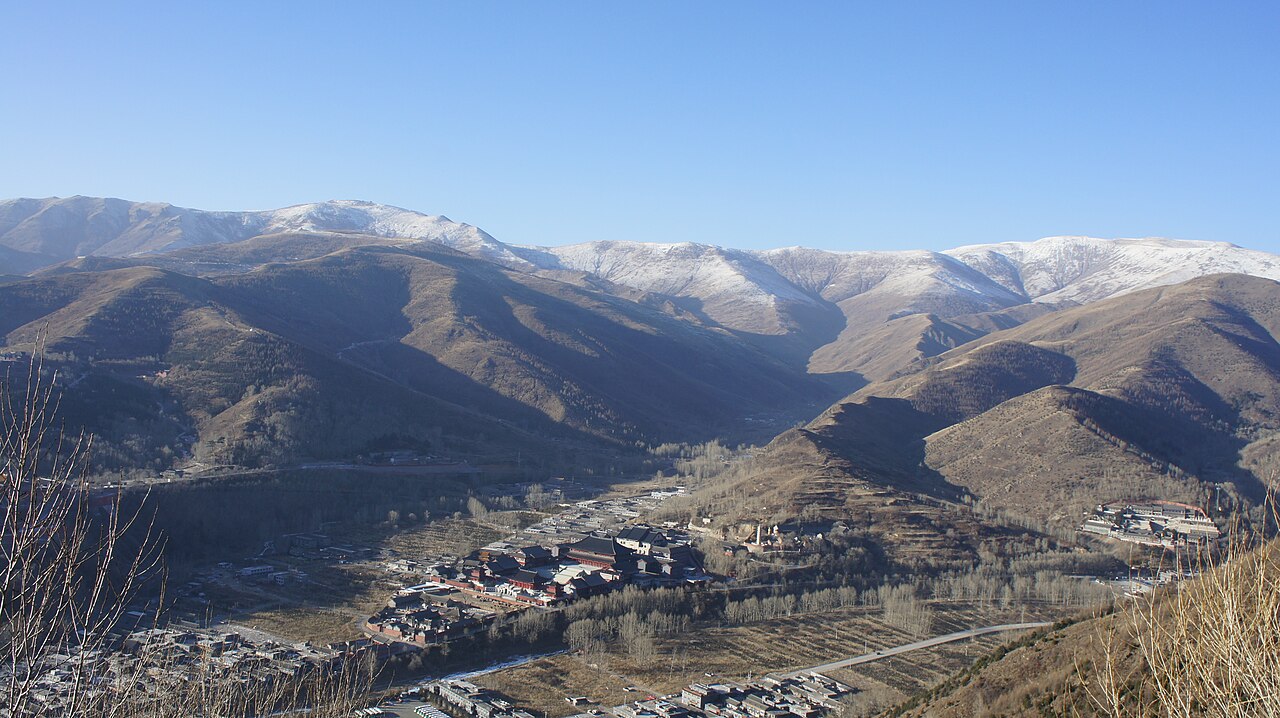
Mount Wutai (五台山, Wǔtái Shān, “Five Platform Mountain”), inscribed by UNESCO in 2009, is the most sacred Buddhist mountain in China and the most important Buddhist pilgrimage site in East Asia outside Tibet: a highland area in northeastern Shanxi Province at 2,400–3,058 metres altitude, whose five flat-topped peaks (the “five platforms” that give the mountain its name) are identified in Buddhist scripture as the earthly dwelling place of Mañjuśrī (文殊菩薩, the Bodhisattva of Wisdom), and whose valley floor at Taihuai town concentrates the largest and oldest intact collection of Buddhist monastic architecture in China — 53 temples spanning more than 1,600 years of continuous Buddhist construction from the Eastern Han period (1st century CE) through the Qing dynasty (18th century CE). The Wutai Mountain inscription’s Outstanding Universal Value rests on this unbroken architectural record: from the Nanchan Temple (782 CE, the oldest surviving wooden structure in China, Tang period, Nanshan district) and the Foguang Temple (857 CE, the second-oldest surviving wooden structure in China, Tang period, Doujin district) through the Northern Wei limestone Buddha at Yanshou Temple and the Song-dynasty Yanshansi complex to the Qing Emperor Qianlong’s White Dagoba at Tayuan Temple (1705 CE, the iconic image of the Taihuai valley), the mountain documents the full architectural history of Chinese Buddhist architecture across more than 1,500 years of uninterrupted patronage by imperial, aristocratic, and popular Buddhist communities.
Shanxi Province’s Buddhist and pre-Buddhist heritage Yungang Grottoes Datong · Yin Xu Anyang · Pingyao Ancient City — 200 to 350 km
Two Hundred Kilometres northwest of Mount Wutai by road (approximately 3 hours from Taihuai to Datong on the Huitong Expressway north, or approximately 2.5 hours from Taiyuan to Datong by HSR from Taiyuan South to Datong South), the Yungang Grottoes (inscribed 2001) are the other major UNESCO Buddhist site in Shanxi Province and the most directly connected companion to Mount Wutai in the history of Chinese Buddhist patronage. Both the Yungang Grottoes and the earliest layers of the Wutai Mountain temple complex were created under Northern Wei imperial patronage (386–534 CE): the same Northern Wei emperor Xiaowen (reigned 471–499 CE) who moved the Northern Wei capital from Datong to Luoyang — and thereby brought Yungang’s grotto-carving programme to its completion — also reorganised the state Buddhist administration that maintained the Wutai Mountain temples. The historical link between Yungang and Wutai is therefore the Buddhist imperial patronage of the Northern Wei dynasty: Yungang was the imperial Buddhist sculptural programme of the early Northern Wei period (when Datong was the capital), and Wutai was the sacred mountain associated with Buddhist imperial legitimacy that subsequent dynasties (Sui, Tang, Song, Ming, Qing) each chose to patronise with temple construction as a demonstration of Buddhist piety. From Mount Wutai, Datong is reached by coach (approximately 3 hours) or by road to Taiyuan (approximately 2.5 hours by express bus) and then HSR to Datong South (approximately 2 hours).
Two Hundred Kilometres south of Mount Wutai by road (approximately 3 hours from Taihuai to Pingyao on the Huitong Expressway south through Taiyuan), the Ancient City of Pingyao (inscribed 1997) is the best-preserved Ming-dynasty county town in China and the financial centre of the Shanxi merchant banking system that dominated Chinese commercial finance from the 17th through the early 20th century. The Shanxi commercial culture that produced Pingyao’s Rishengchang Exchange House (the first Chinese draft bank, established 1823, the precursor of China’s modern banking system) is historically connected to the Wutai Mountain pilgrimage economy: the Shanxi merchant communities were significant funders of Wutai Mountain temple construction from the Ming period onward, and the economic relationship between Shanxi commerce and Buddhist patronage is documented in the temple dedication inscriptions at several Taihuai temples. From Mount Wutai, Pingyao is reached by express bus to Taiyuan (approximately 2.5 hours) and then HSR from Taiyuan South to Pingyao Gucheng (approximately 30 minutes), or by direct coach from Wutai to Pingyao (approximately 3.5 hours).
Two Hundred and Fifty Kilometres southwest of Mount Wutai by road (approximately 3.5 hours from Taiyuan to the Xian-Houma area, or approximately 1.5 hours from Taiyuan South to Xi’an North on the Datong-Xi’an HSR extended to Taiyuan and continuing on the Zhengzhou-Xi’an HSR), the Shanxi plateau’s edge at the Yellow River bend (Jin-Shaan Canyon, the Yellow River gorge between Shaanxi and Shanxi provinces) was the historical boundary of the medieval northern Chinese Buddhist cultural zone. The Northern Wei dynasty’s political capital was at Datong (with its Yungang Grottoes), but its cultural zone extended south through Shanxi’s river valleys, through the Yellow River bend at the Dragon Gate (the historical gateway to the Guanzhong Plain and the Tang capital at Chang’an), and into the Xi’an-Luoyang axis that defines the Tang Buddhist heritage landscape. From Taiyuan (the Shanxi provincial capital, 2.5 hours south of Mount Wutai by coach), HSR connections run to Zhengzhou East (approximately 2.5 hours, with connections to Yin Xu at Anyang East) and to Xi’an North (approximately 2.5 hours on the Datong-Xi’an HSR via Taiyuan).
Within the Mount Wutai inscription, the valley floor at Taihuai concentrates approximately 40 temples in a 2-kilometre radius, walkable in 1–2 days of temple-visiting; the more distant monastic complexes on the five plateau summits (the Northern Terrace, Eastern Terrace, Southern Terrace, Western Terrace, and Central Terrace — Jinding, approximately 3,058 metres, accessible by cable car from the Zhongfeng Road) require 2–3 additional days for a complete mountain circuit. The most significant individual structures are: the Foguang Temple (857 CE Tang wooden hall, approximately 14 km southwest of Taihuai, requiring private transport — a rare Tang wooden structure that survived the Buddhist persecutions of 845 CE because its remote position protected it from imperial enforcement); the Nanchan Temple (782 CE Tang wooden hall, 70 km southwest of Taihuai, requiring private transport — the oldest surviving wooden building in China); the Tayuan Temple (Qing, 1705, Taihuai valley, the white bottle-shaped dagoba that dominates the valley skyline); and the Xiantong Temple (the largest temple complex in Taihuai, founded 1st century CE in its earliest form, repeatedly rebuilt, with 400+ rooms and the 1534 CE Wanfo Pavilion, its most architecturally significant structure). Admission to the inscription area covers all Taihuai valley temples; individual temples may have supplementary admission.
The Buddhist sacred mountains network and the imperial pilgrimage circuit Mount Tai Shandong · Historic Beijing imperial circuit · Leshan Giant Buddha Sichuan — 400 to 900 km
Four Hundred Kilometres east of Mount Wutai by road and HSR (approximately 2.5 hours from Taiyuan South to Jinan West on the Taiyuan-Jinan HSR, then approximately 1 hour from Jinan West to Tai’an on the Beijing-Shanghai HSR), Mount Tai (Taishan, 泰山, inscribed 1987, the First of China’s Five Sacred Confucian Mountains, 1,545 metres, Tai’an City, Shandong Province) is the complementary sacred mountain to Wutai in the Chinese imperial ritual tradition. Where Mount Wutai is the sacred mountain of Buddhist cosmology (the earthly abode of Mañjuśrī), Mount Tai is the sacred mountain of Confucian/Taoist cosmology (the throne of the Yellow Emperor Huangdi, the ritual site for the feng and shan sacrifices performed by Chinese emperors to communicate with Heaven, documented in the Shiji by Sima Qian and performed by 72 emperors from the Qin First Emperor through the 18th century). Both mountains are examples of the Chinese imperial state’s investment in sacred geography as a mechanism of political legitimacy: the Tang emperor Xuanzong’s pilgrimage to Mount Wutai in 737 CE and the Qing emperor Qianlong’s six visits to Mount Wutai (1757–1793 CE) are the Buddhist equivalents of the imperial feng and shan sacrifices at Mount Tai. From Mount Wutai, Mount Tai is reached via Taiyuan (coach 2.5 hours) and HSR Taiyuan South to Tai’an (approximately 3.5 hours total).
Three Hundred and Fifty Kilometres southeast of Mount Wutai by road and HSR (approximately 2.5 hours from Taiyuan South to Zhengzhou East, then 45 minutes from Zhengzhou East to Anyang East), the Central Plains Buddhist and pre-Buddhist heritage sites of Henan — Yin Xu at Anyang (inscribed 2006), Longmen Grottoes at Luoyang (inscribed 2000), and the Historic Monuments of Dengfeng (inscribed 2010, Shaolin Temple) — form the most logical multi-day circuit for visitors using Mount Wutai as the starting point of a northern/central China heritage tour. The specific connection between Mount Wutai and the Henan Buddhist sites is the Tang period (618–907 CE): Tang Buddhism, which achieved its greatest complexity and artistic expression during the 7th–8th centuries (the period of Empress Wu Zetian, who patronised both the Longmen Grottoes’ Ancestor Worship Cave and the Wutai Mountain temples as demonstrations of her Buddhist legitimacy), produced the Foguang Temple’s main hall (857 CE) at Wutai and the Tang sculptural programme at Longmen in the same cultural and religious context. From Mount Wutai, Anyang is reached by coach to Taiyuan and HSR (approximately 4 hours total).
Practical information
Mount Wutai is located in Wutai County, Xinzhou Prefecture, Shanxi Province, approximately 230 kilometres northeast of Taiyuan (the Shanxi provincial capital) on National Highway G85 via the Huitong Expressway. Taiyuan Wusu International Airport (TYN) serves direct flights from major Chinese cities; Taiyuan South Station is on the Taiyuan-Beijing HSR (approximately 2 hours to Beijing West) and the Taiyuan-Jinan HSR (approximately 2.5 hours to Jinan West). From Taiyuan, express buses to Taihuai (the main visitor town at Mount Wutai) run approximately every 2 hours and take 2.5 hours (via the Huitong Expressway to Doucun, then local road). The inscription entrance fee (payable at the main entrance gate approximately 10 km south of Taihuai on the G85) covers all Taihuai valley temples; individual temples may charge supplementary admission (typically CNY 5–15 per temple). The altitude at Taihuai (approximately 1,700 metres) is sufficient to cause mild altitude discomfort; the plateau summits (3,058 metres maximum) require appropriate warm clothing even in summer. Snow is possible on the plateau summits from October through April. The best visiting season for Taihuai valley temple architecture is May–October; July and August are the main pilgrim season with higher visitor numbers. The Foguang Temple and Nanchan Temple (the two oldest surviving wooden structures in China, Tang period) require private transport or a day-hire car from Taihuai (approximately 30–40 minutes each way on mountain roads). Overnight stays in Taihuai are recommended; there is a range of hotel and monastic guesthouse accommodation.
Frequently Asked Questions
Why is Mount Wutai considered the sacred abode of Mañjuśrī and how did this belief develop?
The identification of Mount Wutai as the earthly dwelling place of Mañjuśrī (文殊菩薩, Wènshu Púsà, the Bodhisattva of Wisdom, one of the principal bodhisattvas in Mahāyāna Buddhism) is based on a passage in the Avataṃsaka Sūtra (华严经, Huāyán Jīng, “Flower Garland Sutra”), a major Mahāyāna text probably compiled in Central Asia in the 2nd–4th centuries CE, which describes Mañjuśrī as dwelling on a mountain called “Cool Mountain” (Qingliang Shan, 清凉山) with 10,000 bodhisattvas in a “northeastern” region. Chinese Buddhist commentators beginning with the Eastern Han period (1st–2nd centuries CE) interpreted this reference as describing a real mountain in the Chinese northeast, and identified Mount Wutai’s five flat-topped peaks and its consistently cool summer climate (the mountain’s nickname Qingliang Shan, “Cool Mountain,” is still used) as matching the sutra’s description. The identification was reinforced by reports of miraculous manifestations of Mañjuśrī at Wutai Mountain — a genre of visionary accounts collected in the Wutai Mountain gazetteer (Gu Qingliang zhuan, compiled 667 CE by the monk Huixiang) — and by the mountain’s actual geographical position in the northeastern Chinese cultural zone, which corresponded broadly to the sutras “northeastern direction” reference. By the Tang period (618–907 CE), the identification was universally accepted in Chinese Buddhism and in the Tibetan, Korean, and Japanese Buddhist traditions, making Wutai Mountain an international pilgrimage destination: the Japanese monk Ennin (794–864 CE, whose diary of his Tang-period China pilgrimage, the Nittō guhō junrei gyōki, is one of the most detailed firsthand accounts of Tang society) visited Wutai Mountain in 840 CE; Tibetan Buddhist pilgrims began visiting in the 13th century under the Mongol Yuan dynasty, when Kublai Khan’s patronage of both Tibetan Buddhism and Wutai Mountain formalised the Tibetan-Chinese Buddhist connection at the mountain. Today approximately 100,000–200,000 pilgrims visit annually, from Han Chinese, Tibetan, Mongolian, Korean, and Japanese Buddhist traditions, all sharing the same valley floor at Taihuai but often worshipping at different temples according to their specific Buddhist lineage.
What are the Foguang Temple and Nanchan Temple and why are they considered the most important ancient wooden structures in China?
The Foguang Temple (佛光寺, “Buddhist Light Temple,” 857 CE) and the Nanchan Temple (南禅寺, “Southern Meditation Temple,” 782 CE) are the two oldest surviving large-scale wooden structures in China — a distinction that makes them irreplaceable evidence of Tang-period architectural achievement in a country where fire, warfare, and the “anti-Buddhist” persecutions of 845 CE (Tang Emperor Xuanzong’s Huichang Suppression, which ordered the destruction of thousands of Buddhist temples throughout China) destroyed the overwhelming majority of earlier Buddhist wooden architecture. The historical significance of both buildings’ survival lies in their remoteness: Wutai Mountain’s geographic isolation meant that the Huichang Suppression’s enforcement was incomplete in the Wutai area, and both buildings survived while thousands of Tang and earlier Buddhist wooden halls throughout China were demolished. The Foguang Temple’s main hall (the Dong Da Dian, “East Great Hall,” 857 CE) is the larger and more architecturally significant structure: 34 metres wide by 17.66 metres deep, with a hipped roof supported by internal columns carrying bracket-arm clusters (dougong) of extraordinary scale and complexity — the hall’s dougong systems are 2 metres tall (equal in scale to the columns they sit on) and demonstrate the structural logic of Tang-period wooden frame construction at the highest level of technical achievement. The building was rediscovered as a Tang structure in 1937 by the architectural historian Liang Sicheng (梁思成, 1901–1972) and his wife Lin Huiyin during a survey expedition; before 1937, no Tang-period wooden structure was believed to survive in China. Liang’s discovery of the Foguang Temple — confirmed by dating the dated inscriptions on the clay statues inside, which provide a construction date of 857 CE — was the most significant architectural discovery in 20th-century Chinese architectural history. The Nanchan Temple’s main hall (782 CE), a smaller structure (11.75 metres wide, 3 bays), is the oldest surviving wooden building in China by 75 years, predating the Foguang Temple by three generations of Tang patronage.
How did Tibet’s relationship with Mount Wutai develop and why are there Tibetan Buddhist temples at a Chinese sacred mountain?
The Tibetan Buddhist presence at Mount Wutai began under the Mongol Yuan dynasty (1271–1368 CE), when Kublai Khan’s patronage of Tibetan Buddhism (his personal religious adviser was the Sakya Lama Drogön Chögyal Phagpa) extended to establishing Tibetan Buddhist institutions at the existing Chinese Buddhist sacred sites as a mechanism for integrating the Tibetan Buddhist establishment into the Mongol imperial religious system. The Yuan-period Guangji Monastery at Wutai (14th century) was the first Tibetan Buddhist temple on the mountain; subsequent Ming and Qing patronage significantly expanded the Tibetan Buddhist presence. The Qing dynasty’s relationship with Wutai Mountain was particularly intensive: the Qing emperors (who were Manchu, not Han Chinese, and who maintained Tibetan Buddhism as the state religion of the Manchu ruling class) patronised Wutai Mountain as both a Chinese Buddhist pilgrimage site and as a Tibetan Buddhist holy mountain, financing the construction of new Tibetan-rite temples including the Pusa Ding (“Bodhisattva Summit,” Qing-period temple complex at the top of the central Taihuai hill, the symbolic summit of Mañjuśrī’s presence) and the Shuxiang Temple (1774, the largest temple on the mountain, built by the Qianlong Emperor and containing the tallest indoor Buddha image in Wutai — a 7.7-metre Mañjuśrī on a 8-metre lotus throne). The Qing emperors’ six visits to Wutai Mountain (Qianlong, 1757–1793) were conducted in the dual capacity of Buddhist devotee and imperial political performance — the Tibetan Buddhist clergy at Wutai Mountain were simultaneously objects of Qing religious patronage and political intermediaries between the Qing state and the Tibetan ecclesiastical hierarchy at Lhasa. Today approximately 10 of the 53 temples in the Taihuai area operate under Tibetan Buddhist rites; the Tibetan and Han Buddhist temples coexist on the same valley floor, serving pilgrims from different traditions within the same sacred geographic designation.
Sources
- S1 — UNESCO World Heritage Centre — Mount Wutai (Ref. 1279) — https://web.archive.org/web/20230601000000/https://whc.unesco.org/en/list/1279/
- S2 — UNESCO World Heritage Centre — Statement of Outstanding Universal Value (Ref. 1279) — https://whc.unesco.org/en/list/1279/
Spotted an error? Write to editorial@culturalheritageonline.com and we correct it the same day.