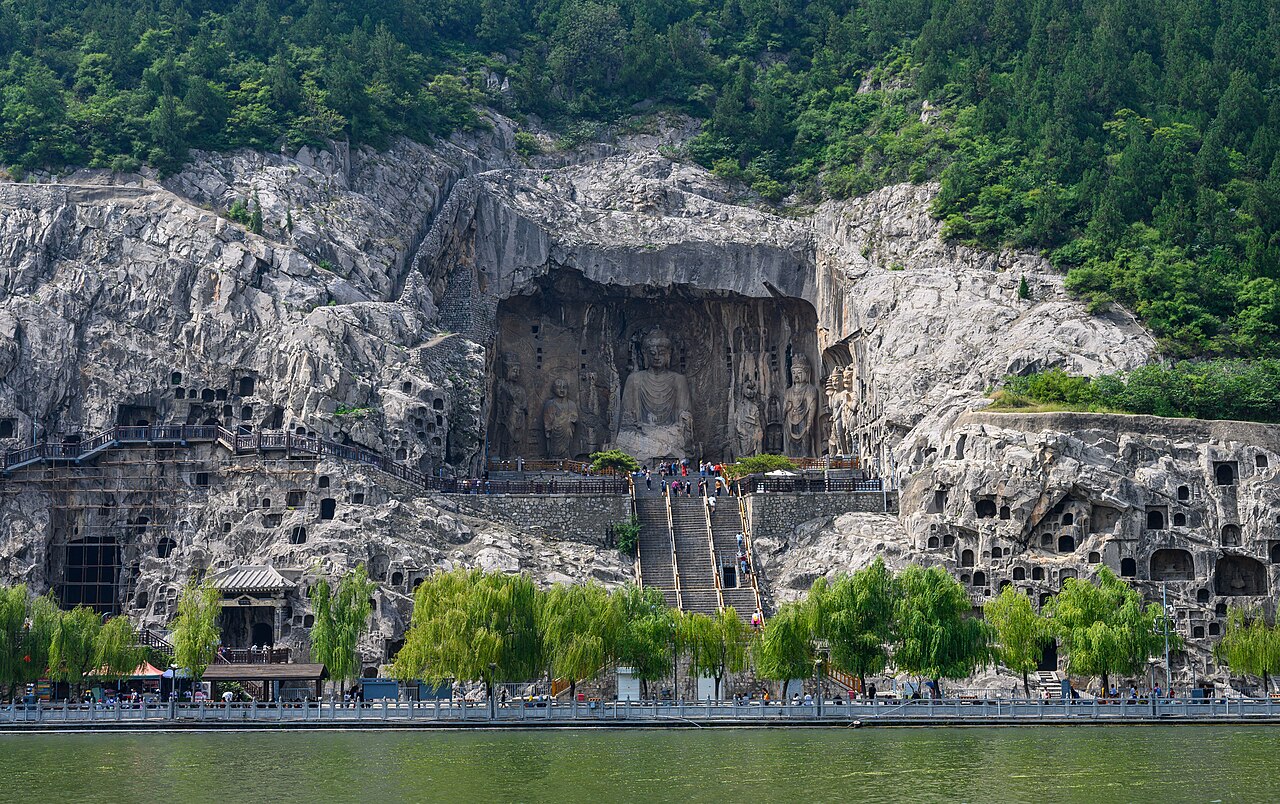
The Longmen Grottoes, inscribed by UNESCO in 2000, are the most extensive and artistically refined Buddhist cave sculpture complex in China: approximately 2,345 caves, 2,860 inscriptions, and 110,000 individual carved stone figures distributed along 1 kilometre of cliff face on the east and west banks of the Yi River at Longmen (“Dragon Gate”), 13 kilometres south of Luoyang City in Henan Province, carved primarily from the Northern Wei dynasty (494–534 CE) and the Tang dynasty (618–907 CE). The Longmen inscription’s Outstanding Universal Value rests principally on the Fengxian Temple complex (Fengxiansi, “Temple of Ancestor Veneration”), commissioned by the Tang Empress Wu Zetian and carved 672–675 CE: an open-air niche 36 metres wide and 33 metres high containing the 17.14-metre seated Vairocana Buddha (the largest sculpture at Longmen), eight standing attendant figures, and two warrior guardians carved in a soft naturalistic Tang style that represents the peak of Chinese Buddhist monumental sculpture, combining the classical Indian Gandharan body proportion with the Tang court’s own idealised figure aesthetic into a synthesis that influenced all subsequent East Asian Buddhist sculpture through the Song period.
The Henan corridor: from the Yellow River to the Tang imperial heartland Shaolin Dengfeng · Yellow River Xiaolangdi · Shang capital Zhengzhou — 50 to 150 km
Fifty kilometres southeast of Luoyang by road (approximately 1 hour from Luoyang to Dengfeng via the G30 Expressway and S323), the Historic Monuments of Dengfeng — “The Centre of Heaven and Earth” (inscribed 2010) at Mount Songshan document the ritual and cosmological centre of the Chinese world as defined in the Zhou-Han cosmological tradition. Mount Songshan (Zhongyue, the Central Sacred Mountain) is the axis mundi of the Chinese classical worldview — the mountain equidistant from the four cardinal sacred mountains of the Five Sacred Mountains system (Taishan east, Huashan west, Hengshan north and south) and therefore the centre of “all under Heaven.” The Dengfeng inscription covers 11 architectural monuments including the Shaolin Monastery (495 CE, the origin point of Chan Buddhism and Shaolin martial arts), the Zhongyue Temple (the oldest continuously occupied Daoist ceremonial complex in China, 2nd century CE origin), the Zhou Gong Observatory (the oldest surviving Chinese astronomical instrument site, 723 CE), and three Songyang Academy complexes from the Song period. The geographical proximity of Longmen and Dengfeng (50 km south of Luoyang and 50 km east of Luoyang respectively) is not coincidental: Luoyang was the Tang imperial capital (its eastern capital, Luoyang, served as the primary seat for Empress Wu Zetian), and the entire Yi River-Songshan corridor was the heart of the Tang empire’s cultural and religious geography. From Luoyang Station, Dengfeng is reached by road (bus from Luoyang Yinan Bus Station, approximately 1 hour).
One hundred kilometres west of Luoyang by high-speed rail (approximately 35 minutes from Luoyang Longmen Station to Xi’an North on the Zhengzhou-Xi’an HSR), the Terracotta Warriors and the Mausoleum of the First Qin Emperor (inscribed 1987) at Lintong, Xi’an, are the most famous single archaeological discovery in Chinese history and the starting point of the same imperial Chinese cosmological tradition that the Longmen Fengxiansi carvings represent in its Buddhist form. The Qin First Emperor (Qin Shi Huang, r. 221–210 BCE) initiated the imperial synthesis of the Zhou sacred geography (the Five Sacred Mountains, the ritual calendar, the astronomical cosmology of the emperor as mediator between Heaven and Earth) that the Tang dynasty’s Longmen programme subsequently expressed in Buddhist sculptural form. The terracotta army (8,000+ figures in three pits, discovered 1974) documents the same imperial theology — the emperor as ruler of the human world and coordinator of the cosmic forces — in a funerary medium: the army that guards the emperor’s underground palace is a literalist expression of the same belief in imperial-cosmic power that the Fengxiansi Vairocana Buddha expresses in a Buddhist medium 900 years later. From Luoyang Longmen Station, Xi’an North is reached in approximately 35 minutes on the Zhengzhou-Xi’an HSR; from Xi’an North, the terracotta warriors are accessible by shuttle bus (approximately 1 hour to Lintong).
One hundred thirty kilometres east of Luoyang by high-speed rail (approximately 35 minutes from Luoyang Longmen to Zhengzhou East), the city of Zhengzhou and its surrounding Yellow River basin contain the Yin Xu site at Anyang (inscribed 2006) — the Bronze Age capital of the Shang dynasty (approximately 1250–1046 BCE), approximately 200 km north of Zhengzhou — and the historical sequence from which Luoyang’s importance as an imperial capital derives. Zhengzhou itself was the site of the Shang dynasty’s early capital (Zhengzhou Shang City, 1600–1300 BCE, partially excavated) and the Yellow River’s most historically significant crossing point — the same geographical logic that made Luoyang the preferred site for the Northern Wei and Tang imperial capitals (command of the Yi River-Yellow River confluence zone, access to both the North China Plain and the Guanzhong agricultural basin to the west). The sequence of imperial capitals in Henan and Shaanxi — Shang at Zhengzhou and Anyang, Zhou at Luoyi (Luoyang), Han and Tang at Chang’an and Luoyang alternating — is the core of Chinese imperial geography, and the Longmen Grottoes are the physical expression of this geography’s Buddhist period (Tang dynasty, 618–907 CE). From Luoyang Longmen Station, Zhengzhou East is reached by HSR in approximately 35 minutes; from Zhengzhou East, Anyang is reached in approximately 1 hour by HSR north.
Sixty kilometres north of Luoyang by road (approximately 1.5 hours from Luoyang to the Xiaolangdi Reservoir area), the Xiaolangdi Dam on the Yellow River — while not UNESCO-inscribed — is the most significant modern engineering intervention in the same river whose siltation patterns defined the Yellow River Basin’s agricultural history and the imperial geography that made Luoyang important. The Yellow River (Huang He) is China’s second-longest river and the “cradle of Chinese civilization” — the Neolithic cultures (Yangshao, Longshan, 5000–2000 BCE), the Xia and Shang Bronze Age states (2100–1046 BCE), and the Zhou, Qin, Han, and Tang imperial dynasties all developed in the Yellow River basin. The Xiaolangdi Reservoir (construction 1994–1999) manages the Yellow River’s flood and sediment discharge below the Wei River confluence — the same section where the river historically caused catastrophic floods (the Yellow River changed course 26 times in recorded history, each time altering the agricultural geography of Henan). The Luoyang-to-Xiaolangdi day trip combines the Buddhist artistic heritage of Longmen with the hydro-engineering history of the river that made the Henan agricultural plain productive enough to sustain the successive imperial capitals whose religious ambitions produced Longmen. From Luoyang, Xiaolangdi is accessible by tourist bus or private car (approximately 1 hour north).
North toward the Shanxi corridor and south toward the Han River headwaters Yungang Grottoes · Wudang Mountains · Pingyao — 350 to 500 km
Three hundred fifty kilometres north of Luoyang by high-speed rail (approximately 2.5 hours from Luoyang Longmen to Datong North via Zhengzhou East and the Datong-Xi’an HSR), the Yungang Grottoes (inscribed 2001) in Datong City document the earliest phase of the same Northern Wei Buddhist imperial sculpture programme of which the Longmen Grottoes represent the mature second phase. The Northern Wei court carved Yungang (460–524 CE) while its capital was at Datong; after moving the capital south to Luoyang in 494 CE, the same imperial carving programme shifted to Longmen, producing the succession that the two inscriptions together document: Yungang’s massive Buddha figures (the Northern Wei emperors as Buddha, formally portrayed in 5 imperial caves) represent the raw ambition of the first phase; Longmen’s refined Tang sculpture (particularly the Fengxiansi Vairocana) represents the mature synthesis of the second. Visiting both in sequence — Yungang then Longmen, Datong then Luoyang, traveling south along the same route the Northern Wei court followed in 494 CE — traces the 500-year arc of Chinese Buddhist imperial art from the Northern Wei beginning to the Tang culmination. From Luoyang Longmen Station, the route to Yungang is via Zhengzhou East and Datong North (approximately 2.5 hours total on HSR).
Four hundred kilometres south of Luoyang by high-speed rail (approximately 3 hours from Luoyang Longmen to Shiyan area, the Wudang Mountains gateway), the Ancient Building Complex in the Wudang Mountains (inscribed 1994) in Hubei Province is the Daoist sacred mountain whose Tang-period temple foundation was patronised by the same Tang dynasty that commissioned the Longmen Fengxiansi carvings. The Tang court’s syncretic policy of simultaneously patronising Buddhism (Longmen), Daoism (Wudang early patronage), and Confucianism (the civil examination system) was the Three Teachings (Sanjiao) doctrine that allowed the Tang to build the largest and most artistically refined Buddhist cave complex in China (Longmen) while also initiating the Daoist temple tradition on Wudang. The geographical distance between Longmen (Luoyang) and Wudang (Shiyan, Hubei) — 400 km south on the same central China corridor — reflects the depth of the Tang court’s cultural reach: the Fengxiansi carvings and the early Wudang temples are both expressions of Tang imperial religious investment across the full north-south extent of the Tang territory. From Luoyang, Wudang Mountains are reached by HSR to Zhengzhou, then Xiangyang, then Wudangshan Station (approximately 3 hours).
Four hundred kilometres northwest of Luoyang by high-speed rail (approximately 2.5 hours from Luoyang Longmen to Pingyao Ancient City Station via Zhengzhou East and Taiyuan South on the Datong-Xi’an HSR), the Ancient City of Pingyao (inscribed 1997) in Shanxi Province is the late Ming-Qing merchant city whose Shanxi banking tradition served the same Yellow River commercial corridor that Luoyang dominated in the Tang period. The historical sequence from Luoyang (Tang cultural capital, 618–907 CE) to Pingyao (Song-Ming commercial capital, 10th–19th centuries) mirrors the shift in Chinese civilizational weight from the Yellow River imperial capitals of the north (which declined after the An Lushan Rebellion destroyed the Tang in the 8th century) toward the Yangtze Delta commercial cities of the south — a shift that left Luoyang as a provincial market town for a thousand years after the Longmen carvings were completed, while Pingyao’s Shanxi banking network rose to dominate the financial geography of the Qing empire. From Luoyang Longmen Station, Pingyao Ancient City Station is reached by HSR via Zhengzhou East and Taiyuan South (approximately 2.5 hours).
Practical information
The Longmen Grottoes are 13 kilometres south of Luoyang city centre in Henan Province. The nearest high-speed rail station is Luoyang Longmen Station (洛阳龙门站) on the Zhengzhou-Xi’an HSR, approximately 3 kilometres from the grottoes’ east entrance (served by local bus 71 or taxi, approximately 10 minutes). From Zhengzhou East Station, HSR to Luoyang Longmen takes approximately 35 minutes; from Xi’an North, approximately 35 minutes; from Beijing West, approximately 2 hours (via Zhengzhou East). From Luoyang Longmen Station, direct trains also serve Shanghai Hongqiao (approximately 4.5 hours), Wuhan (approximately 2 hours), and Chengdu East (approximately 3.5 hours). The grottoes are entered from the east bank (main entrance, east gate) or the west bank; the east bank path (approximately 1.3 km linear walk from north to south) provides the primary visitor circuit and passes all the major cave complexes. The Fengxiansi complex (Vairocana Buddha and attendants) is at the southern end of the east bank path and is the principal destination. Admission includes both east and west bank circuits; a boat cruise on the Yi River (departing from the east bank dock area, approximately 30 minutes) provides the aerial view of the full cliff-face composition that ground-level walking cannot give. The Medical Prescription Cave (Yaofangdong, approximately 140 Tang-period medical text inscriptions on its walls) is significant for the history of Chinese medicine. Full coverage of the site requires 3–4 hours. Best visiting seasons: March–April (river in flood, dramatic water level), October–November (autumn colour, clear skies). Luoyang is also famous for its spring peony festival (April, the Luoyang Peony Festival) — if visiting in April, the city’s flower gardens are simultaneously at peak and the grottoes are more crowded than at other seasons.
Frequently Asked Questions
Who was Empress Wu Zetian and why did she commission the Fengxiansi Vairocana Buddha at Longmen?
Wu Zetian (624–705 CE) is the only woman in Chinese history to have ruled as emperor in her own name — she reigned as Emperor of the Zhou dynasty (690–705 CE) after a period of effective control as regent from 655 CE, when her husband the Tang Emperor Gaozong suffered a stroke. The Fengxiansi complex at Longmen was commissioned in 672 CE (during Gaozong’s reign but widely attributed to Wu Zetian’s personal patronage) and completed in 675 CE with a dedication ceremony attended by both Gaozong and Wu Zetian. The choice of Vairocana Buddha (毗盧遮那佛, Piluzhe’na) — the cosmic Buddha of the Huayan (Avatamsaka) sutra, whose body is the universe itself and whose presence illuminates all worlds simultaneously — as the principal figure of the Fengxiansi was specifically connected to Wu Zetian’s political theology: the Huayan sutra’s concept of the Buddha-nature as pervasive and universal provided a scriptural basis for arguing that a woman could embody Buddhist enlightenment as fully as a man, and Wu Zetian’s court scholars used Huayan Buddhist arguments to justify her unprecedented assumption of imperial authority. The Vairocana’s face in the Fengxiansi is traditionally said to resemble Wu Zetian’s own — a claim that cannot be archaeologically verified but reflects the historical understanding of the commission as simultaneously a religious and political act of self-identification. Wu Zetian’s court donated 20,000 strings of cash (approximately the equivalent of 2 million individual coins) from her personal cosmetics budget to fund the Fengxiansi carving — a donation amount that the Tang huiyao (institutional records) documents precisely, making it one of the few Longmen carving campaigns with a specific funding source on record.
What is the Guyang Cave and why is it significant for the history of Chinese calligraphy?
The Guyang Cave (古阳洞) at Longmen is the oldest major carved grotto at the site (begun 493 CE, during the Northern Wei capital relocation period) and contains 19 large statue niches and 800+ inscribed donor votive texts carved into the walls and ceiling by Northern Wei officials and monks between 493 and 575 CE. The votive inscriptions of the Guyang Cave are the primary source for the “Wei stele” (Wei bei) calligraphy style — the dominant formal writing style of the Northern Wei period, characterised by angular, forceful strokes, flat horizontal orientation, and a distinctive “upturned” stroke ending that distinguishes it from the earlier Han clerical script (li shu) and the later Tang “regular script” (kai shu). The 20 most important Guyang Cave inscriptions were selected by the Qing scholar Kang Youwei in his 1889 treatise “Guangyizhou Shuangji” as the canonical examples of Wei stele calligraphy and named the “Twenty Classic Examples of Longmen” (龍門二十品, Longmen ershipin) — making them the foundational texts of the Wei stele school that dominated calligraphy training in China from the 19th century onward. The Wei stele revival of the 19th century (championed by Kang Youwei, Zhao Zhiqian, and other Qing scholar-calligraphers) was explicitly a reaction against the dominance of the Wang Xizhi cursive and regular script tradition (which had dominated Chinese calligraphy for 1,400 years) in favour of the Northern Wei’s more architecturally structured stroke system: the Wei stele’s angular clarity was seen by the 19th century reformers as more honest and more structurally rigorous than the flowing elegance of the Wang Xizhi tradition. The Longmen Guyang Cave inscriptions are therefore simultaneously a 5th–6th century Buddhist votive text archive and the foundational calligraphy training documents for one of the two major competing schools in modern Chinese calligraphy practice.
How were the Longmen sculptures damaged and what remains of the original polychrome colouring?
The Longmen sculptures have suffered several distinct phases of damage over their 1,500-year history. The most significant damage occurred in three periods: Tang-period Buddhist purges (the Huichang suppression of Buddhism, 842–845 CE, during which some Tang-period figures were defaced at imperial command), Song and Ming iconoclast incidents (localised but documented); Western and Japanese antiquities theft of the 19th–20th centuries (the most damaging systematic removal, primarily between 1900 and 1935, when thieves and antiques dealers removed statue heads, relief panels, and complete niches using saws, chisels, and dynamite — the Guyang Cave’s 19 major niches lost approximately 30% of their figures to this period of theft, and the heads of many principal Buddha figures, including several Fengxiansi attendants, are now in the Metropolitan Museum of Art, the Freer Gallery, the Atkinson Museum, and other Western and Japanese collections); and natural weathering (the Longmen limestone is a porous sedimentary rock subject to freeze-thaw cracking in the Henan winter). Of the original polychrome colouring — most figures were originally painted in red, gold, blue, and green pigments — approximately 5–10% survives in sheltered locations, primarily in small niches with adequate natural overhanging protection. The most visible surviving colour is in the Binyang North Cave (begun 523 CE), where traces of red and gold remain on some figures in the cave interior. The Chinese government has conducted four major conservation campaigns since 1950 (1952, 1971, 1991, and ongoing from 2012), including structural stabilisation of cliff sections threatened by erosion, chemical consolidation of vulnerable limestone surfaces, and the installation of drainage systems to reduce moisture infiltration. The recovery of looted sculptures from international museum collections has been a priority since 2001: several institutions have returned components under bilateral cultural heritage agreements, but the majority of the Longmen fragments in Western collections remain there.
Sources
- S1 — UNESCO World Heritage Centre — Longmen Grottoes (Ref. 1003) — https://web.archive.org/web/20230601000000/https://whc.unesco.org/en/list/1003/
- S2 — UNESCO World Heritage Centre — Statement of Outstanding Universal Value (Ref. 1003) — https://whc.unesco.org/en/list/1003/
Spotted an error? Write to editorial@culturalheritageonline.com and we correct it the same day.