The three World Heritage properties closest to the Bamiyan Valley are the Minaret and Archaeological Remains of Jam (218 km), also in Afghanistan, and two in Tajikistan: the Tugay forests of Tigrovaya Balka (266 km) and the Cultural Heritage Sites of Ancient Khuttal (314 km). Bamiyan itself is a serial property of eight separate sites in the Hindu Kush, inscribed in 2003 and on the List of World Heritage in Danger since that year.
The World Heritage sites around the Bamiyan Valley
The distances below are straight lines between the reference points that UNESCO publishes for each property, measured to the nearest component of a serial site. They show which properties are close on the map. They are not road distances.
| Site | Country | Distance | Inscribed | Type |
|---|---|---|---|---|
| Minaret and Archaeological Remains of Jam | Afghanistan | 218 km | 2002 | Cultural |
| Tugay forests of the Tigrovaya Balka Nature Reserve | Tajikistan | 266 km | 2023 | Natural |
| Cultural Heritage Sites of Ancient Khuttal | Tajikistan | 314 km | 2025 | Cultural |
| Buddhist Ruins of Takht-i-Bahi and Sahr-i-Bahlol | Pakistan | 379 km | 1980 | Cultural |
| Historic Centre of Shakhrisyabz | Uzbekistan | 470 km | 2000 | Cultural |
| Taxila | Pakistan | 470 km | 1980 | Cultural |
Three of the six belong to the same story. UNESCO describes Bamiyan as a stopping place on the branch of the Silk Route that linked China and India via ancient Bactria. Taxila was an important Buddhist centre of learning from the 5th century BC to the 2nd century AD, and Takht-i-Bahi is a Buddhist monastic complex founded in the early 1st century. Khuttal’s remains, from the 7th to 16th centuries, include Buddhist temples and caravanserais. The Tajik forest reserve is the exception: a natural property, inscribed under criterion (ix) for its riverine tugay forests. Jam, a 65 m minaret of the 12th century, and Shakhrisyabz, a Timurid city of the 15th and 16th centuries, mark the Islamic centuries that followed.
What does the Bamiyan property include besides the Buddha niches?
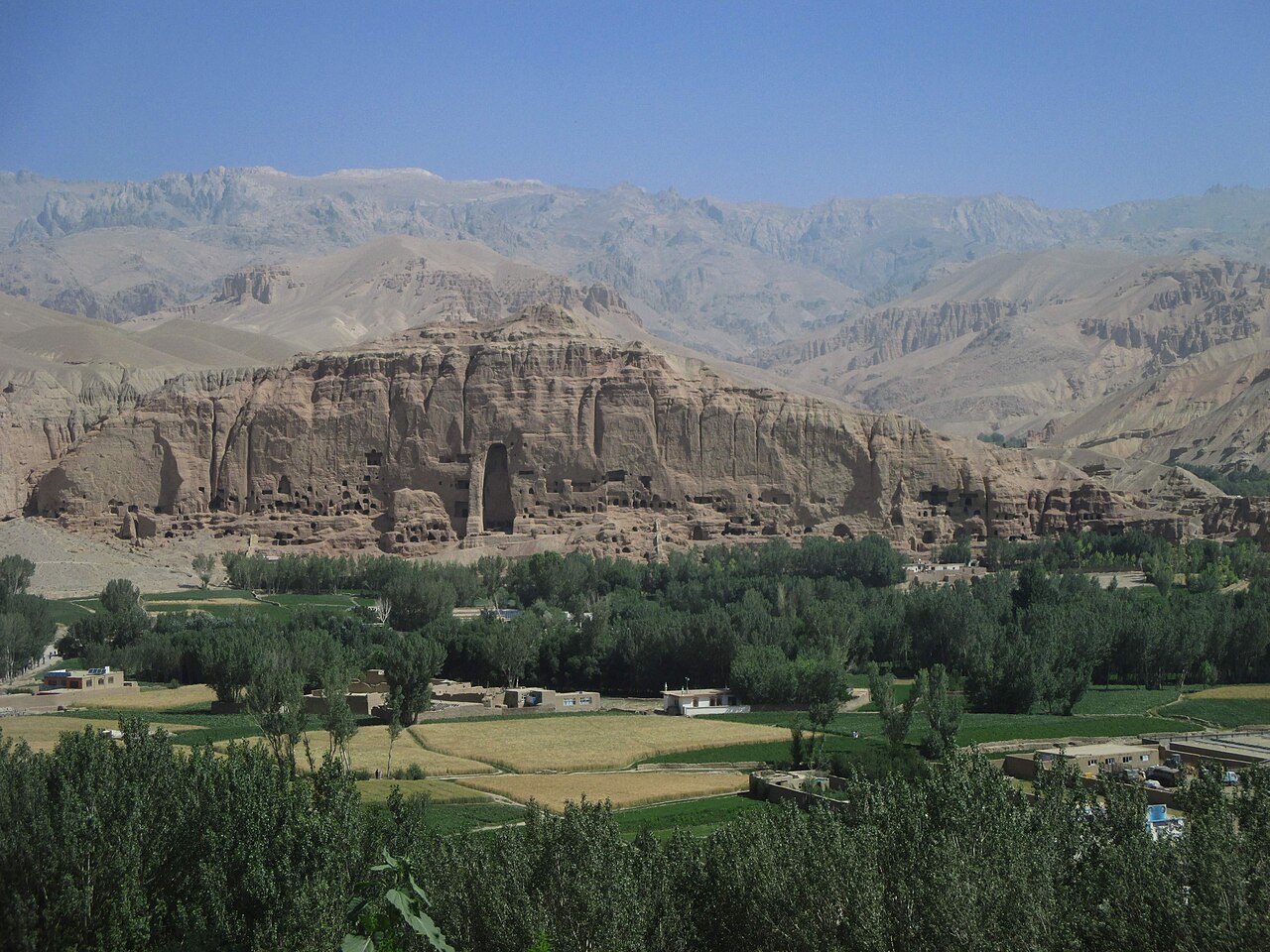
Most people know Bamiyan for two niches. UNESCO’s listing is wider. It comprises eight separate sites in the valley and its tributaries. The Bamiyan Cliffs hold the niches of the two statues, 55 m and 38 m high, and numerous caves forming a large ensemble of Buddhist monasteries, chapels and sanctuaries. Several caves and niches, often linked by galleries, retain remains of wall paintings and seated Buddha figures.
The other seven components spread along the valley. The Kakrak Valley Caves, about 3 km south-east of the cliffs, include more than one hundred caves dating from the 6th to 13th centuries, with fragments of a 10 m standing Buddha. In the Fuladi valley lie the caves of Qoul-i Akram and Lalai Ghami. The fortress of Shahr-i Ghulghulah marks the original settlement of Bamiyan. Further east are the fortified settlements of Qallai Kaphari A and B, and, some 15 km from the cliffs, Shahr-i Zuhak, where earlier remains are overlaid by developments of the 10th to 13th centuries. The architecture is a record of Indian, Hellenistic, Roman, Sasanian and later Islamic influence.
What happened to the two Buddha statues in 2001?
UNESCO records that the Taliban destroyed the two standing Buddha statues in March 2001. Its own text calls the act internationally condemned and deliberate, and names it as a major loss to the integrity of the site. It also says a significant proportion of the attributes that express the property’s value remain intact at all eight sites, including the monastery in the cliffs that once contained the statues.
The cave art suffered as well. Yoko Taniguchi, writing on the conservation project led by UNESCO and Tokyo’s National Research Institute for Cultural Properties, reports that over 80 per cent of the wall paintings that remained before the conflict were lost, through the blasts and through looting. A Japanese committee later held displaced fragments for safekeeping. More than 200 displaced cultural properties were returned to Afghanistan: 99 in June 2005 and 102 in 2016.
Since 2003 UNESCO has led a three-phase safeguarding plan. Its aims were to consolidate the niches, to protect the artefacts that survived and to make the site safe, notably by de-mining. In March 2011 Afghan officials and international experts concluded that the property was potentially ready to leave the Danger List by 2013, subject to progress on security, the stability of the niches and the conservation of the remains. UNESCO’s page lists it as in danger from 2003 to the present.
Why do the Bamiyan cave paintings matter to art historians?
In 2008 an international team from Japan, France, the United States and the European Synchrotron Radiation Facility reported that some Bamiyan paintings were made with oil. They found drying oils in samples from 12 of 50 caves studied, perhaps walnut and poppy seed. The murals, painted in the mid-7th century, show Buddhas in vermilion robes sitting cross-legged amid palm leaves and mythical creatures. European textbooks often place the beginning of oil painting in the 15th century.
Taniguchi later summarised the finding more strongly: analysis of samples from 31 of 279 caves, she writes, confirmed these paintings as the world’s earliest examples to use drying oil as a binding medium. That is the authors’ own claim, and it rests on the samples that survive. UNESCO’s text puts the cave art in a wider frame, as part of the Gandharan school of Buddhist art in Central Asia, fed by Indian, Hellenistic, Roman and Sasanian influence.
Frequently Asked Questions
Which UNESCO World Heritage sites are near the Bamiyan Valley?
The Minaret and Archaeological Remains of Jam in Afghanistan is closest, 218 km away in a straight line. Next come the Tigrovaya Balka tugay forests (266 km) and Ancient Khuttal (314 km), both in Tajikistan, then Takht-i-Bahi in Pakistan (379 km). Shakhrisyabz and Taxila follow at 470 km.
Is the Bamiyan Valley on the List of World Heritage in Danger?
Yes. UNESCO shows it on the List of World Heritage in Danger from 2003, the year it was inscribed. In 2011 an expert group judged it potentially ready for removal by 2013, pending progress on security, the stability of the niches, conservation of the remains and a management plan.
How many caves are there at Bamiyan?
Taniguchi counts about 750 caves, of which roughly 50 were decorated with wall paintings and sculpture. UNESCO describes the Bamiyan Cliffs as holding numerous caves that form a large ensemble of Buddhist monasteries, chapels and sanctuaries, and does not give a single total.
Are the Bamiyan murals the oldest oil paintings?
Researchers say so, with qualifications. A 2008 study found drying oils in 12 of 50 caves sampled, in murals of the mid-7th century. Taniguchi describes them as the world’s earliest examples of drying oil used as a binding medium. The claim rests on the samples analysed.
Sources
- UNESCO World Heritage Centre, Cultural Landscape and Archaeological Remains of the Bamiyan Valley (inscribed 2003; List of World Heritage in Danger 2003 to present). https://whc.unesco.org/en/list/208/
- UNESCO World Heritage Centre, Minaret and Archaeological Remains of Jam (2002). https://whc.unesco.org/en/list/211/
- UNESCO World Heritage Centre, Tugay forests of the Tigrovaya Balka Nature Reserve (2023). https://whc.unesco.org/en/list/1685/
- UNESCO World Heritage Centre, Cultural Heritage Sites of Ancient Khuttal (2025). https://whc.unesco.org/en/list/1627/
- UNESCO World Heritage Centre, Buddhist Ruins of Takht-i-Bahi and Neighbouring City Remains at Sahr-i-Bahlol (1980). https://whc.unesco.org/en/list/140/
- UNESCO World Heritage Centre, Historic Centre of Shakhrisyabz (2000). https://whc.unesco.org/en/list/885/
- UNESCO World Heritage Centre, Taxila (1980). https://whc.unesco.org/en/list/139/
- European Synchrotron Radiation Facility, “Synchrotron light unveils oil in ancient Buddhist paintings from Bamiyan”, 21 April 2008. https://www.esrf.fr/news/general/bamiyan/ (study: Cotte et al., J. Anal. At. Spectrom. 2008, 23, DOI 10.1039/b801358f)
- Taniguchi, Y., “Materials and Technologies of the Bamiyan Wall Paintings”, in Conservation and Painting Techniques of Wall Paintings on the Ancient Silk Road, Springer, 2021, pp. 177-195. DOI 10.1007/978-981-33-4161-6_10
- Taniguchi, Y., “Cultural Identity and the Revival of Values After the Demolishment of Bamiyan’s Buddhist Wall Paintings”, in The Future of the Bamiyan Buddha Statues, Springer, 2020, pp. 51-70 (open access). DOI 10.1007/978-3-030-51316-0_4
Spotted an error? Write to editorial@culturalheritageonline.com and we correct it the same day.