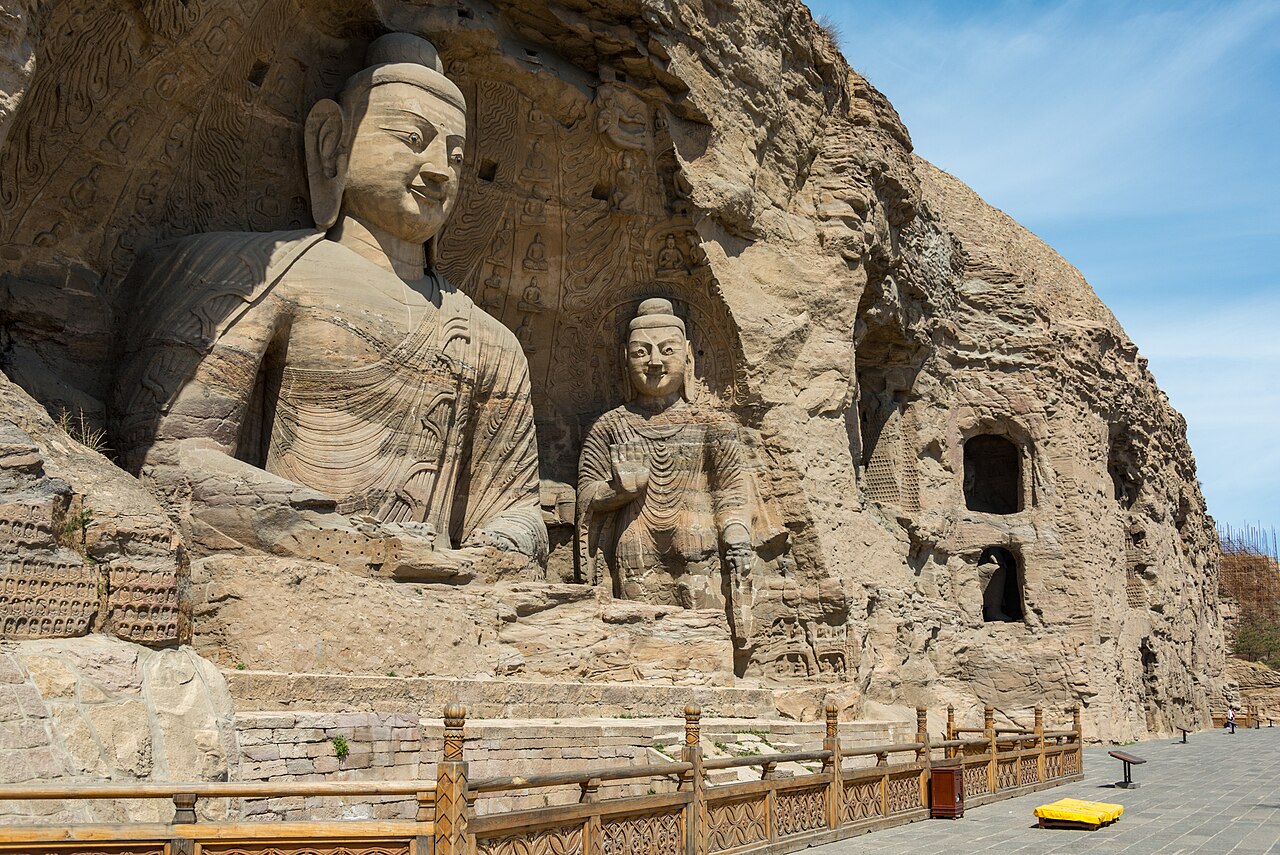
The Yungang Grottoes, inscribed by UNESCO in 2001, are the oldest and most architecturally integrated Buddhist cave sculpture complex in China: 252 caves and 51,000 individual carved figures distributed along a 1-kilometre sandstone cliff face at Wuzhou Mountain, 16 kilometres west of Datong City in Shanxi Province, carved primarily from 460 to 525 CE during the Northern Wei dynasty (386–534 CE) and representing the first monumental Buddhist sculpture programme directly commissioned by a Chinese imperial court. The Yungang inscription’s Outstanding Universal Value rests above all on the five Tan Yao caves (Caves 16–20), commissioned by the Northern Wei Emperor Wencheng (r. 452–465 CE) in 460 CE at the initiative of the monk Tan Yao: these five caves each contain a single colossal Buddha figure (ranging from 13.7 to 17 metres seated height) carved as a formal portrait of five successive Northern Wei emperors — the first documented instance in world Buddhist art of a living or recently deceased ruler deliberately identified with a Buddha figure in monumental stone sculpture. The Yungang complex is equally significant for the extraordinary range of stylistic influences it synthesises: Indian Gandharan classical figural style (imported via Central Asian sculptors brought along the Silk Road), Chinese lacquer-painted clay sculpture tradition, and the emergent Northern Wei court style that would eventually develop into the Tang Buddhist aesthetic that reached its peak at the Longmen Grottoes 500 kilometres south.
The Shanxi heritage corridor: coal plateau and Buddhist art Mount Wutai · Ancient City of Pingyao · Hanging Temple Hengshan — 150 to 280 km
One hundred fifty kilometres southeast of Datong by road (approximately 2.5 hours from Datong North on the G208 national road and S201 via Fanshi County to the Wutai Mountain area), the Mount Wutai Scenic Area (inscribed 2009) is the other major Shanxi UNESCO site and the most architecturally significant Buddhist sacred mountain in China — home to 53 active monasteries and the only surviving Tang-dynasty wooden temple halls in existence. The connection between Yungang and Mount Wutai is biographical and dynastic: the same Northern Wei imperial dynasty that built Yungang also patronised the earliest recorded temples on Mount Wutai (the Lingyin Monastery, mentioned in the earliest Wutai texts as a Northern Wei construction), and the monk Tan Yao who initiated the Yungang carving programme was operating in the same court religious culture that was simultaneously building the Wutai monastery network. The most historically significant structures at Mount Wutai are the Nanchan Temple (completed 782 CE) and the Foguang Temple (857 CE) — the two surviving Tang wooden halls in China — which post-date Yungang by 300 years but represent the full maturation of the Tang Buddhist temple architecture that grew directly from the Northern Wei cave-temple tradition at Yungang. From Datong North Station, the Wutai Mountain area is reached by high-speed rail to Xinzhou North and then by bus (approximately 2.5 hours total) or by road via Fanshi (approximately 2.5 hours).
Two hundred Eighty kilometres south of Datong by high-speed rail (approximately 1.5 hours from Datong North to Pingyao Ancient City Station via the Datong-Xi’an HSR and Taiyuan South), the Ancient City of Pingyao (inscribed 1997) in Jinzhong City is the most complete Ming-Qing walled city in China and the historic headquarters of China’s first national banking network. The cultural connection between Yungang and Pingyao is through the Shanxi provincial identity: both are in Shanxi Province, both are products of the same resource-rich but administratively marginal highland zone west of the Taihang Mountains. Shanxi’s coal and iron resources (exploited since the Han dynasty) supported both the Northern Wei imperial construction programme that produced Yungang and the Ming-Qing commercial networks that concentrated in Pingyao. The Shanxi merchant tradition that built Pingyao’s piaohao banking houses had deep roots in the same coal and salt trade that the Northern Wei court had taxed to fund the Yungang carving programme: both represent the conversion of Shanxi’s mineral wealth into cultural monuments of international significance. The visitor circuit Datong-Yungang-Wutai-Pingyao-Taiyuan covers the full arc of Shanxi’s cultural heritage in four sites accessible by high-speed rail within a 3-day circuit. From Datong North Station, Pingyao is reached by HSR (approximately 1.5 hours via Taiyuan South).
Thirty kilometres southwest of Datong by road (approximately 45 minutes from Datong to the Hanging Temple at Hunyuan County), the Xuankong Temple (Hanging Temple) at Mount Hengshan — China’s Northern Sacred Mountain (Bei Yue, one of the Five Sacred Mountains) — is not separately UNESCO-inscribed but is the most extraordinary surviving example of cliff-face architecture in China and was built contemporaneously with the earliest Yungang caves. The Hanging Temple (founded 491 CE, Northern Wei, rebuilt and expanded in successive dynasties through the Ming) is a monastery complex built directly into the rock face of a vertical cliff, 75 metres above the valley floor of Jinlong Gorge, supported on wooden brackets drilled into the cliff rock — the most visually dramatic expression of the Northern Wei’s characteristic strategy of treating cliff faces as sacred surfaces for architectural intervention (the same strategy that produced Yungang, where the caves ARE the architecture). The temple uniquely houses Buddhist, Daoist, and Confucian images simultaneously within the same compound, reflecting the Three Teachings (Sanjiao) syncretic approach that the Northern Wei court adopted alongside its Buddhist patronage at Yungang. From Datong, the Hanging Temple is efficiently combined with the Yungang Grottoes as a single day trip (Yungang in the morning, Hengshan Hanging Temple in the afternoon, returning to Datong for the night). From Datong city, the Hanging Temple is approximately 45 minutes by road; tourist buses depart from Datong Bus Station in the morning.
Sixty kilometres north of Datong by road (approximately 1 hour from Datong to the Juyongguan Great Wall section at Yanqing District, or more importantly to the Datong Great Wall at Yanggao County), the Great Wall of China (inscribed 1987) in Shanxi-Hebei border zone is immediately accessible from Datong as a day trip along the same northern frontier that the Northern Wei was defending when it built Yungang. The Yungang carving programme (460–525 CE) was the Northern Wei dynasty’s most ambitious religious project — but the Northern Wei was simultaneously the greatest builder of the earliest pre-Ming Great Wall in the Datong area. The Northern Wei “outer wall” (北魏外长城) ran approximately from Datong west to Yanggao, approximately 50 km north of Yungang, and was the defensive barrier that protected the same capital zone (Datong was the Northern Wei capital, Pingcheng, from 398 to 494 CE) whose security the carving programme celebrated. The geographical coincidence — the most ambitious Chinese Buddhist cave programme and the most important early Great Wall section in the same location, built at the same time by the same dynasty — documents the Northern Wei’s dual strategy: build walls against the northern Rouran confederation’s cavalry, and build Buddha portraits against the ontological uncertainty of being a Tuoba Xianbei dynasty ruling Han Chinese subjects. From Datong, the Yanggao Northern Wei wall sections are accessible by road (approximately 1 hour); the more photogenic Ming Wall sections are at Tianzhen and Zuoyun Counties (approximately 1.5 hours from Datong).
East to Beijing and south toward the Yellow River corridor Forbidden City · Zhoukoudian · Wangcheng Platform Luoyang — 400 to 600 km
Four hundred Kilometres southeast of Datong by high-speed rail (approximately 2.5 hours from Datong North to Beijing West via the Datong-Zhangjiakou-Beijing HSR), the Imperial Palaces of the Ming and Qing Dynasties — the Forbidden City (inscribed 1987) — are the administrative capital of the Ming and Qing dynasties that succeeded the Northern Wei as the dominant cultural powers of northern China. The historical arc from Yungang (Northern Wei, 460 CE) to the Forbidden City (Ming Yongle, 1406–1420 CE) covers 960 years of northern Chinese imperial culture, during which the same geopolitical problem (how a non-Han ruling dynasty establishes legitimacy over a Han Chinese subject population) was solved in different ways: the Northern Wei at Yungang solved it through Buddhist art (making the emperor-Buddha the shared sacred figure of both Tuoba Xianbei conquerors and Han Chinese subjects), while the Yongle Emperor at the Forbidden City solved it through Confucian ritual architecture (making the emperor-Son-of-Heaven’s formal palace the legitimate expression of the Mandate of Heaven regardless of ethnic origin). Both solutions required massive state investment in a single iconic monument at the centre of the capital — Yungang’s Tan Yao caves at Pingcheng and the Forbidden City’s central axis at Beijing are both expressions of the same imperial legitimacy problem solved through architectural scale. From Datong North Station, Beijing West is reached by HSR in approximately 2.5 hours.
Four Hundred Fifty kilometres south of Datong by high-speed rail (approximately 2 hours from Datong North to Luoyang Longmen Station via Taiyuan South and Zhengzhou East on the Datong-Xi’an HSR), the Longmen Grottoes (inscribed 2000) at Luoyang document the continuation and culmination of the same Northern Wei Buddhist sculpture programme that Yungang represents in its earliest phase. The move of the Northern Wei capital from Pingcheng (Datong) to Luoyi (Luoyang) in 494 CE was motivated by Emperor Xiaowen’s deliberate sinification policy: he mandated that the Tuoba Xianbei elite adopt Chinese family names, Chinese dress, and the Chinese language, and moved the capital to the Han Chinese heartland as a physical expression of this cultural transformation. The Longmen carving programme that followed the capital move (approximately 495 CE onward) therefore documents the sinified phase of the same imperial sculpture tradition: where Yungang’s Buddha figures retain Central Asian stylistic elements (the round face, the heavy drapery folds, the frontal symmetry of Gandharan figuration), the Longmen Wei-period figures (particularly the Guyang Cave’s Northern Wei donation niches, 493–575 CE) show a progressively elongated, flatter, more calligraphically linear style that reflects the Han Chinese aesthetic entering the sculptural vocabulary. The two sites together — Yungang (pre-sinification, 460–494 CE) and Longmen (post-sinification, 495 CE onward through the Tang period) — document the most important transformation in the history of Chinese Buddhist art. From Datong North Station, Luoyang Longmen is reached in approximately 2 hours on the Datong-Xi’an HSR.
Five Hundred Kilometres east of Datong by high-speed rail and road (approximately 2.5 hours from Datong North via Beijing West to Zhoukoudian), the Peking Man Site at Zhoukoudian (inscribed 1987) in Fangshan District, Beijing, documents the hominin occupation of the North China Plain approximately 700,000–230,000 years before the Northern Wei dynasty built the first Yungang caves. The Zhoukoudian fossils represent a different dimension of the same North China Plain geology whose limestone formations the Northern Wei craftsmen at Yungang were carving: the Sangganhe basin that forms Datong’s geological context and the Taihang Mountain limestone that forms Yungang’s cliff face are part of the same North China geological platform whose loess deposits preserved both the Peking Man fossils at Zhoukoudian and the stratigraphic record that allowed the Yungang cliff-face engineering to be planned with the confidence that the sandstone would carve without collapse. From Datong, Zhoukoudian is most efficiently combined with a Beijing visit (2.5 hours from Datong to Beijing West, then 1.5 hours by local transport to Fangshan).
Practical information
The Yungang Grottoes are 16 kilometres west of Datong city centre in Shanxi Province. The nearest high-speed rail station is Datong North Station on the Datong-Xi’an HSR, approximately 25 kilometres east of the grottoes (served by tourist shuttle bus departing from Datong’s historic Yungang Grottoes Museum of Datong, or by local bus 3 from Datong Station, approximately 45 minutes). A dedicated grottoes tourist bus departs from the Datong Bus Station (approximately 1 hour to grottoes). From Beijing North Station (Beijing North), direct high-speed trains reach Datong North in approximately 1.5 hours on the Beijing-Datong HSR (connecting to the Datong-Zhang Jiakou-Beijing HSR opened for the 2022 Winter Olympics). The grottoes are entered from the main gate with a wooden-walkway system along the cliff face that connects all 252 caves over approximately 1 kilometre. The five Tan Yao caves (Caves 16–20) are the primary destination, particularly Cave 20 with the Great Seated Buddha (Dafosi Zuo, 13.7 metres high) whose front wall collapsed in an unknown past period, leaving the figure fully exposed to open air — the most dramatic single composition at Yungang and the most photographed. Cave 6 (Northern Wei, end of the 5th century) is the most ornate interior, with a central stone pillar carved in four stories of 32 Buddha niches, covered floor-to-ceiling with narrative reliefs of Shakyamuni’s life story. Cave 12 is the “Music Cave,” with 54 carved musicians playing ancient Chinese instruments carved in two rows of the cave ceiling. Full coverage of the main caves requires 3–4 hours. The adjacent Yungang Museum (purpose-built 2018, accessed through a landscaped approach route) provides geological, archaeological, and art historical context for the cave complex. Best visiting seasons: April–May and September–October (mild temperatures, clear skies over the sandstone cliffs); winter (November–February) brings Datong’s extreme continental cold (minimum temperatures −20°C) and much smaller crowds; summer (June–August) is warm and busy.
Frequently Asked Questions
Who were the Northern Wei and why did they build the Yungang Grottoes?
The Northern Wei dynasty (386–534 CE) was a state founded by the Tuoba clan of the Xianbei people — a Mongolic or proto-Mongolic semi-nomadic group from the Mongolian steppe north of the Great Wall that conquered North China in the late 4th century and ruled it for 150 years. The Tuoba’s political problem was the classic problem of steppe conquerors ruling sedentary agrarian civilisations: how to maintain the loyalty of a predominantly Han Chinese subject population while retaining the military effectiveness of the original steppe warrior class. The Yungang carving programme was one of the Northern Wei court’s primary solutions to this problem. The decision to commission the five Tan Yao caves in 460 CE as portraits of five emperors-as-Buddhas was simultaneously a religious act (affirming the emperor’s Buddhist status and the Buddhist legitimacy of his rule) and a political act (creating a shared sacred figure — the emperor-Buddha — that could claim loyalty from both Tuoba warriors who understood the emperor as their war-chief and Han Chinese subjects who understood the emperor as the Son of Heaven with a Buddhist mandate). The scale of the programme (252 caves, 51,000 figures, carved over 65 years) was calibrated to the scale of the legitimacy problem: a dynasty whose origins lay in steppe raiding needed a cultural programme of overwhelming sophistication to establish itself as the legitimate successor to the Han cultural tradition that its Chinese subjects valued. The Yungang Grottoes — alongside the Northern Wei’s adoption of the Chinese examination system, Chinese court rituals, and eventually Chinese surnames and language under Emperor Xiaowen in 492–494 CE — are the archaeological evidence of the most successful cultural sinification programme in Chinese imperial history.
What foreign stylistic influences are visible in the Yungang sculpture and how did they arrive?
The Yungang Grottoes are the most direct evidence in Chinese art history of the transmission of Buddhist iconographic styles from India to China via the Silk Road, because the sculptures of the 460–494 CE period (the Tan Yao caves and the caves of the reign of Emperor Xianwen) retain clearly recognisable elements of the Gandharan sculptural tradition — the classical Hellenistic-influenced Buddhist art style that developed in the Gandhara region (modern Pakistan-Afghanistan) from approximately the 1st to 5th centuries CE. The Central Asian artistic influence at Yungang arrived through multiple routes: Central Asian monks and craftsmen who accompanied diplomatic missions to the Northern Wei court (the court maintained official relations with Kushan, Sassanid Persian, and Sogdian merchant communities from Central Asia); the artistic influence of the Qiuci (Kucha) kingdom’s painted cave temples (the Kizil Caves of Xinjiang, which represent an intermediate stage between Gandharan Indian sculpture and the Chinese adaptation at Yungang); and the direct importation of bronze Buddha images from India and Central Asia as diplomatic gifts, which served as prototypes for the Yungang sculptors. The most visible Gandharan elements at Yungang are: the treatment of the robe drapery (the “wet drapery” technique, showing the drapery folds as if the robe were clinging to the body’s underlying form — a technique derived from Hellenistic Greek sculpture via the Gandharan tradition); the flame-shaped ushnisha (the cranial protuberance on the Buddha’s head that Gandharan art rendered as a flame, versus the later Chinese preference for a snail-shell hair arrangement); and the facial type (round, full-cheeked, with deep-set eyes and heavy brows — visually different from the elongated, thin-faced Tang Buddhist aesthetic that would develop 200 years later at Longmen). By the later Yungang caves (Cave 5 and 6, carved 490–525 CE), the Indian and Central Asian elements have largely been absorbed into a distinctly Chinese aesthetic, demonstrating the complete visual transformation of Buddhist iconography from Indian origin to Chinese expression within a single 65-year carving programme.
How did the Yungang Grottoes survive and what is the current state of conservation?
The Yungang Grottoes have survived 1,560 years through a combination of the sandstone’s relative durability (the Datong sandstone is a medium-grained sedimentary rock that resists fracture better than the limestone at Longmen), geographic isolation (Yungang was remote from the major urban centres of Chinese culture from the Tang dynasty onward, reducing both the risk of deliberate destruction and the pressure of heavy visitor use until the 20th century), and the protective wooden facade structures that successive dynasties built in front of the caves to shield them from weathering. The cave facades visible today — elaborate five-bay temple front buildings attached to the cliff face in front of Caves 5–8 — are Qing-period rebuildings of earlier Ming structures, themselves rebuildings of possible Tang-period originals; the wooden facade tradition has been continuously maintained, slowing the sandstone’s weathering by reducing wind erosion and moisture penetration. The primary current conservation threats are coal dust from Datong’s large coal-processing industry (Datong is China’s largest coal production city, and particulate matter deposits on the carved surfaces are accelerating surface erosion) and visitor-generated humidity (the sharp increase in visitor numbers from approximately 100,000 per year in the 1980s to approximately 3 million per year in the 2010s has raised interior humidity in enclosed caves). The Yungang Research Institute and Chinese Academy of Cultural Heritage have conducted targeted conservation campaigns since 2003, including digital three-dimensional scanning of all 252 caves (completed by 2017) — the most comprehensive digital heritage documentation of any Chinese UNESCO site — and chemical consolidation treatments applied to structurally vulnerable surfaces in Caves 1–4 and 6. The 2018 Yungang Museum, built 1.5 kilometres from the cave site to draw visitor numbers away from the most sensitive caves, is part of the same conservation strategy: reducing the direct visitor pressure on the historic caves while providing a high-quality archaeological experience in purpose-built modern facilities.
Sources
- S1 — UNESCO World Heritage Centre — Yungang Grottoes (Ref. 1039) — https://web.archive.org/web/20230601000000/https://whc.unesco.org/en/list/1039/
- S2 — UNESCO World Heritage Centre — Statement of Outstanding Universal Value (Ref. 1039) — https://whc.unesco.org/en/list/1039/
Spotted an error? Write to editorial@culturalheritageonline.com and we correct it the same day.