
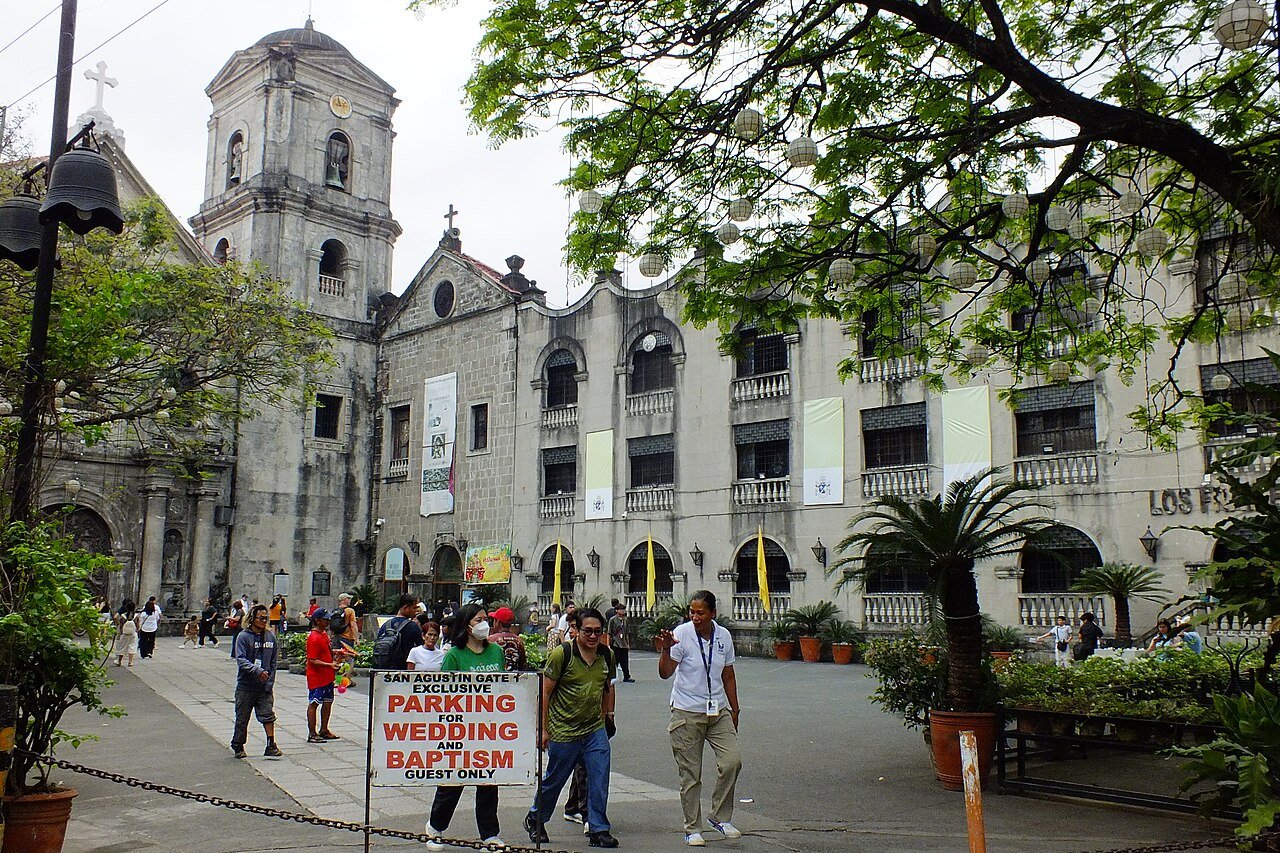
The Philippines holds six UNESCO World Heritage Sites, four of which are directly connected to travel from Manila — ranging from a 16th-century church you can visit this afternoon to 2,000-year-old rice terraces carved into the mountain Cordillera. Each tells a different chapter of Filipino history, from Spanish colonisation to pre-Hispanic indigenous engineering. From Cultural Heritage Online.
Baroque Churches of the Philippines 20 min by taxi (San Agustin, Intramuros)
Four Spanish colonial churches, inscribed in 1993, survive as the finest ensemble of baroque religious architecture in Southeast Asia. The oldest and most accessible is San Agustin Church in Intramuros — begun in 1571, completed in its current stone form in 1607, it is the oldest stone church in the Philippines and one of the very few structures in Manila to survive the devastation of World War II. The interior holds gilded altars, trompe-l’oeil ceiling paintings executed by local Augustinian artists, and a museum housing colonial-era vestments and ivory santos that span four centuries of religious life.
The three other inscribed churches require longer journeys but reward them. Paoay Church in Ilocos Norte (1710) is the exemplar of what architects call “earthquake baroque”: massive coral-stone buttresses flare from the nave walls like ribs, a direct response to the seismic violence of the Philippine archipelago. Santa Maria Church in Ilocos Sur rises on a hilltop above the town and doubles as a fortress, its walls thick enough to shelter a community under siege. Miagao Church in Iloilo, on the island of Panay, carries an extraordinary carved facade where saints stand amid coconut palms and papaya trees — European iconography translated into a wholly Filipino landscape.
Getting there: San Agustin — 20-min taxi from Ermita or Malate; enter Intramuros via Victoria or Aduana gate. Paoay and Santa Maria — 1.5 hr flight to Laoag, then 1-2 hr by van. Miagao — 1 hr flight to Iloilo. Allow: 2 hours for San Agustin including the museum; half a day for each provincial church. Best for: History and architecture travellers, first-time Manila visitors, those with limited time.
Historic City of Vigan 400 km north — 8 hr by bus or 1 hr flight to Laoag
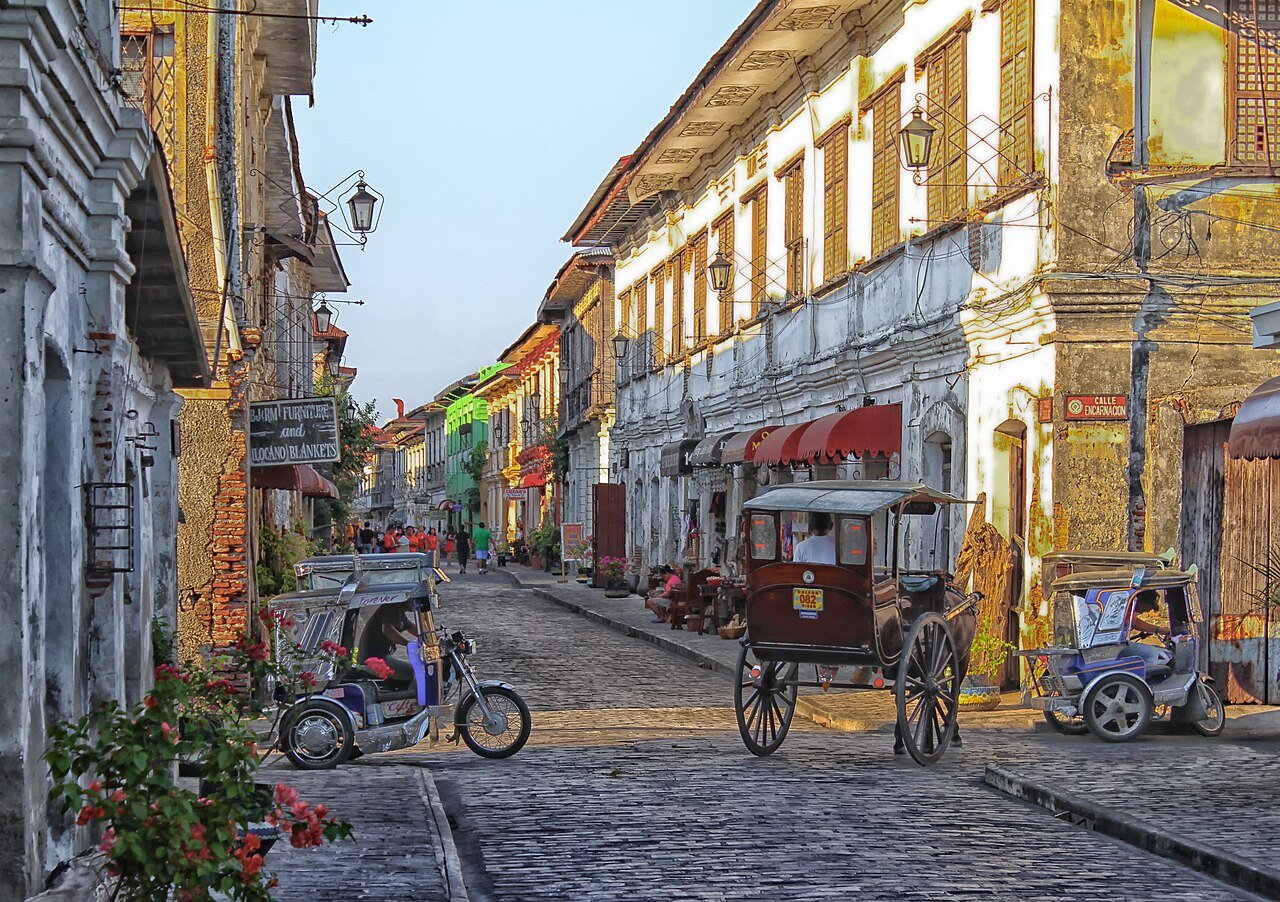
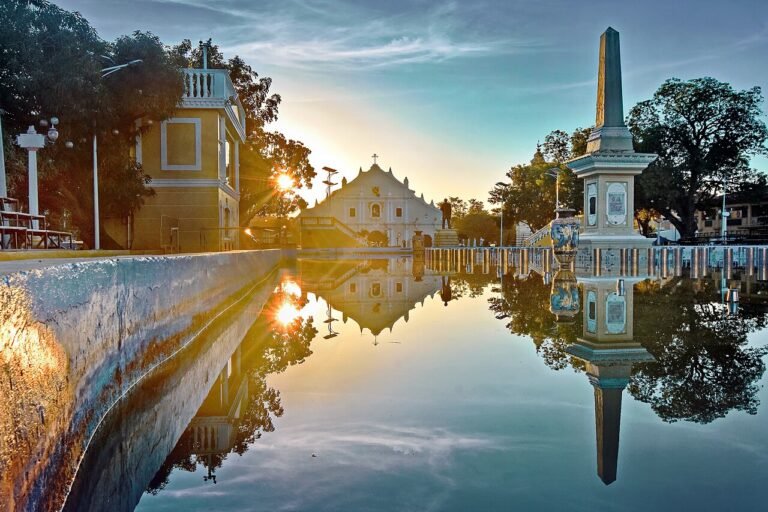
Inscribed in 1999, Vigan is considered the best-preserved example of a planned Spanish colonial city in Asia. Its streets were not rebuilt after colonisation ended; they were simply maintained and inhabited. Walk Calle Crisologo at dusk — when kalesas, the two-wheeled horse-drawn carriages that have operated here for two centuries, clatter over grey basalt cobblestones — and the 18th century feels less like a historical abstraction and more like an ongoing condition of the place.
The architecture is genuinely hybrid. Vigan’s merchant class was Filipino-Chinese mestizo, and their houses fuse a Spanish colonial ground floor (designed for commerce, with wide arcaded portales) with an upper story that follows Chinese building traditions: sliding capiz-shell windows, tiled roofs with upswept eaves, interior courtyards. This synthesis — called bahay na bato, or stone house — exists nowhere else at this scale or in this state of preservation.
The city is compact and best explored on foot or by rented bicycle. Beyond Calle Crisologo, the Plaza Salcedo fronts the Metropolitan Cathedral of the Conversion of St Paul, and the surrounding streets hold ancestral houses converted into heritage inns, pottery workshops producing the distinctive burnay earthenware, and street stalls selling Vigan longganisa and bagnet.
Getting there: Nightly bus from Pasay (Partas, Dominion) — 8 hr, arrives early morning. Alternatively fly to Laoag (1 hr), then 1 hr van south to Vigan. Allow: Minimum 1 night; 2 nights to do it properly. Best for: Cultural travellers, photographers, anyone seeking an overnight trip from Manila that feels genuinely different.
Rice Terraces of the Philippine Cordilleras 340 km north — 9 hr by bus from Manila
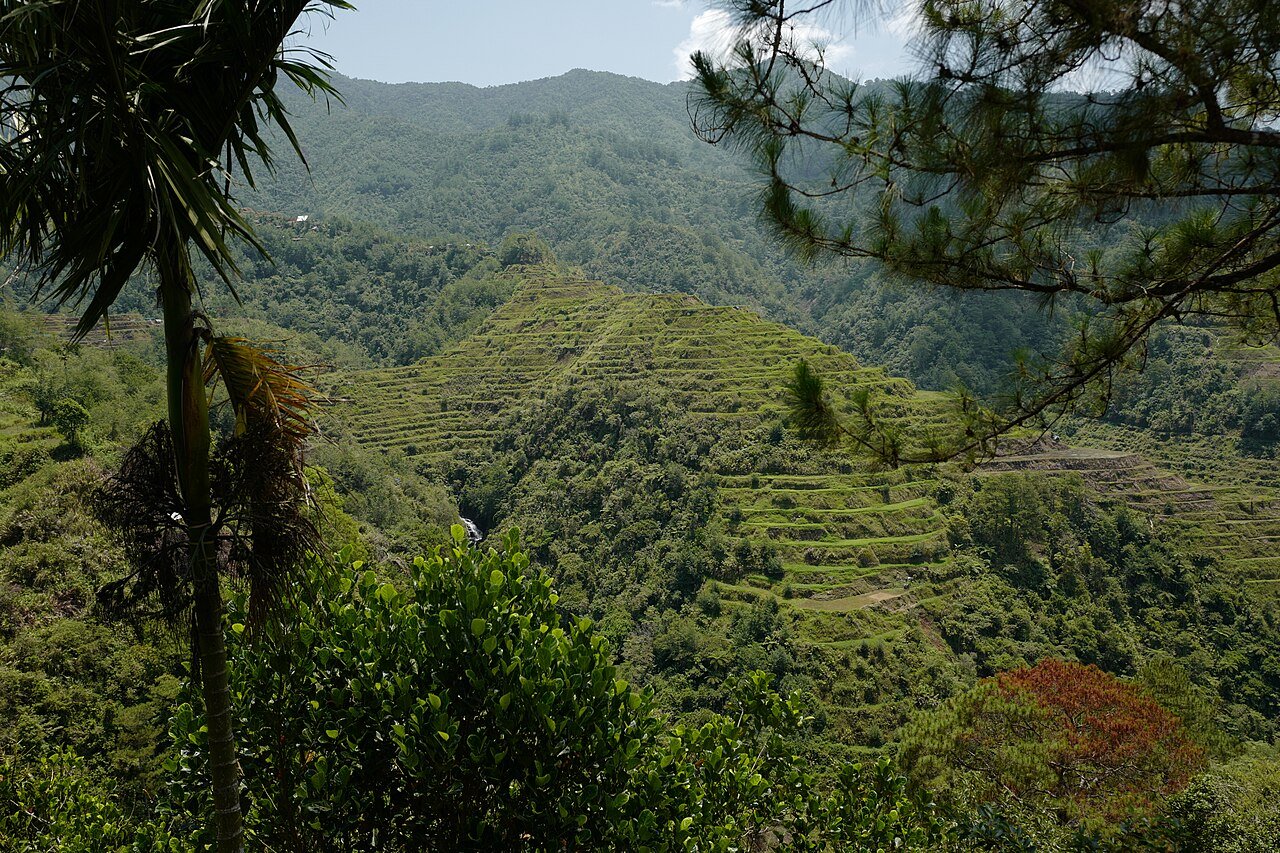
The Ifugao rice terraces were inscribed in 1995 and have been called the Eighth Wonder of the World — a phrase that, for once, earns its use. The figures alone are staggering: 2,000 years old, covering 10,360 hectares across the mountains of Ifugao Province, constructed and maintained entirely without machinery. If the terrace walls were laid end to end, they would circle half the globe.
What the figures do not convey is the quality of the light in early morning, when mist fills the lower valleys and only the upper terraces catch the sun; or the sound of the irrigation channels, an ancient system of wooden pipes and stone weirs that carries water from mountain springs down through hundreds of consecutive paddies. The Ifugao people continue to farm the terraces using traditional methods, and the cultural knowledge embedded in their agricultural calendar — including the rituals associated with bul-ol, the carved wooden rice granary gods — is as much a part of the inscription as the stone walls themselves.
The main viewpoint is at Banaue town, but the most dramatic terraces are at Batad, a saddle village accessible only on foot: a 3-hour trek from the Banaue junction, without a road in or out. The isolation keeps Batad close to what these mountains looked like before tourism arrived.
Getting there: Overnight bus from Cubao (Ohayami Trans, GV Florida) — departs ~9pm, arrives Banaue ~6am. Batad requires an additional 3 hr trek or jeepney plus trek. Allow: Minimum 2 nights in Banaue; 3 nights to include Batad. Best for: Hikers, photographers, travellers with a high tolerance for mountain roads and the rewards that come with them.
Tubbataha Reefs Natural Park 1 hr flight to Puerto Princesa, Palawan; then liveaboard
Inscribed in 1993 and expanded in 2009, Tubbataha Reefs Natural Park covers 97,030 hectares of coral reef in the Sulu Sea, roughly equidistant from Palawan and Borneo. It is among the most pristine marine environments in the world: remote enough that human pressure has remained negligible, and rich enough to support manta rays, whale sharks, hammerhead sharks, sea turtles, and hundreds of reef fish species at densities that experienced divers describe as rare even by Indo-Pacific standards.
Access is deliberately difficult. The park is reachable only by liveaboard vessel from Puerto Princesa, a crossing of roughly 10-12 hours across open water. The dive season runs from March to June, when the sea is calm enough for the passage. Outside that window, the park is effectively closed. This inaccessibility is not incidental — it is part of what has kept the reefs intact.
Getting there: Fly Manila to Puerto Princesa (1 hr, multiple daily flights); book a liveaboard operator in Puerto Princesa. Permits are required and typically handled by the operator. Allow: 5-7 days minimum for a proper liveaboard trip. Best for: Experienced divers; March-June only.
Frequently Asked Questions
How many UNESCO World Heritage Sites are near Manila?
The Philippines has six UNESCO World Heritage Sites. Four are linked to Manila as a base: the Baroque Churches of the Philippines (inscribed 1993), the Historic City of Vigan (1999), the Rice Terraces of the Philippine Cordilleras (1995), and Tubbataha Reefs Natural Park (1993, extended 2009). The remaining two — Puerto-Princesa Subterranean River National Park and the Ancestral Domain of the Ifugao — are either best approached from their own regional hubs or overlap with the Cordillera entry point.
Which UNESCO site is closest to Manila, and how do I visit?
San Agustin Church in Intramuros is the most accessible — it sits inside Manila’s 16th-century walled city, roughly 20 minutes by taxi from the tourist belt of Ermita and Malate. Admission to the church is free; the adjacent Museo de San Agustín charges a small entry fee and contains one of the finest collections of colonial religious art in the Philippines. The walled city is walkable, and a half-day covers San Agustin, Fort Santiago, and the main plazas.
Can I combine Vigan and the Rice Terraces in a single trip from Manila?
Yes, and the combination is a natural circuit of northern Luzon. The most practical route: overnight bus or flight to Vigan (1-2 nights), then van north to Laoag or east across the mountains toward Banaue (4-5 hr by van via the Ilocos-Cagayan road or the Abra route). Allow 7-10 days for the full northern loop. November to February is the most comfortable season — dry and cool in the highlands, and Vigan’s Heritage Festival runs in January.
Why are the Baroque Churches of the Philippines considered significant enough for UNESCO inscription?
The four churches represent a fusion of European baroque forms with local building materials, craftsmanship, and — particularly at Miagao — indigenous iconography. They were designed by Spanish friars but built largely by Filipino and Chinese artisans who adapted the forms to local seismic conditions (hence the massive buttresses at Paoay) and tropical materials such as coral stone and hardwood. The ensemble documents how a transplanted European tradition was transformed into something genuinely distinct over two centuries of colonial contact, producing what art historians call “Philippine baroque” — a category that exists nowhere else.
Sources
- S1 — Galende, Pedro G. Angels in Stone: Architecture of Augustinian Churches in the Philippines. San Agustin Museum, 1996. ISBN 978-971-91571-0-6.
- S2 — Scott, William Henry. Barangay: Sixteenth-Century Philippine Culture and Society. Ateneo de Manila University Press, 1994. ISBN 978-971-550-135-4.
Spotted an error? Write to editorial@culturalheritageonline.com and we correct it the same day.

.jpg)
.jpg)
