
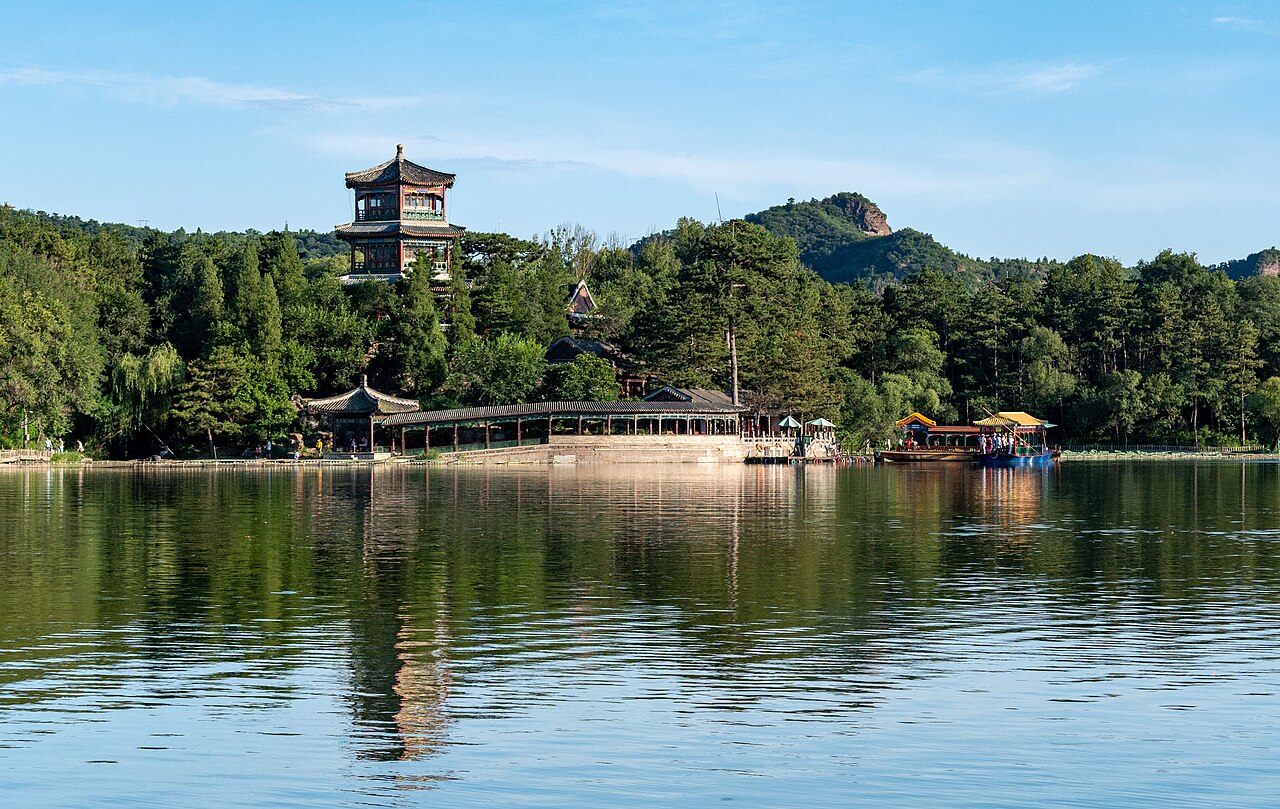
The Mountain Resort and its Outlying Temples, Chengde, inscribed by UNESCO in 1994, is the largest imperial garden in China: a 564-hectare walled retreat compound in Chengde City, Hebei Province, 250 kilometres northeast of Beijing, built as the Qing emperors’ summer residence between 1703 and 1792 under the Kangxi, Yongzheng, and Qianlong emperors. The inscription encompasses the main resort palace complex (Bishu Shanzhuang, the “Mountain Villa for Escaping the Heat”) and eight surviving outlying temples (from an original twelve) built on the mountain ridges surrounding the resort between 1713 and 1780, constructed in the architectural styles of the Tibetan, Mongolian, Han, and Uyghur peoples to express the Qing court’s rule over a multi-ethnic empire. The Putuozongcheng Temple (1767–1771, modelled on Lhasa’s Potala Palace at two-thirds scale) and the Xumifushou Temple (1780, modelled on the Tashilhunpo Monastery in Shigatse, Tibet) are the most architecturally significant of the outlying temples.
Northeast Beijing and the Great Wall corridor Forbidden City · Great Wall Jinshanling · Ming Tombs — 60 to 250 km
Sixty kilometres south of Chengde by road (approximately 50 minutes on the Chengde-Beijing Expressway), the Jinshanling section of the Great Wall of China (inscribed 1987) crosses the Yanshan Mountain granite ridge that forms the northern boundary of the North China Plain. The Jinshanling section (10.5 kilometres of Wall crossing 67 watchtowers) is the best-preserved continuous stretch of Ming Great Wall in Hebei Province, with the famous Simatai section to the east (closed for renovation since 2010) providing the most dramatic vertical face sections. The Chengde Mountain Resort and the Jinshanling Great Wall are geographic complements: the Wall marks the northern limit of direct Ming-Qing military control (the outer defensive perimeter), while Chengde’s Bishu Shanzhuang marks the symbolic centre of the Qing court’s summer diplomacy with the Mongolian nobility and Tibetan lamas who lived beyond the Wall. Qing emperors regularly inspected the Wall sections north of Chengde during hunting expeditions to the royal hunting ground (Mulan Weichang) north of the city; the Jinshanling Wall and the Chengde resort are at the two ends of the same Yanshan Mountain diplomacy system.
Two hundred fifty kilometres southwest of Chengde by road (approximately 3 hours on the Chengde-Beijing Expressway, or approximately 90 minutes by direct high-speed rail from Chengde to Beijing North/Chaoyang), the Imperial Palaces of the Ming and Qing Dynasties — the Forbidden City (inscribed 1987) — is the complementary inscription to Chengde’s summer retreat. The Bishu Shanzhuang was designed specifically as the Qing court’s warm-season counterpart to the Forbidden City’s formal winter residence: Emperor Kangxi built the Mountain Resort because Beijing’s summer heat (and the political distance from the Mongolian borderlands) required a cooler, northern base for the seasonal administration of the empire’s non-Han periphery. The relationship between the Forbidden City’s formal state ceremonial (the winter court, the great ritual audience in the Three Great Halls) and Chengde’s informal diplomatic architecture (the garden compound where the Kangxi, Yongzheng, and Qianlong emperors received Mongolian khans and Tibetan lamas) is the relationship between two complementary modes of Chinese imperial authority. From Chengde, Beijing is reached by high-speed rail in approximately 90 minutes (Chengde Station to Beijing Chaoyang) or by expressway in approximately 3 hours.
Two hundred fifty kilometres southwest of Chengde via Beijing (approximately 3.5 hours total, combining the Chengde-Beijing HSR and Metro Line 8), the Imperial Tombs of the Ming and Qing Dynasties at Changling (the Ming Tombs, inscribed 2000) are at Changping District’s Tianshou Mountain 40 kilometres northwest of central Beijing. The thirteen Ming emperors buried at Changling in the 15th–16th centuries built their tombs in the Yanshan Mountain foothills at the same northern limit of the North China Plain where Chengde is situated: Chengde is 250 kilometres further up the same mountain chain from the Ming Tombs, at the point where the plain ended and the Mongolian steppe beyond the Wall began. The Qing emperors who built Chengde’s Mountain Resort used the Changling tombs’ Spirit Way (the ceremonial processional road lined with stone animals and officials) as the model for the honorary approach roads to the outlying temples’ main gates; the architectural scale reference for the Putuozongcheng Temple’s red wall complex was both the Potala Palace in Lhasa and the spatial logic of the Changling imperial complex.
Two hundred sixty kilometres southwest of Chengde via Beijing (approximately 3.5 hours combining rail and Metro Line 5 or bus), the Temple of Heaven (Tiantan) at the eastern periphery of central Beijing (inscribed 1998) documents the other main Qing imperial ceremonial site: the altar where the emperor performed the annual winter solstice sacrifice to Heaven. The spatial arrangement of the Qing imperial ceremonial year — the summer diplomatic audience at Chengde’s Mountain Resort (June–September), the inspection of the northern frontier hunting grounds (October), the return to Beijing for the winter court at the Forbidden City, and the winter solstice sacrifice at the Temple of Heaven (December) — maps onto a seasonal circuit between these inscriptions. The Qianlong Emperor in particular was documented spending more time at Chengde than at the Forbidden City in his later reign (the annual Chengde season lasted approximately 160 days under Qianlong), making Chengde as much the de facto capital as Beijing for the diplomatic reception of the Qing dynasty’s non-Han subjects.
Northeast China and connections north and east Shenyang Imperial Palace · Eastern Qing Tombs · Peking Man Site — 200 to 500 km
Five hundred kilometres northeast of Chengde by high-speed rail (approximately 3 hours from Chengde to Shenyang via Beijing and the Beijing-Shenyang HSR), the Imperial Palace of the Qing Dynasty in Shenyang (inscribed 2004, as an extension of the Forbidden City inscription) documents the Qing dynasty’s Manchu origins in the pre-Beijing phase of its history. The Shenyang (Mukden) palace — built by Nurhaci and Hong Taiji, the Qing founders, between 1625 and 1636, before the Qing conquest of Beijing in 1644 — is a smaller, architecturally less regularised precursor to the Forbidden City that reveals the Manchu architectural tradition before it absorbed the Han Chinese ceremonial building system. The arc from the Shenyang Mukden Palace (Manchu dynastic origin, 1625) to the Chengde Mountain Resort (Qing multi-ethnic accommodation of Mongolian and Tibetan subjects, 1703–1792) to the Beijing Forbidden City’s Qing imperial phase (formal state authority, 1644–1912) maps the evolution of Qing legitimacy across 250 years. From Chengde, Shenyang requires changing trains at Beijing; the full journey is approximately 3–3.5 hours.
One hundred fifty kilometres south of Chengde by road (approximately 2 hours on the Chengde-Beijing-Tianjin Expressway to the Zunhua City exit), the Eastern Qing Tombs (Qing Dongling) are the Qing imperial burial complex where the Shunzhi, Kangxi, Qianlong, Xianfeng, and Tongzhi emperors are interred, along with four empresses dowager including the Cixi Empress Dowager. The Eastern Qing Tombs complex is not separately inscribed as a UNESCO World Heritage Site (the Imperial Tombs of the Ming and Qing Dynasties inscription includes the Western Qing Tombs at Yixian but not the Eastern Qing Tombs); the omission reflects the complexity of extending the inscription rather than a determination that the Eastern tombs are of lesser significance. The Emperor Kangxi who began the Mountain Resort at Chengde in 1703 is buried at the Jingxiling tomb in the Eastern Tombs, approximately 70 kilometres south of Chengde; the connection between the builder of the Mountain Resort and his own burial complex is a 70-kilometre road journey in the same Yanshan Mountain landscape.
Two hundred fifty kilometres southwest of Chengde by road (approximately 3 hours via the Chengde-Beijing Expressway and Beijing western ring road), the Peking Man Site at Zhoukoudian (inscribed 1987) in Fangshan District, Beijing, documents the deep prehistory of the same North China Plain landscape that the Qing court administered from Chengde. The Zhoukoudian Homo erectus (700,000–200,000 years ago) occupied the same cave-and-limestone-hill landscape at the Taihang Mountain foothills’ base that the Qing emperors’ horseback hunting expeditions traversed on the route from Beijing to Chengde; the two sites are at the southern (Zhoukoudian) and northern (Chengde) ends of the same mountain arc. The 700,000-year arc from the earliest documented human occupation of the North China Plain to the Qing court’s 18th-century management of the same geography is the full span of hominid and human presence in this landscape.
Five hundred kilometres northeast of Chengde by high-speed rail (approximately 3.5 hours via Beijing and the Shenyang HSR to Dandong, then road), the Koguryo Kingdom Royal Tombs (inscribed 2004) in Ji’an City, Jilin Province, document the Koguryo state’s cultural presence in the northern margins of the Northeast Asian heritage zone that the Qing dynasty incorporated into its empire. The Koguryo Kingdom (37 BCE – 668 CE) built its royal burial mounds across a territory that included what are now Jilin and Liaoning provinces in China and the North Hamgyong region of North Korea; the Ji’an inscriptions (14 royal tombs and 26 noble tombs) document the tomb mound tradition with elaborate interior murals depicting Koguryo court life, military scenes, and Buddhist imagery. The Qing dynasty’s homeland in Manchuria (Liaoning, Jilin, Heilongjiang) included the Koguryo tomb zone; the Nurhaci who founded the Qing state built his capital at Hetu Ala within 50 kilometres of the Ji’an Koguryo tomb area, which his successors would later incorporate into the Qing administrative system.
Practical information
Chengde is 250 kilometres northeast of Beijing by road (approximately 3 hours on the G101 Expressway via the Chengde Expressway) and served by direct high-speed rail from Beijing Chaoyang Station (Chengde Express, approximately 80 minutes) and Beijing North Station (approximately 90 minutes). Chengde Train Station in the city centre also receives conventional rail from Beijing Chaoyang (approximately 3 hours). The Mountain Resort (Bishu Shanzhuang) is accessible from the city centre by taxi or bus (approximately 15 minutes from the rail station). The resort’s main entrance is at the Lizhengmen (Unicorn Gate) south of the palace complex; the lake and palace zones are accessed from the main gate, and the outlying mountain zone (less visited, but including the Siku Quanshu Library pavilion and a series of spring-pavilions on the mountain slopes) requires a full additional day. The outlying temples are distributed across the mountain ridges 1–5 kilometres north and east of the resort’s walls; the most important (Putuozongcheng, modelled on the Potala Palace, and Xumifushou, modelled on the Tashilhunpo Monastery) are 3–5 kilometres from the main resort gate, accessible by public bus or taxi. Full coverage of the resort and all eight accessible outlying temples requires 2 full days. The best seasons are May–June and September–October (summer heat in July–August is ironic given the resort’s function as a cool-weather retreat). Chengde city’s municipal market near the train station sells Chengde specialities including chestnut confections (Chengde is one of China’s primary chestnut production areas) and the local apricot brandy.
Frequently Asked Questions
Why did the Qing emperors build Chengde instead of staying in Beijing during summer?
The Qing emperors’ construction of the Mountain Resort at Chengde (begun 1703 under Kangxi) was motivated by a combination of climatic, political, and military factors specific to the Qing’s position as a Manchu dynasty ruling a multi-ethnic empire. The climatic factor was real: Beijing’s summer (June–August) is extremely hot and humid, while Chengde at a higher elevation in the Yanshan Mountains is notably cooler. The Kangxi Emperor’s own descriptions of the site in his 36 poems on the Mountain Resort emphasise the cool air and the morning mist rising from the lakes. The political-military factor was equally significant: Chengde is 250 kilometres north of Beijing, within practical cavalry distance of the Mongolian steppe, and the Qing court used the Mulan Weichang (Mulan Royal Hunting Ground) north of Chengde for the annual autumn hunt — a Manchu military tradition that demonstrated to the Mongolian and Manchurian bannermen the court’s continued martial capability. The Mongolian khans and their entourages who came to Chengde for audience received the Qing court’s hospitality in an environment that was deliberately designed to feel native to their steppe and plateau experience: the outlying temples in Tibetan and Mongolian architectural styles, the horse-riding grounds in the resort’s northern zone, and the relatively informal garden atmosphere of Bishu Shanzhuang contrasted with Beijing’s formal palace ceremonial. The Chengde system was effectively a diplomatic soft-power investment: by receiving Mongolian, Tibetan, and Central Asian leaders at a site adapted to their visual and cultural expectations, the Qing court maintained the loyalty of its non-Han subjects without requiring them to submit to the full formal Confucian bureaucratic ritual of the Beijing court.
What is the Putuozongcheng Temple and how does it compare to the real Potala Palace?
The Putuozongcheng Temple (Pǔtuózōngchéng Miào, “Temple of the Potala Zongcheng”) was built between 1767 and 1771 by the Qianlong Emperor to commemorate his mother the Empress Dowager Chongqing’s 80th birthday and to serve as a reception hall for the Mongolian leaders attending the ceremonies. The temple’s design was deliberately modelled on the Potala Palace in Lhasa (Potala = “Putuoluo” in Chinese transliteration; “Zongcheng” is a translation of the Tibetan “dzong” — fortress or administrative centre) to provide a familiar architectural context for the Tibetan Buddhist leaders who came to Chengde. The Chengde version is built at approximately two-thirds the scale of the original Potala: the main red-walled podium structure (Dahong Tai, Great Red Platform) stands 43 metres high and 60 metres wide, compared to the Potala’s podium of 120 metres high and 400 metres wide. The most significant architectural difference is structural: the Chengde version’s “Great Red Platform” is a hollow shell of exterior walls surrounding an interior structure of Chinese timber framing, rather than the solid Tibetan stonework of the Lhasa original. The main hall of the Chengde Putuozongcheng (the Wanfa Guiyi Hall, “Hall of All Laws Returning to One”) is decorated with approximately 1,300 thangka paintings and 80 gilded Tibetan Buddhist sculptures, commissioned by the Qianlong court’s Tibetan Buddhist culture programme, which included the translation of major Tibetan texts into Chinese, Mongolian, and Manchu and the patronage of the Panchen Lama’s 1779–1780 Beijing visit (for which the Xumifushou Temple was specifically built). The Chengde Putuozongcheng has been a functioning Buddhist temple since 1994, with resident monks and regular ritual services; the Lhasa Potala was converted to a museum after 1959.
Who are the diplomatic figures most associated with the Chengde Mountain Resort?
The Mountain Resort’s diplomatic history is primarily associated with the Kangxi, Yongzheng, and Qianlong emperors’ management of the Inner Asian frontier, but its most dramatic episode occurred in 1793 when the British Lord Macartney Mission — the first formal British diplomatic mission to China, sent by King George III to negotiate a commercial treaty and establish an embassy in Beijing — was received by the 83-year-old Qianlong Emperor at Chengde during the annual summer court. Lord Macartney’s refusal to perform the full kowtow (the nine prostrations required by Qing court protocol) before the emperor produced one of the most discussed diplomatic disputes in world history: Macartney insisted on kneeling on one knee (the European gesture of respect before one’s own monarch) rather than the three full prostrations with nine ground touches. The Qianlong Emperor’s letter to King George III, written after the mission, contains the famous phrase “We have never valued ingenious articles, nor do we have the slightest need of your country’s manufactures” — a response to the British trade demands that encapsulates the Qing court’s position on the trade imbalance that would produce the Opium War 47 years later. The Macartney Mission’s account (published in 1797 by Sir John Barrow, who accompanied the mission as a page) contains some of the earliest British descriptions of the Mountain Resort’s gardens, lakes, and outlying temples, and is the primary European documentary source on Chengde at the height of Qing power.
Sources
- S1 — UNESCO World Heritage Centre — Mountain Resort and its Outlying Temples, Chengde (Ref. 703) — https://web.archive.org/web/20230601000000/https://whc.unesco.org/en/list/703/
- S2 — UNESCO World Heritage Centre — Statement of Outstanding Universal Value (Ref. 703) — https://whc.unesco.org/en/list/703/
Spotted an error? Write to editorial@culturalheritageonline.com and we correct it the same day.

.jpg)