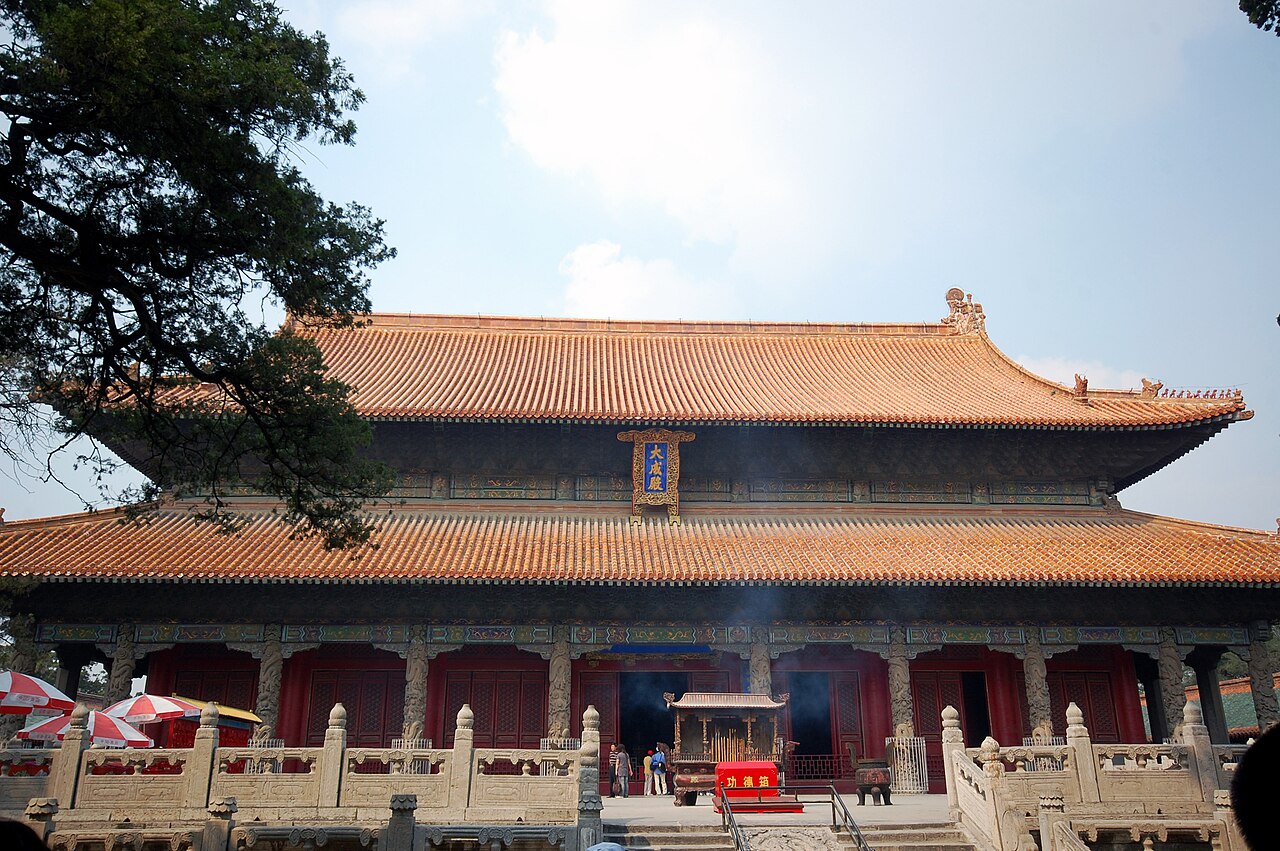
The Temple and Cemetery of Confucius and the Kong Family Mansion in Qufu, inscribed by UNESCO in 1994, are the three-component heritage ensemble at the birthplace of Confucius (Kong Qiu, 551–479 BCE) in Qufu City, Shandong Province. The Kongmiao (Temple of Confucius), first built in 478 BCE — one year after Confucius’s death — and continuously expanded through 22 centuries of successive dynasties, covers 22 hectares within nine successive walled courtyards and contains 466 buildings; the Konglin (Forest of Confucius), the burial ground of Confucius and his descendants covering 2,000 hectares north of the city, contains more than 100,000 graves spanning 2,500 years of continuous burial; and the Kongfu (Kong Family Mansion), the residence of Confucius’s direct lineal descendants, is the largest surviving aristocratic domestic complex in China after the Forbidden City, covering 16 hectares with 480 rooms.
Shandong and the Yellow River cultural corridor Mount Taishan · Grand Canal · Longmen Grottoes — 80 to 500 km
Eighty kilometres north of Qufu by road (approximately 1 hour via the Jiqing Expressway to Tai’an), Mount Taishan (inscribed 1987) is the most sacred mountain in the Chinese cosmological system — the First of the Five Sacred Mountains (Wuyue) — and the most directly connected UNESCO site to the Qufu inscription. The ritual relationship between Taishan and Qufu is reciprocal: Confucius was born on the north face of Mount Ni (Nishan), 30 kilometres southeast of Qufu, and the young Confucius is documented in the Analects climbing Mount Taishan to survey the horizon of the known world from its summit. The First Emperor (Qin Shi Huang), who unified China in 221 BCE, performed the first recorded feng sacrifice (a ceremonial earth-burning at the mountain’s base) at Taishan immediately after unification, and attributed the ritual’s cosmic authority to the Confucian tradition of mountain veneration that Qufu’s Temple codified. The connection between the philosophical tradition headquartered at Qufu and the state ritual geography centred on Taishan is the foundation of what historians call the Confucian political theology of the Chinese empire: the legitimating authority of the emperor derives from his proper conduct toward Heaven (enacted at Taishan) and his proper governance of human relationships (codified by the Qufu tradition). From Qufu, Taishan is reached by bus to Tai’an and cable car or walking trail to the summit (approximately 2 hours total from Qufu).
One hundred thirty kilometres north of Qufu by high-speed rail (approximately 40 minutes from Qufu East to Jinan, then transfer), the Grand Canal (inscribed 2014) passes through Jinan and the Shandong section of the Beijing-Hangzhou Canal, the world’s longest artificial waterway at 1,776 kilometres, built from the 5th century BCE through the Sui dynasty (completed 609 CE) and continuously used through the Qing period. The Shandong section of the Grand Canal is archaeologically the most complex because the Shandong highland requires locks and summit-level ponds to pass the canal over the watershed — the engineering challenge that successive dynasties navigated differently (the Ming period constructed a 40-kilometre summit section at Nanwang, Shandong, 55 metres above sea level, requiring a system of 38 locks). Confucius’s native state of Lu (the territory centred on Qufu) was one of the Zhou-period states whose waterway and road infrastructure the Grand Canal later incorporated; the commercial geography of Shandong that the Canal documents is the economic context within which Confucius’s political philosophy — addressed to the rulers of competing states in the 5th century BCE — was developed.
Three hundred kilometres southwest of Qufu by high-speed rail (approximately 2 hours from Qufu East via Shangqiu to Kaifeng or Zhengzhou), the Longmen Grottoes at Luoyang (inscribed 2000) document Tang-dynasty Buddhist sculpture 700 years after Confucius’s death and in the state that succeeded the Zhou empire within which Confucianism originated. The Longmen caves were carved along the Yi River cliff face south of Luoyang by the Northern Wei (493–534 CE), Sui (589–618 CE), and Tang dynasties, with the largest caves commissioned by Empress Wu Zetian (the Fengxian Temple’s 17-metre Vairocana Buddha, 672–676 CE); the Buddhist visual programme at Longmen is the Tang court’s cultural project, partially displacing the Confucian ceremonial tradition that Qufu’s Temple institutionalised. The Confucian and Buddhist traditions coexisted in Tang culture without formal conflict, but competed for court patronage: the Tang Emperor Xuanzong (r. 712–756 CE) who produced the most important Confucian scholarly documents of the Tang period also patronised the Longmen caves’ final phase of construction. From Qufu, Longmen Grottoes and Luoyang are reached by high-speed rail (Qufu East to Zhengzhou East, then Zhengzhou to Luoyang Longmen, approximately 2 hours total).
Four hundred fifty kilometres northeast of Qufu by high-speed rail (approximately 2.5 hours from Qufu East to Qingdao or Jinan to Qingdao), the Jinan springs system (not UNESCO-inscribed but notable) and the Qingdao German colonial architecture (not inscribed) represent Shandong’s other heritage dimensions. More directly relevant: the Taishan inscription’s lower Dai Temple (Daijiao Miao), 80 kilometres north of Qufu at Tai’an city’s centre, contains the largest extant Song-dynasty palace-style timber structure in China (the Tianxuang Hall, 1008–1009 CE), and the Shandong Provincial Museum in Jinan holds the primary collection of Confucian-period (Eastern Zhou, 770–256 BCE) bronze vessels, stone inscriptions, and Han-period stone relief carvings from the Jiaxiang area — the visual documentation of the cultural world that Confucius inhabited and that Qufu’s Temple commemorates.
South and west: Confucian influence across dynasties Suzhou · Huangshan · Forbidden City — 500 to 700 km
Five hundred kilometres southeast of Qufu by high-speed rail (approximately 3 hours from Qufu East via Nanjing to Suzhou), the Classical Gardens of Suzhou (inscribed 1997, extended 2000) document the most sophisticated physical expression of the Confucian-literati aesthetic tradition that Qufu’s Temple institutionalised philosophically. The Suzhou private garden was the retreat form created by retired Ming-Qing officials (and occasionally by merchants who aspired to literati status) who had passed the Confucian civil examination system and then withdrawn from official life; the garden was simultaneously a philosophical statement (the cultivation of self through aesthetic contemplation of landscape) and a social display (the owner’s Confucian learning expressed in the garden’s inscribed poems and named pavilions). The most celebrated Suzhou gardens — the Humble Administrator’s Garden (Zhuozhengyuan, established 1513), the Lingering Garden (Liuyuan, established 1593), and the Master of Nets Garden (Wangshiyuan, established 1140) — bear their classical names from Tang-Song poetry, itself a repository of Confucian philosophical allusion. The garden owner who named his garden the “Humble Administrator” (after a poem by the 3rd-century poet Pan Yue) was simultaneously claiming the Confucian virtue of political humility and satirising the political system from which he had withdrawn — the kind of layered reference that the Qufu Temple’s 2,500-year accumulation of scholarly ritual had made possible.
Five hundred fifty kilometres south of Qufu by high-speed rail (approximately 3.5 hours from Qufu East via Nanjing to Huangshan North), the Huangshan (Yellow Mountain) inscription (inscribed 1990) is the physical landscape that the 17th-century Confucian-Buddhist hybrid painting tradition made into China’s most celebrated aesthetic subject. The Huangshan painters — Hongren, Shitao, Kuncan — were Ming loyalists who refused to serve the Qing dynasty after the 1644 conquest of Beijing; their refusal was a Confucian political act (loyalty to the legitimate dynasty) expressed through a Buddhist visual medium (ink landscape painting as spiritual practice). The connection between Qufu’s Confucian political philosophy (the duty of the official to the legitimate ruler) and Huangshan’s 17th-century landscape paintings (the resistance of the literati to serving an illegitimate conqueror) is the most direct political application of Confucian ethics to the visual arts in Chinese history. From Qufu, Huangshan is reached by high-speed rail (Qufu East to Nanjing to Huangshan North, approximately 3.5 hours).
Seven hundred kilometres north of Qufu by high-speed rail (approximately 3.5 hours from Qufu East to Beijing South), the Imperial Palaces of the Ming and Qing Dynasties — the Forbidden City (inscribed 1987) — is the institution that administered the Confucian civil examination system that Qufu’s scholarly tradition underwrote for 2,000 years. The Forbidden City’s Hall of Literary Glory (Wenhuadian) housed the library and editorial bureau that produced the official Confucian canonical compilations — the Siku Quanshu (Complete Library of the Four Branches of Literature, commissioned by the Qianlong Emperor and completed 1782) and the Yongle Dadian (the Ming period’s 11,095-volume encyclopaedia) — that encoded the intellectual tradition descending from Confucius. The Board of Rites (Libu), headquartered in a complex south of the Forbidden City, administered the state sacrifices at Qufu’s Temple that every dynasty from the Han through the Qing performed annually, sending an official from Beijing to present offerings at the Dacheng Hall on behalf of the reigning emperor. The ritual link between the Forbidden City and the Qufu Temple — maintained continuously for 2,000 years through the Han, Tang, Song, Ming, and Qing periods — was severed in 1912 with the end of the imperial system. From Qufu, Beijing is reached by high-speed rail in approximately 3.5 hours.
Five hundred kilometres north of Qufu by high-speed rail (approximately 2.5 hours from Qufu East to Beijing South, then Metro to the Peking Man Site transfer), the Peking Man Site at Zhoukoudian (inscribed 1987) in southwest Beijing documents the deep prehistory of the same North China Plain where Qufu sits: the transition from Homo erectus (700,000–200,000 years ago) to Homo sapiens (Upper Cave Man, approximately 30,000 years ago) at the Fangshan limestone caves represents the biological ancestry of the population that, 27,500 years after the Upper Cave Man, would produce Confucius. The cultural distance between Zhoukoudian’s Homo erectus fire users and Qufu’s 5th-century BCE philosopher is 700,000 years; the geographical distance between the two UNESCO inscriptions on the North China Plain is 500 kilometres. Both inscriptions document different moments in the same continuous human occupation of the Yellow River watershed.
Practical information
Qufu is in southwestern Shandong Province, served by Qufu East Station on the Beijing-Shanghai HSR (direct high-speed rail from Beijing South in approximately 3 hours 30 minutes, from Shanghai Hongqiao in approximately 2 hours 20 minutes, from Nanjing South in approximately 1 hour 30 minutes, from Jinan West in approximately 30 minutes). Qufu East Station is 15 kilometres east of the city centre; public buses and taxis connect to the Temple of Confucius main entrance (approximately 25 minutes). The three main components of the UNESCO inscription are within walking distance of each other in the old city centre: the Temple of Confucius (Kongmiao) main entrance is on Queli Street; the Kong Family Mansion (Kongfu) is immediately adjacent; the Forest of Confucius (Konglin) is 1.5 kilometres north of the Temple, accessible by rickshaw or a 20-minute walk via Lindao Street. A combined ticket (Sankan Ticket) covers all three sites. The Temple of Confucius requires at minimum 2 hours: the main ceremonial axis from the Lingxing Gate (outer ceremonial arch) through the Dacheng Gate to the Dacheng Hall (the ceremonial centre, with the Confucius portrait hall in the hall’s centre cell, and the 28 carved stone dragon-pillar façade unique in Chinese architecture) and the Shengtang (Sanctuary Hall) requires systematic coverage to appreciate the eight-century accumulation of calligraphic steles (the stele forest in the east garden contains approximately 1,000 inscribed stones). The Confucius Temple Fair (Kongzi Wenhua Jie), held annually on the date of Confucius’s birthday (28th day of the 8th lunar month, approximately late September), brings scholars, students, and officials from across Asia for the ceremony at the Dacheng Hall.
Frequently Asked Questions
Why has Confucius’s descendant family maintained the Qufu complex for 2,500 years?
The Kong family’s continuous maintenance of the Qufu Temple, Cemetery, and Mansion across 77 generations (by the Kong family’s own count) from Confucius’s son Kong Li (died 483 BCE) through the 77th-generation descendants living in Taiwan and mainland China today is the longest-documented unbroken aristocratic lineage in human history and is recorded in the Guinness World Records. The institutional continuity is explained by a sequence of dynastic decisions to elevate the Kong family’s status as custodians of the Confucian tradition that each dynasty sought to appropriate. The Han Emperor Gaozu (Liu Bang) visited Qufu in 195 BCE and performed a state sacrifice at Confucius’s tomb — the first time a ruling emperor personally honoured the philosopher — and appointed a Kong descendant as “Sacrificial Official for the Holy Confucian Temple.” Successive dynasties escalated the honours: the Tang dynasty awarded the title “Duke of Exalted Sageness” (Yansheng Gong) to the primary male Kong line in 739 CE; the Song dynasty confirmed this title in perpetuity; the Ming and Qing dynasties maintained the Yansheng Duke as a hereditary noble rank (one of only two such ranks maintained by the Qing, the other being the head of the Zhuang Zhou [Taoist] tradition). The result is that the Kong family’s property rights, residential rights, and ceremonial authority at Qufu were recognized and financially supported by 23 successive dynasties without interruption — a political investment in the Confucian legitimating tradition that each dynasty found worth maintaining. The 77th-generation descendant Kong Decheng (1920–2008) held the Yansheng Duke title through the Republic of China period and moved to Taiwan in 1949; the mainland branch of the family maintains a separate lineage registry.
What is the Dacheng Hall and why are its dragon pillars unique?
The Dacheng Hall (Hall of Great Achievement) is the ceremonial centre of the Temple of Confucius, rebuilt in the Qing period (current structure 1730, under the Yongzheng Emperor) after a fire destroyed the Ming predecessor. The hall’s name derives from Mencius’s description of Confucius as having “achieved great completeness” (dacheng) in the development of Chinese ethical thought — the philosophical claim that Confucius integrated all previous moral insights into a coherent system. The structure is 9 bays wide and 5 bays deep (the largest format allowed in Chinese architecture below imperial palace level), topped by a double-eave hip-gable roof of yellow glazed tiles (the imperial colour, specifically granted to the Kong family’s Qufu complex). The 28 carved stone columns of the exterior façade are unique in Chinese architecture: whereas the Forbidden City’s ceremonial halls use plain timber columns (lacquered red), the Dacheng Hall’s front 10 columns are each carved from a single stone shaft with two dragons coiling around a central pearl in high relief, with the dragons’ coils producing a visual rotation around the column that changes with the viewing angle. These dragon stone columns were reportedly covered with yellow cloth during the visits of Qing emperors to the temple so that the emperor would not feel that the Confucius temple’s columns exceeded the Forbidden City’s in visual splendour — a protocol detail that illustrates the delicate hierarchy between imperial authority and Confucian ritual precedence. The remaining 18 columns of the hall’s side facades are carved with shallow-relief cloud and dragon patterns. No other structure in China has stone columns of this type and scale.
Who are the scholars buried in the Forest of Confucius and how are the graves organised?
The Konglin (Forest/Cemetery of Confucius) is the largest family cemetery in the world in continuous use: a 3.7-kilometre-circumference walled park north of Qufu containing more than 100,000 graves of Kong-surname descendants accumulated over 2,500 years, from the burial of Confucius himself (died 479 BCE, buried at what is now the central tomb area of the cemetery) through to graves of Kong family members who have died in the past decade. The cemetery is organized by generational proximity to Confucius: the earliest graves (the descendants of Confucius’s son Kong Li and his grandson Kong Ji) are immediately adjacent to Confucius’s tomb mound; later generations spread progressively outward in a radial pattern from the ancestral centre. Confucius’s own grave mound (approximately 5 metres high and 15 metres in diameter at the base) is marked by a Song-dynasty stone tablet bearing the title “Throne of the Venerable Exemplary Prince of Literature King” (Da Cheng Zhi Sheng Wen Xuan Wang Mu) — the posthumous title conferred by the Northern Song dynasty. Adjacent to Confucius’s grave is the tomb of his most devoted student Zi Gong (Duanmu Ci, 520–456 BCE), who — according to traditional accounts — remained at the grave for six years after Confucius’s death, maintaining the mourning vigil for twice the normal period; the area around Zi Gong’s grave contains the largest of the ancient trees in the cemetery. The cemetery also contains the tombs of the Yansheng Dukes and their families, the most significant Confucian scholars who served the Temple, and an accretion of memorial stones commemorating visits by Han, Tang, Song, Ming, and Qing emperors — each requiring its own stele and protective pavilion structure.
Sources
- S1 — UNESCO World Heritage Centre — Temple and Cemetery of Confucius and the Kong Family Mansion in Qufu (Ref. 704) — https://web.archive.org/web/20230601000000/https://whc.unesco.org/en/list/704/
- S2 — UNESCO World Heritage Centre — Statement of Outstanding Universal Value (Ref. 704) — https://whc.unesco.org/en/list/704/
Spotted an error? Write to editorial@culturalheritageonline.com and we correct it the same day.