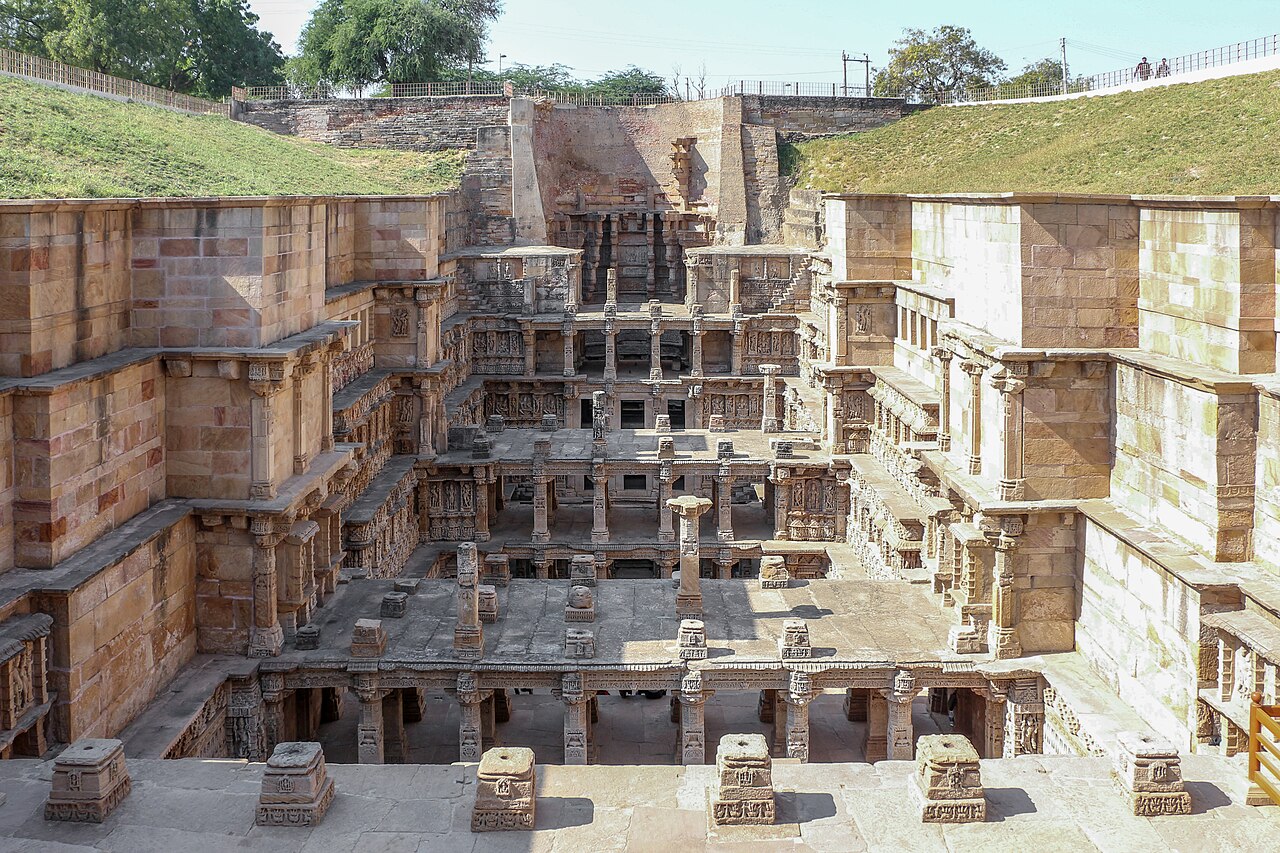
Rani-ki-Vav, the “Queen’s Stepwell” at Patan in Gujarat, is a 65-metre subterranean monument built around 1063 CE by Queen Udayamati to honour her late husband, the Solanki king Bhimadeva I. Its seven descending levels carry more than 500 principal sculptures and over 1,000 minor carvings, making it one of the most elaborately decorated architectural structures on the Indian subcontinent. UNESCO inscribed it in 2014, describing it as a masterpiece of fluid linear sculpture and the foremost example of stepwell architecture in India.
A reverse temple descending into the earth 130 km north of Ahmedabad by road
The stepwell as a building type is unique to the Indian subcontinent: a staircase that leads not to a roof but into the ground, providing access to the water table through an elaborate system of landings, colonnaded pavilions and galleried halls. At Patan, this tradition reached its apogee. Rani-ki-Vav measures approximately 65 metres in length, 20 metres in width and 28 metres in depth. The orientation is east-west, so a visitor walking from the entrance descends steadily toward the western end where the water shaft sits, the surrounding city gradually disappearing above the rim. The seven levels of stairs are interrupted by five assembly platforms, each framed by carved pillars and corbelled roofs. The effect is less of descending into a utilitarian reservoir and more of entering a temple whose deity is water itself.
The iconographic programme is overwhelmingly Vaishnava. Vishnu’s ten avatars appear in full relief across multiple panels: Varaha the cosmic boar lifting the earth goddess from primordial waters; Narasimha the lion-man tearing apart the demon Hiranyakashipu; Vamana the dwarf who crosses the three worlds in three strides; and Kalki, the avatar yet to come, shown as a warrior on horseback. These are not decorative afterthoughts. The stepwell’s descent into the water table was understood as a descent toward the source of creation, and the avatars guard each threshold. The Apsaras — celestial beings depicted in 16 distinct poses applying cosmetics, arranging jewellery, checking their reflections — appear on the pillar shafts at eye level, their intimacy deliberate: they inhabit the boundary between the human world above and the sacred world below. Nagakanya serpent maidens mark the deepest galleries nearest the water.
The stepwell was built during the reign of the Solanki dynasty (also known as Chaulukya), who ruled Gujarat from their capital at Patan between 942 and 1244 CE. At its height this was one of the wealthiest mercantile kingdoms in South Asia, commanding trade routes that connected Gujarat’s ports to Central Asia, Arabia and East Africa. The quality of stone carving at Rani-ki-Vav reflects both the dynasty’s resources and a school of sculptors working in a distinctive Gujarati idiom — figures with pronounced three-dimensionality, a preference for torsion in the body and an extraordinary attention to surface texture in fabric and hair.
Five centuries under silt, and what that preserved Patan city centre, 5 minutes’ walk from Sahastralinga Talav
Rani-ki-Vav was lost. A catastrophic flood of the Saraswati River, probably in the 11th or 12th century, buried the stepwell under metres of alluvial silt. It remained covered — known locally through legend but invisible — until the Archaeological Survey of India began systematic excavations in the 1940s. The work continued through subsequent decades. What emerged was extraordinary: because the silt had sealed the galleries, the sculpture had been shielded from wind erosion, rain and the mechanical damage caused by human contact over centuries. The result is carving of a precision and freshness that outdoor monuments rarely retain after a thousand years. Faces on Apsaras retain fine surface modelling. The drill-work on jewellery is unclogged. The layered carving on textile folds reads clearly at arm’s length.
The preservation accident also tells us something about the Saraswati River itself. The river that once fed the stepwell’s water table is now dry — the Saraswati has disappeared from the landscape, its course traceable only through satellite imagery and the presence of ancient settlements along its former banks. This geological fact adds a further dimension to a visit: Rani-ki-Vav was built to reach water that no longer exists in this form, above a riverbed that has been dry for centuries. The monument is also an archive of a vanished hydrology.
Patan’s second outstanding heritage asset sits about two kilometres from the stepwell: Patola silk weaving. Patola is a double-ikat textile, meaning that both the warp threads and the weft threads are individually tie-dyed in complex patterns before the cloth is woven, so that the finished fabric shows identical designs on both faces. The mathematics of planning the dye resist for a double-ikat — such that the colour shifts fall precisely where the threads cross — is extraordinarily complex. Today only five families in Patan maintain the technique, each producing only a small number of pieces per year. A single Patola sari represents months of work. The Salvi families who weave them maintain workshops open to visitors, where the scale of the process — floor-to-ceiling dyed thread bundles, the rhythmic tension of the loom — becomes apparent.
Practical information
Rani-ki-Vav is located in Patan, Gujarat, approximately 130 kilometres north of Ahmedabad. By road, the drive from Ahmedabad takes around two hours. The nearest railway station is Mehsana (60 km south), from which regular bus services connect to Patan. Direct buses from Ahmedabad also serve Patan. The stepwell is open daily except Fridays, from sunrise to sunset. Entry is charged at standard Archaeological Survey of India rates; foreign nationals pay a higher fee than domestic visitors. There is no direct entry fee for photography, though tripod and video permissions should be verified on arrival. The best light for photography falls between 7 and 10 am, when the low-angle sun reaches the lower levels. The site has modest facilities including a small interpretive display near the entrance and toilets. The Sahastralinga Talav, a large medieval artificial lake complex with 1,000 Shiva shrines along its banks, is within easy walking distance and rounds out a half-day in Patan. Patola silk workshops are open in the mornings and require an appointment for a demonstration visit — your guesthouse in Patan can arrange this. Accommodation in Patan is limited; Mehsana and Ahmedabad are the main bases.
Frequently Asked Questions
What does “stepwell” mean, and how is Rani-ki-Vav different from other examples?
A stepwell (in Gujarati, vav; in Hindi, baoli or bawdi) is a subterranean water structure in which a staircase descends from ground level to the water table, often interrupted by landings, columns and pavilions. The type is found across the Indian subcontinent, from Rajasthan and Gujarat in the west to Delhi and Fatehpur Sikri in the north, with examples spanning roughly 2,000 years of construction. Their function was practical — providing reliable access to groundwater in a region where surface water is seasonal — but they consistently received architectural and sculptural investment far beyond what utility required. What makes Rani-ki-Vav exceptional is threefold: its scale (seven levels is unusual; most stepwells have three or four), its sculptural density (over 500 major figures plus more than 1,000 secondary carvings), and the quality and state of preservation of that carving, directly attributable to centuries of burial under flood silt. Other celebrated stepwells include Adalaj Vav, about 20 kilometres north of Ahmedabad, which dates to 1498 and shows the transition from Hindu to Sultanate architectural vocabulary; and Chand Baori in Abhaneri, Rajasthan, which is visually dramatic for its 3,500 perfectly geometric steps but carries far less sculpture than Rani-ki-Vav. UNESCO recognised Rani-ki-Vav as the pre-eminent example of the form.
Who was Queen Udayamati and what do we know about the Solanki dynasty?
Udayamati was the wife of Bhimadeva I, who ruled the Solanki (Chaulukya) dynasty of Gujarat from approximately 1022 to 1064 CE. After his death, she commissioned the stepwell as a memorial — a practice with precedent in the subcontinent, where architectural patronage by royal women was one of the few modes of public expression available to them, and one they pursued with considerable ambition. The Solanki dynasty governed from Patan (then called Anhilwara or Anhilpur Patan) from 942 CE until the Sultanate of Delhi conquered Gujarat in 1299. At its height under Kumarапala (r. 1143-1172) the kingdom was among the most prosperous in South Asia, drawing revenue from Gujarat’s ports on the Arabian Sea. Solanki patronage of architecture and sculpture was extensive: the Sun Temple at Modhera (1026 CE), also in Gujarat, is the other great surviving monument of this period. The dynasty’s cultural context was one of competitive Hindu temple-building across Rajasthan and Gujarat, in which sculptural programmes served as assertions of dynastic legitimacy and religious patronage. Bhimadeva I’s reign coincided with Mahmud of Ghazni’s repeated raids into Gujarat, including the sack of Somnath in 1025 — the historical backdrop against which Udayamati’s commemorative commission must be understood.
How long should I allow for a visit, and what else is worth seeing in the area?
Allow a minimum of two hours for Rani-ki-Vav itself if you want to read the sculpture carefully. The lower galleries in particular repay slow attention: the Vishnu avatar panels are arranged in a theological sequence that becomes apparent as you descend, and the Apsara figures on the upper pillars are different from those lower down. A full morning — arriving at opening, leaving around noon — is comfortable. Within Patan, Sahastralinga Talav (the medieval reservoir with 1,000 Shiva shrines, now mostly ruined, around its perimeter) takes another 30 to 45 minutes. A Patola workshop visit, if pre-arranged, adds an hour. For a broader circuit: Modhera’s Sun Temple is approximately 30 kilometres southeast of Patan on the road back toward Mehsana — the temple complex includes a large tank (kund) with stepped ghats and a mandapa (assembly hall) with outstanding carved pillars. The combination of Rani-ki-Vav and Modhera in a single day from Ahmedabad is physically possible but rushed; two days based in Patan or Mehsana is the more considered approach. Ahmedabad’s old city (also UNESCO, inscribed 2017) is the logical starting point for a northern Gujarat heritage circuit and has good accommodation at all price levels.
Sources
- S1 — Jain-Neubauer, Jutta. The Stepwells of Gujarat: In Art-Historical Perspective. Abhinav Publications, 1981. ISBN 978-0-391-02284-3.
- S2 — Livingston, Morna. Steps to Water: The Ancient Stepwells of India. Princeton Architectural Press, 2002. ISBN 978-1-56898-324-0.
Spotted an error? Write to editorial@culturalheritageonline.com and we correct it the same day.