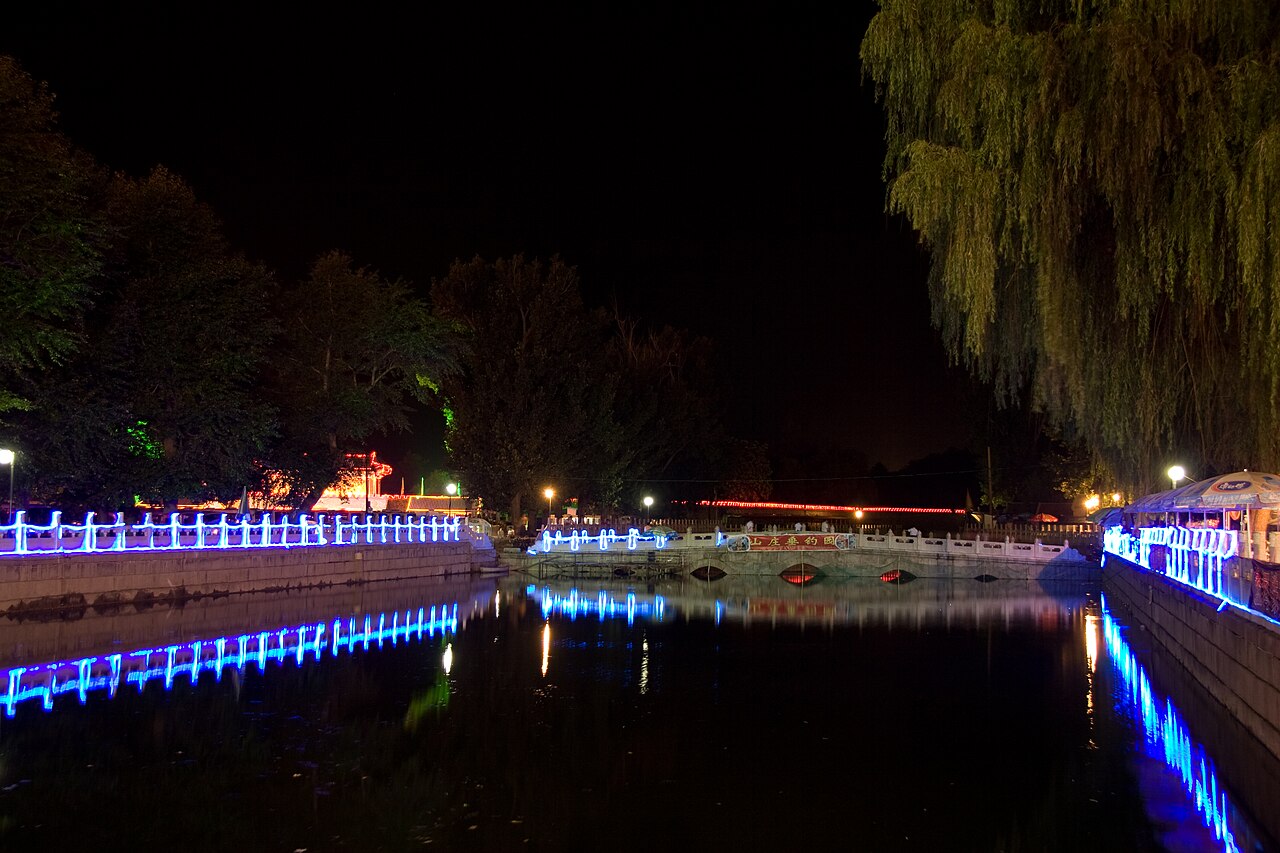
The Mountain Resort and Its Outlying Temples at Chengde were inscribed as a UNESCO World Heritage Site in 1994. The resort covers 5.6 square kilometres of parkland enclosed by a 10-kilometre wall and was built between 1703 and 1792 as the Qing dynasty’s summer capital; outside the enclosure, eight outlying temples constructed between 1713 and 1780 served as diplomatic reception spaces for Mongolian, Tibetan and other Inner Asian delegations whose religious and political expectations the Manchu emperors were careful to manage. The Puning Temple (1755), the largest of the eight, contains a 22.28-metre wooden statue of Avalokiteshvara with 42 arms—the tallest wooden interior sculpture in the world—and is modelled on the Samye Monastery in Tibet as a deliberate architectural statement of Qing authority over Tibetan Buddhism.
Jinshanling and the Great Wall corridor 50 km south, 1 hour by car or chartered minibus
The Great Wall of China was inscribed as a UNESCO World Heritage Site in 1987; the inscription covers the wall in its full historical extent but the best-preserved and most studied Ming-dynasty sections lie in Hebei and Beijing, and the Jinshanling section in Hebei Province is 50 kilometres south of Chengde by road, reachable in approximately one hour by car or chartered minibus from the city. Jinshanling preserves 10.5 kilometres of Ming wall built primarily between 1368 and 1644, including 67 watchtowers of varying design; it is the section most recommended to visitors who want to walk on the wall itself with relatively few crowds and a well-maintained parapet surface, as opposed to the heavily reconstructed and commercially developed sections at Badaling (north of Beijing) or Mutianyu. The wall at Jinshanling sits on a ridge system that continues northeast toward Gubeikou, where it passes through a river valley and the wall design adapts to the topography with lower towers and doubled wall sections across the gaps; this stretch, known as the Jinshanling–Simatai route, is a classic hiking traverse of 10–12 kilometres achievable in 4–5 hours for fit walkers. The geographical relationship between Chengde and Jinshanling is not coincidental: the Northern Gate of Chengde’s outer wall aligned with the Gubeikou pass through which the imperial procession from Beijing passed on the way to the resort, and the Great Wall at this latitude functioned as the structural boundary between the inner Chinese agricultural zone and the steppe and forest lands where the Qing emperors held their annual autumn hunts at Mulan. The hunting ground at Mulan, northwest of Chengde, covered over 10,000 square kilometres and was used from 1681 to 1820 for the Qing imperial institution known as the Mulan Qiuxi (Autumn Hunt at Mulan): an annual military exercise and diplomatic event at which emperors demonstrated cavalry and archery skills to Inner Asian nobles who would have regarded inability to hunt on horseback as disqualifying for any legitimate ruler. The hunting ground itself is not included in the UNESCO inscription, but understanding it makes the outlying temples—positioned to receive Mongolian and Tibetan guests arriving through Gubeikou and Zhangjiakou—immediately legible as part of a single connected political-spatial system.
Beijing’s imperial core and the Eastern Qing Tombs 150–250 km southwest, 2–3 hours by train or car
The Imperial Palace (Forbidden City) in Beijing, inscribed in 1987, lies 250 kilometres southwest of Chengde, reachable in approximately three hours by express train from Chengde station to Beijing’s Chaoyang or Chengde’s fast rail connections via Chengde–Beijing intercity rail (opened 2020, reducing journey times to under 2 hours on some services). The relationship between the Forbidden City and Chengde is functional and ideological. The Forbidden City was the formal governmental and ritual centre of Qing rule, used for the ceremonies and audiences that required the full apparatus of Han Chinese court protocol; Chengde was designed deliberately as an alternative capital where the same emperors could function within a different political identity, conducting the audiences, hunts and Buddhist ceremonies appropriate to their role as Manchu khans and protectors of Tibetan Buddhism. The contrast in architectural language is precise: the Forbidden City’s yellow-glazed tile rooftops and axial symmetry performed Confucian cosmological order for Han officials, while Chengde’s irregular landscape garden and Tibetan-style temple facades performed a different kind of sovereignty for Inner Asian visitors. Visiting both within a single itinerary makes the dual-identity architecture of Qing imperial rule visible in a way that either site alone cannot achieve. The Ming Tombs (Changling and associated imperial burials northwest of Beijing), inscribed in 2003 as part of the serial Imperial Tombs of the Ming and Qing Dynasties, are 200 kilometres from Chengde by road, reachable in approximately 2.5 hours. Their inclusion in the same serial inscription as the Qing tombs allows visitors to read the two dynasties’ contrasting approaches to the ritual landscape of imperial death across a single UNESCO property. The Eastern Qing Tombs at Zunhua (Qing Dongling) are 150 kilometres east of Chengde, reachable in approximately two hours by car via Hebei’s regional road network. The Eastern Tombs complex contains the mausoleums of five Qing emperors including Shunzhi (r. 1644–1661), Kangxi (r. 1661–1722), Qianlong (r. 1736–1796) and the Empress Dowager Cixi, making it the largest imperial funerary complex surviving in China: 15 mausoleums across 78 square kilometres. Qianlong, who was responsible for the most significant expansion of Chengde’s outlying temples and who commissioned the Puning Temple in 1755 to commemorate the Dzungar campaigns, is buried at the Yuling mausoleum at Zunhua; the tomb’s underground chambers are lined with Sanskrit and Tibetan Buddhist texts carved in relief, the most elaborate funerary decoration in the Qing series and a direct extension of the Tibetan Buddhist patronage that defines the Chengde outlying temples above ground. The Zunhua visit pairs logically with Chengde: both sites document the Qianlong court’s sustained engagement with Tibetan Buddhism as a pillar of imperial legitimacy, and the road between the two passes through terrain associated with the imperial hunting network.
Practical information
Chengde is reached from Beijing by intercity rail from Beijing Chaoyang or Beijing North stations; journey time is approximately 1 hour 40 minutes to 2 hours on direct services, with multiple departures daily. The city can also be reached in 3 hours by long-distance bus from Beijing Sihui or Dongzhimen stations. From Chengde station, the Mountain Resort main gate is 3 kilometres by taxi or city bus. The resort itself requires a minimum of half a day for the lake and garden area and one or two of the main palace halls; a full day covers the palace zone, the lake, the forested park on the northern section and two or three of the outlying temples accessible by taxi or the resort’s internal shuttle. The outlying temples are spread over several kilometres outside the resort wall—Puning Temple is 1.5 kilometres north; Pule Temple and the Anyuan Temple cluster are a further kilometre east—and are not conveniently walkable between each other; a taxi circuit of three or four temples takes half a day. The Putuo Zongcheng Temple (modelled at one-third scale on the Potala Palace in Lhasa) and Xumifushou Temple immediately northwest of the resort are the most frequently visited and can be combined in two hours.
May to October is the recommended period; the resort’s lakes are navigable by rowing boat in summer, and the forested northern section of the park is particularly effective in September when the foliage begins to turn. Winter closes some outlying temples. Chinese national holidays (especially Golden Week in early October) bring very large crowds to both the resort and the Beijing-area Great Wall sections; Jinshanling receives significantly fewer visitors than Badaling or Mutianyu and remains manageable during holiday periods.
Frequently Asked Questions
Why was Chengde built as a second capital rather than expanding the Forbidden City?
The Qing dynasty’s Manchu rulers governed a multiethnic empire that could not be administered through a single political identity. The Forbidden City in Beijing was designed to perform Confucian sovereignty for Han Chinese officials and subjects: its yellow-glazed tile rooftops, strict axial symmetry, and ritual calendar of state ceremonies all referenced Han Chinese cosmological and political tradition. But the Qing emperors also needed to function as Manchu khans in relation to Mongolian bannermen and tribal leaders, as patrons of Tibetan Buddhism in relation to Tibetan and Mongolian religious elites, and as skilled hunters and warriors in relation to the cavalry culture of the steppe. These political identities required different spatial and ritual settings. The Chengde complex provided them: the irregular landscape garden designed without the Forbidden City’s strict axis performed a different, less formally Chinese kind of space; the outlying temples in Tibetan and Central Asian styles provided a setting appropriate for receiving Mongolian and Tibetan nobles on their own religious terms; and the nearby Mulan hunting ground provided the annual military demonstration that sustained Manchu identity within the banner system. The first Qing emperor to make substantial use of Chengde was Kangxi (r. 1661–1722), who began construction in 1703; his son Yongzheng barely used the complex, but his grandson Qianlong (r. 1736–1796) spent up to six months of each year at Chengde and commissioned its most ambitious construction phase, including all eight outlying temples. From Qianlong’s reign onward, Chengde functioned as a genuine parallel seat of government during the summer months, with key ministers, the Board of Revenue and the Grand Council all relocating to the resort for the summer session.
What is the Putuo Zongcheng Temple and why is it a one-third scale copy of the Potala Palace?
The Putuo Zongcheng Temple (Pǔtuó Zōngchéng Zhī Miào) was constructed between 1767 and 1771 at the order of the Qianlong Emperor, immediately northwest of the Mountain Resort perimeter wall, to receive the Mongolian and Tibetan religious leaders attending the celebrations of his sixtieth birthday (1780). Its exterior reproduces the massed white walls and red upper palace of the Potala Palace in Lhasa at approximately one-third scale: the platform walls are 18 metres high, the red palace structure rises above them, and the ensemble is visible from the Mountain Resort gardens as a deliberate horizon feature. The choice to model the temple on the Potala was a precise political statement: the Potala was the residence and religious seat of the Dalai Lama, the highest religious authority in Tibetan Buddhism. By constructing a replica near his summer capital, the Qianlong Emperor was claiming a form of symbolic parity with, or patronage over, that authority; the Tibetan Panchen Lama, Lobsang Palden Yeshe, visited Chengde in 1780 for the birthday celebrations and stayed in the temple complex, an event documented in both Chinese court records and Tibetan sources. A second contemporary temple at Chengde, the Xumifushou Temple (completed 1780), was specifically built to receive the Panchen Lama’s visit and modelled on the Tashilhunpo Monastery in Shigatse, Tibet—the Panchen Lama’s own seat—following the same logic of architectural reciprocity. The Putuo Zongcheng Temple’s interior contains a series of shrines, mandalas and Tibetan Buddhist paintings executed by craftsmen brought from Tibet; it remains an active site of Buddhist practice alongside its function as a UNESCO-listed monument.
How is the Great Wall at Jinshanling different from the better-known sections at Badaling and Mutianyu?
Badaling, 75 kilometres northwest of Beijing, is the most-visited section of the Great Wall in China: it was the first section to be formally restored for tourism (from the 1950s), received Richard Nixon during his 1972 China visit, and now accommodates several million visitors annually via a cable car and extensive commercial facilities at the base. The restored sections are in excellent physical condition but present a heavily reconstructed surface that differs in material and profile from what the Ming engineers built. Mutianyu, 90 kilometres northeast of Beijing, is similarly well-known and similarly reconstructed, with cable car access and a toboggan slide descent. Jinshanling, in contrast, received only partial restoration in the 1980s; significant sections of the wall between Jinshanling and Simatai retain original Ming brickwork, including towers where the brick facing has partially collapsed to reveal the packed-earth core, giving visitors direct exposure to the wall’s construction method rather than a restoration approximation of it. The parapet and tower designs at Jinshanling are also more varied than at the more uniform Beijing sections: 67 towers in a 10.5-kilometre stretch display differences in height, window pattern and battlement design that reflect the work of different garrison units responsible for different sections. Visitor numbers at Jinshanling are a fraction of Badaling’s; it is realistic to walk a full kilometre of the Jinshanling wall without sharing it with other visitors on weekday mornings outside summer. The Jinshanling–Simatai hiking traverse is 10–12 kilometres; note that the Simatai end requires a separate ticket and the connecting section near Simatai has restricted access in places—confirm current conditions before departure.
Sources
- S1 — UNESCO World Heritage Centre — Mountain Resort and its Outlying Temples, Chengde (Ref. 703) — https://web.archive.org/web/20230601000000/https://whc.unesco.org/en/list/703/
- S2 — Chengde Cultural Heritage Bureau — https://whc.unesco.org/en/list/703/
- S3 — Kuhn, Dieter. <em>The Age of Confucian Rule: The Song Transformation of China</em>. Harvard University Press, 2009. ISBN: 978-0-674-03661-1.
Spotted an error? Write to editorial@culturalheritageonline.com and we correct it the same day.